
Some refugees may return to Syria because they want to live there again. But many won’t—for the same reasons many refugees from Nazi-occupied Europe didn’t after World War II.
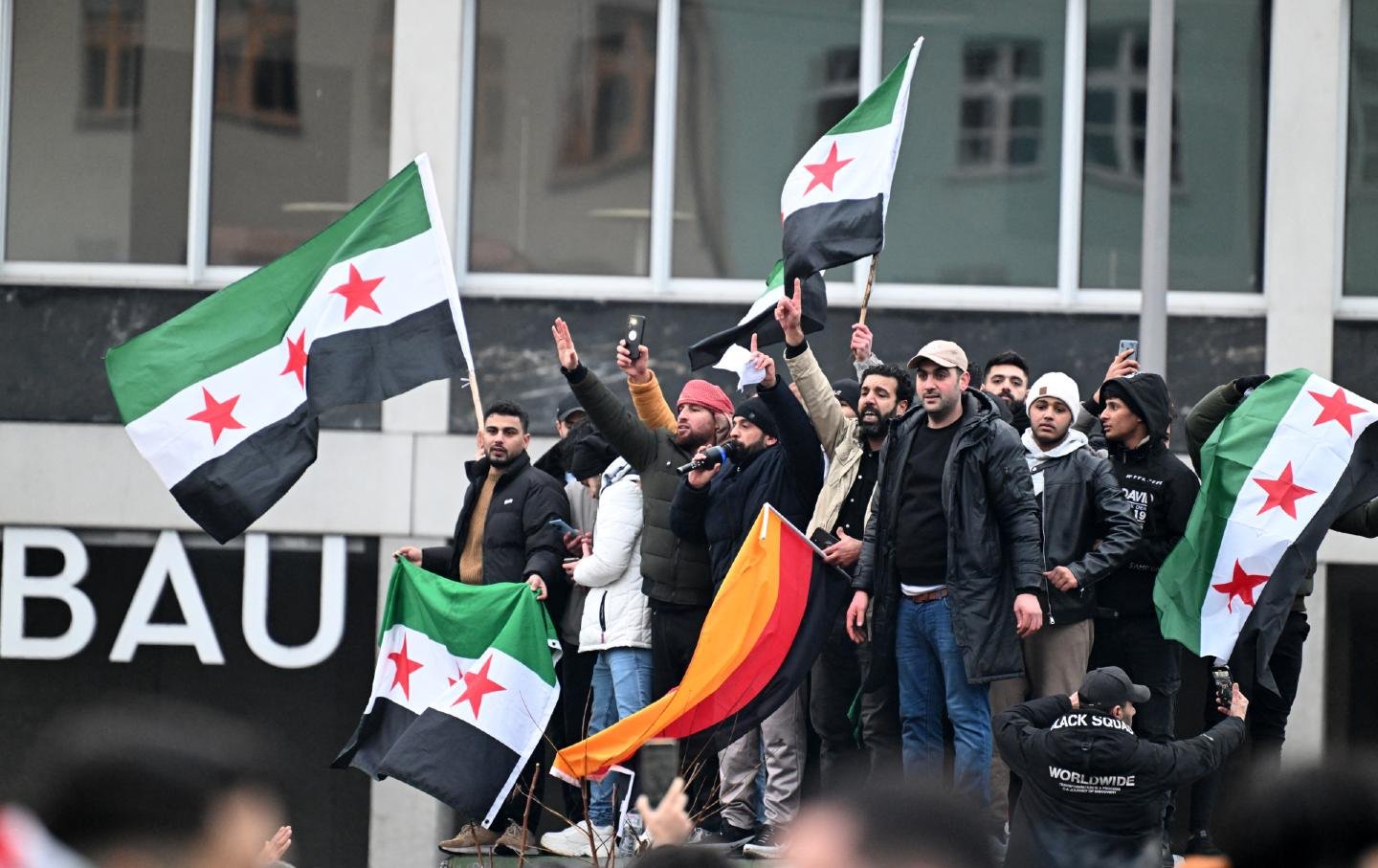
Berlin—The day the Assad regime collapsed in Syria, people were dancing on the streets in the Neukölln district of Berlin. Cars honking their horns and flying the three-starred flag of free Syria rode down Sonnenallee. A woman ran up to one of the cars and hugged a man leaning out the passenger’s window. A group of young men danced in a circle while two parents hoisted their toddlers on their shoulders so the children could see. Fireworks went off somewhere, the bam! bam! bam! electrifying the air. A small girl in front of a bakery handed out sweets to passersby from a cardboard box while a man standing nearby nodded to encourage her. A baby-faced twentysomething with the free Syrian flag tied around his shoulders tied a flag around the shoulders of his friend. And everywhere, outside every café, groups of people sat talking. This was where you came to find the people you knew. This was where you came to celebrate.
Germany is home to the largest Syrian diaspora outside the Middle East. Almost a million Syrian-born people live in Germany, and Neukölln is the neighborhood where many asylum seekers and refugees settled. Most arrived after 2015, when then-Chancellor Angela Merkel, visiting a refugee camp, announced that Germany would welcome asylum seekers and explained to the country, “We can do this.” The asylum seekers—fleeing war and brutal dictatorship—arrived at German train stations after gruelling journeys to applause, signs welcoming them, and volunteer support from local people. Many were initially housed as guests with families, put up in disused airports, and even given shelter in the former headquarters of the East German State Security Police—the Stasi. Settlements made up of small pre-fabricated buildings—Tempohomes—appeared in several German cities.
In the nearly 10 years since then, the refugees have found permanent housing, studied German, gained employment, launched businesses, and started families. By 2023, more than 160,000 Syrians had applied for—and been granted—German citizenship. Well-qualified educationally compared to other refugee groups, 61 percent of Syrian refugees who have been in Germany for seven years or more have found employment. Almost 6,000 of Germany’s doctors have a Syrian passport, and it’s estimated that 15,000–20,000 doctors in the country have a Syrian background.
As Germany’s right-wing politicians demand that the refugees return to Syria, stories appear in the media about employment sectors that will collapse without Syrian-born workers—elder care and medical care in particular. In the eastern German states that were once part of the GDR—Saxony, Saxony Anhalt, and Thuringia—Syrian doctors now make up the core of health services.
And the news here is filled with accounts of refugees and former refugees who are both celebrating the fall of a dictator in Syria and explaining that Germany is now their home.
A neurologist tells Süddeutsche Zeitung that his family is in Germany and his life is firmly anchored there; returning to Syria is out of the question. An actor, comedian, and author tells taz that his company, his work, and his life are now in Germany; he wants to go to Syria to visit. A student who has lived in Germany for half his life tells Tagesspiegel that he feels like a part of Germany after 10 years there and has more to do with Germany and its values than with Syria.
Current Issue

When Bashar al-Assad’s hold on Syria was loosened after 53 years of brutal autocratic rule by him—and, before that, his father Hafez al-Assad—no one anticipated how quickly the regime would collapse. As the world watched Hayat Tahrir al-Sham (HTS) lead rebel forces first to Aleppo, then to Hama, and then to Homs, it still was not clear how quickly they would advance. But by December 7, people were already gathering on the streets of Neukölln to celebrate, anticipating victory. And the next morning, it came: the rebels had taken Damascus. Assad, whose whereabouts were initially unknown, later emerged in Moscow.
While the humanitarian act of welcoming refugees is the response to Syrian civil war that Germany is best known for, the history of German interaction with Syria is complex and goes far back. Germans helped to set up Syria’s intelligence service between 1948 and 1954, notes legal scholar and journalist Ronen Steinke—but these were not advisors acting on behalf of the German government. They were Nazis who had fled Germany and ultimately moved on to Argentina. Later, in 1966, the Stasi provided training to Syria’s “Political Police”. The most recent German support for Assad has also not come from the German government but from deputies of Germany’s far-right political party the Alternative for Germany, who, traveling to Syria in 2018 and 2019, were courted by pro-Assad hosts, and upon their return to Germany, announced that Syria was not only a safe place to travel, but a victim of the West.
It was AfD leader Alice Weidel who posted—on the same day that the world learned of Assad’s departure—that “anyone celebrating ‘free Syria’ in Germany obviously no longer has a reason to flee. They should return to Syria immediately.” This was followed by the center right CDU politician Jens Spahn suggesting that the government would charter planes for anyone who wants to return to Syria and provide each returnee with a starting fund of 1,000 euros. Spahn quickly qualified this, saying that none of this would happen before the situation in Syria “stabilized”. Then, CDU leader Friedrich Merz—who is almost certain to become Germany’s Chancellor following the February snap elections—said that while Syrians who were employed and integrated could of course stay, “two-thirds do not work, mostly young men…and many of them have to go back.” (This figure is misleading, as it includes recent arrivals to Germany who won’t yet have begun the process to look for employment.)
How these statements will translate into policy is unclear, however. No other German political party will form an alliance with the AfD; the party will have no place in government on a national level. The CDU, when they do form a government, will need to go into coalition with the center-left SPD or Greens or both following the elections; they won’t have enough support on their own. And Olaf Scholz, the chancellor and SPD leader, emphasized that “anyone who works here, who is well integrated, will remain welcome in Germany. That goes without saying.”
Yet, at the exact moment that the unimaginable has happened—that Syria has finally thrown off a half-century of dictatorship and might see the end of its civil war—many of Germany’s politicians are more interested in establishing their opposition to migration and playing to what they imagine is an anti-refugee crowd than in celebrating. “Anyone who now tries to misuse this situation in Syria, whose future is completely unclear, for party political purposes has lost their absolute connection to reality in the Middle East,” Green Foreign Minister Annalena Baerbock observed.
By December 10, a number of European countries, including Germany, announced that they would pause asylum applications from Syrians. Not only would no new applications be accepted—preliminary applications that had been submitted would be frozen. At the same time, a European Commission spokesperson confirmed to reporters in Belgium that “for the time being, in line with the UNHCR, [we maintain] conditions are not met for safe, voluntary, dignified returns to Syria.”
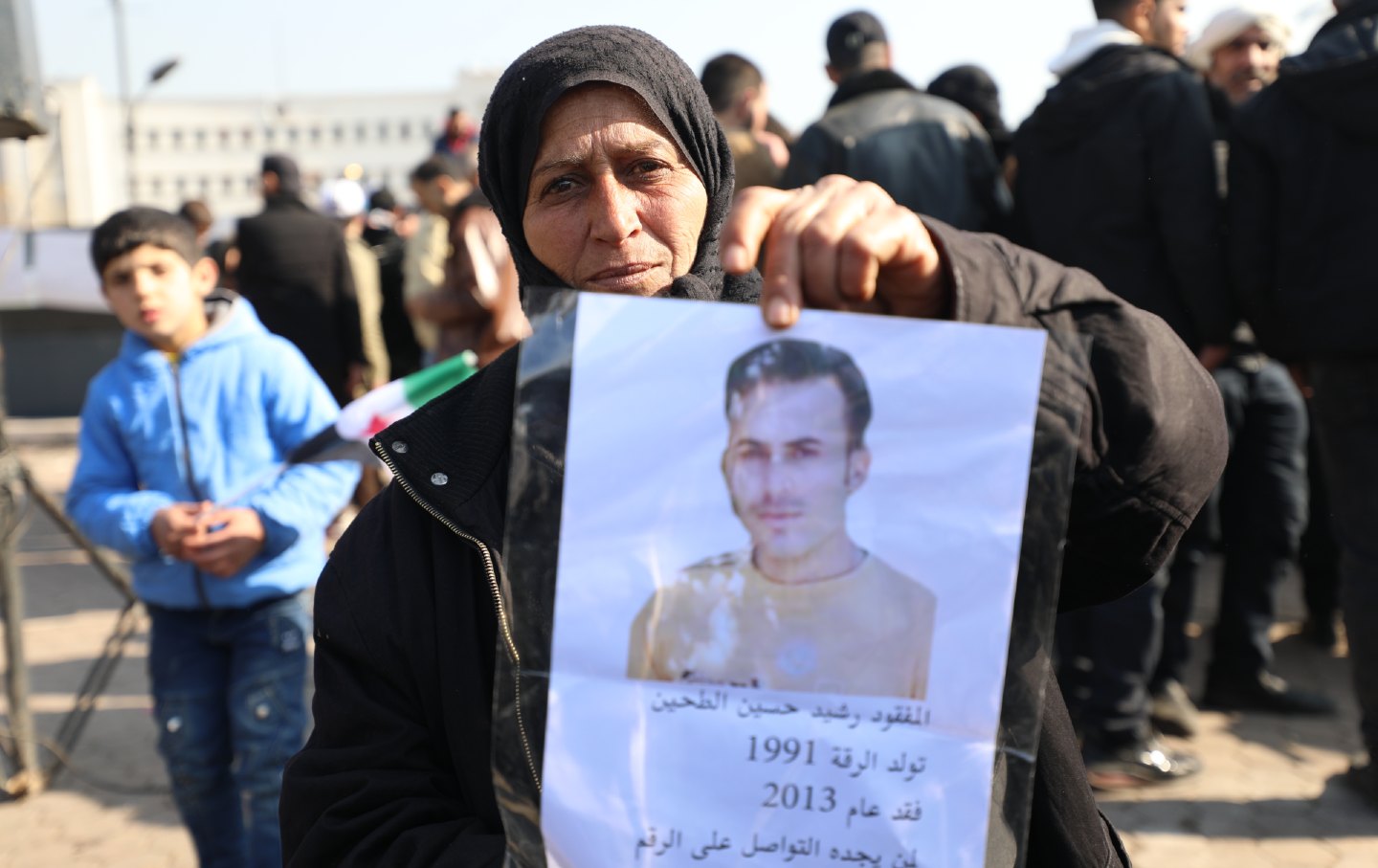
As the rebels swept across Syria, they began to free the prisoners in detention centers —157,634 Syrians were arrested by the regime between the start of the war 2011 and August 2024, imprisoned in over a hundred detention centers. The most notorious of these, Sednaya, is known locally as “the slaughterhouse”. It is estimated that 30,000 detainees have been killed there. When the surviving prisoners—isolated and emaciated—were told Assad was gone, many could not believe they were free finally. Some observers, wrote Leon Holly in taz, felt reminded of the liberation of Buchenwald.
All atrocities leave us searching for some way to describe them, for something to compare them to. And so many atrocities are connected to other atrocities.
“From our experiences in Syria, we might be among those most able [to understand] the pain of the people of Ukraine,” Raed al-Saleh, head of Syria’s White Helmets, told AFP in April 2022, six and a half years after Russia had entered Syria’s civil war. Syrian opposition’s support for Ukraine included passing on information about war crimes documentation, making video tutorials on how to treat causalities, and sending doctors to Ukraine. And it was, ultimately, Russia’s focus on Ukraine that contributed to Assad’s defeat. “Our priority is Russia’s own security, “ explained reporter Yevgeny Kiselev on Russian State TV, “what is happening in the zone of the Special Military Operation [Ukraine].”
While Russia was fighting on both fronts, Germany became the place where asylum seekers from both countries found refuge. When Syrian refugees moved on to permanent housing and left their Tempohomes, Ukrainians fleeing war moved in.
Ranim Ahmed of The Syria Campaign spoke of the dilemma that asylum seekers in Germany face now. “They are eager to go and search for their loved ones,” she said when we spoke on Zoom. “But if they go to Syria, that they will lose [their asylum seeker] status, which means that they will have to start their lives again from zero.” She wants the German government to make an exception for Syrian asylum seekers on humanitarian grounds.
Popular
“swipe left below to view more authors”Swipe →
Some of the refugees may also return to Syria because they want to live there again. But many of them won’t—for the same reasons that many refugees from Nazi-occupied Europe didn’t return to the places they had fled from when World War II was over. Once you live in a place for a few years, it becomes the place you belong to.
In the weeks since the celebrations marking Syria’s liberation, the Christian Social Union (the CDU’s more right-wing sister party in Bavaria) has proposed limitations on the rights of asylum-seekers and refugees so severe that those limitations would be in violation of EU law. Evoking the kind of anti-migrant sentiment that defined the CDU before Merkel moved it to the center, the proposals were seen by some as political positioning rather than serious proposals. Again, a cycle of statements from political parties made headlines. Interior Minister Nancy Faeser of the SPD released a statement on January 5 that Germany might revoke protection status for some Syrian refugees, while also stating that “anyone who is well integrated, works, has learned German and has found a new home here should be allowed to stay in Germany.” The next day, Green Party Candidate for Chancellor Robert Habeck expressed similar sentiments on Deutschlandfunk radio.
Voting preferences for the upcoming elections—which in Germany are measured on a weekly basis —have not moved in any significant way over the past month (or indeed for almost a year now). And while the political positioning will continue, it seems equally impossible to imagine Germany returning to a time before the refugees arrived here, and to imagine the refugees who have built their lives in Germany leaving.
More from The Nation
Coverage of Syria’s prisons overlooks their decades-long use as key destinations for extraordinary rendition, where terror suspects were sent for brutal interrogations.

China’s latest export restriction lays bare the complex geopolitics behind President Trump’s proposed tariffs—and the green energy transition.

While the War on Terror has receded into the background of our lives, its premises and tactics remain all too readily available.
Yoon Suk Yeol rose to power by courting antifeminists. Now young women are going to be his downfall.
