
- Russia has four options to rebuild its military power after heavy losses against Ukraine.
- Russia’s easiest option isn’t to move into the future, but rather go back to the past.
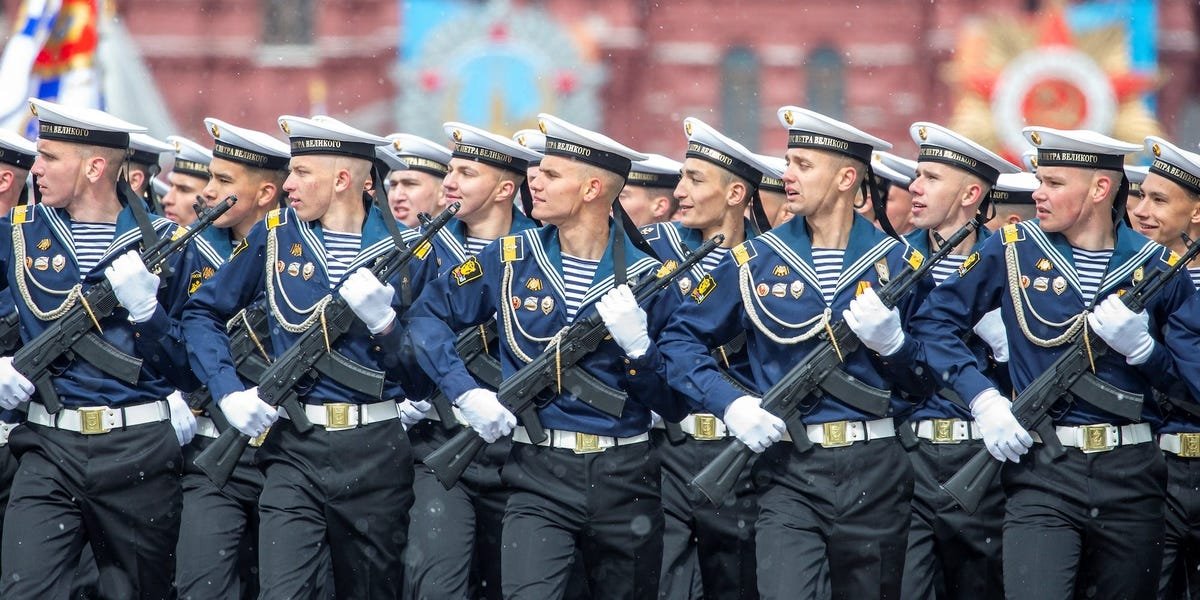
- If the war were to end soon, it’s likely Russia would opt for a large, Soviet-style army.
Regardless of whether Russia wins or loses in Ukraine, one thing is certain: the Russian military will have to be rebuilt.
With its arsenal depleted and its reputation battered, Russia will have to decide the future shape of its armed forces. The most likely choices range from reverting back to a Soviet-style mass army, to adopting a smaller but more flexible Western-style military, according to a new study by the Washington-based RAND Corp. think tank. But all of those options are either difficult to implement or wouldn’t fix the flaws in Russia’s military system.
Focused for now on winning the war in Ukraine, the Kremlin is sticking to what it knows best: a large military designed to fight major land wars. “Moscow has, for now, decided to embark on rebuilding the armed forces based on a model familiar to Russian military leaders, a group that was highly critical of earlier reform attempts,” RAND wrote. Nowhere is this need more clear than in Russia’s ground forces, which have lost thousands of armored vehicles, hundreds of thousands of troops and been bolstered with convicts.
After the war, Russia will have to assess its goals, resources and the international situation, especially vis-a-vis the West, which has imposed export controls that, if kept in place, will hamper the rebuilding effort.
RAND envisions four ways Russia might rebuild. The first is what RAND dubs the “Shoigu plan,” based on various statements by Sergei Shoigu, a close associate of Russian leader Vladimir Putin who led the defense ministry from 2012 to 2024. This would return the Russian military to what it was before the Ukraine war. It would try to balance mass and firepower by expanding and modernizing the military, and importing weapons to make up for domestic shortfalls.
What is most striking is that the Shoigu plan assumes that Russia’s military is basically in good shape, no matter the evidence to the contrary in Ukraine. It contends that “the Russian armed forces were not structurally flawed, at least for conflicts such as those in the Donbas region [of Ukraine] (2014) and Syria (2015), as much as they were poorly led in the initial stages of the conflict and unable to execute in the context of high-intensity conflict in a contested environment,” the study explained.
Another option is to fully implement reforms proposed in 2008, that would create a smaller but higher-quality military designed for hybrid warfare, including cyber and information operations, and private military contractors such as the former Wagner Group. “This approach would entail a serious attempt to pursue personnel reforms and prioritize the development and use of asymmetric means of warfare,” said RAND. Hybrid warfare depends on intimidation and disruption — deniable operations to undermine NATO and non-aligned states — but this plan likely lacks the ground force size to expand Russian hegemony.
Tian Bing/China News Service/VCG via Getty Images
The third option is the most radical one. Junk the old Soviet and Russian ways of war, and create an entirely new military system. This could mean copying tactics from other nations, such as less rigid command and control found in Western armies, and discarding traditional military culture.
This idea is rooted in “the realization that the Soviet and Russian operational models are no longer viable, a fact highlighted by the Russian armed forces’ poor performance in Ukraine,” RAND wrote.
Ironically, Russia’s easiest option isn’t to move into the future, but rather go back to the past. This path would see the Russian military revert back to the Soviet-era, with huge armies of conscripts armed from massive weapons stocks built by Russia’s defense-industrial base. “An underlying argument for this pathway is that the Russian military, in many respects, has had to revert to this model during its war in Ukraine by relying on older systems, overwhelming firepower, and mass — and while this has not led to a decisive Russian victory in Ukraine, it has been sufficient to achieve a stalemate,” RAND wrote.
A Soviet-style military is “a more comfortable fit for Russia’s current leaders — both political and military — because it remains highly centralized, and mass- and attrition-oriented,” Mark Cozad, who coauthored the RAND study, told Business Insider.
It’s normal for nations to analyze and incorporate lessons after a war, especially for the losing side. The Germans studied their defeat in the First World War — and the advent of new technologies such as the tank and airplane — to devise its blitzkrieg strategy in World War II, while America’s failure in Vietnam spurred military reforms that bore fruit in Desert Storm.
Russia’s record on military reform is checkered. Defeat in World War I generated innovations in mechanized warfare by Soviet theorists like General Mikhail Tukhachevsky in the 1930s. Poor combat performance in Chechnya in the 1990s, and Georgia in 2008, led to calls for changes, such as shifting away from mass conscript armies to a professional volunteer force.
The problem is that these reforms have tended to be stymied by obstacles such as Russia’s economic woes after the collapse of the Soviet Union, reactionary Soviet-era generals resistant to change, cronyism and politicians distrustful of their own military; Tukhachevsky was executed by Stalin in 1938.
RAND expects Russia will ultimately choose some mixture of the various reform options. The final decision will be shaped by several factors, including how the Ukraine war ends, the strength of Russia’s economy, declining birthrates, the ability to develop and manufacture advanced military technologies, the opportunity to import technologies that can’t be produced domestically, and relations with allies such as China.
Much will depend on how Russia reads the lessons of the Ukraine war. Their record so far doesn’t inspire confidence. “In general, Russian military experts’ perceptions of the nature of future warfare have not materialized in the war in Ukraine,” the RAND study pointed out, such as overestimating the impact of airpower and how trench warfare replaced maneuver.
Russia would probably choose to go back to a Soviet-style army “if the war were to end tomorrow and Putin walks away declaring and believing that Russia was successful, because that was what ended up working and Russia is limited by material and technical factors,” said Cozad. “In a second case, if Putin were to somehow exit the scene you might see some more drastic change.”
Either way, the US and NATO need to monitor how Russia rebuilds its military, Cozad warns. Whatever the model chosen, “they have some impressive capabilities that will factor heavily into their future conventional forces, particularly in the areas of electronic warfare and drones.”
Most dangerous might be a Soviet-style mass army. This would certainly be smaller than the 12 million soldiers deployed by the Red Army in 1945, but might be larger than the 1.5 million active-duty personnel decreed by Putin in 2024. “For the past three decades we’ve planned for much more limited scenarios, and we’ve not had to address the cost and inventory issues associated with countering an enemy built on mass and attrition,” Cozad said.
Michael Peck is a defense writer whose work has appeared in Forbes, Defense News, Foreign Policy magazine, and other publications. He holds an MA in political science from Rutgers Univ. Follow him on Twitter and LinkedIn.
