
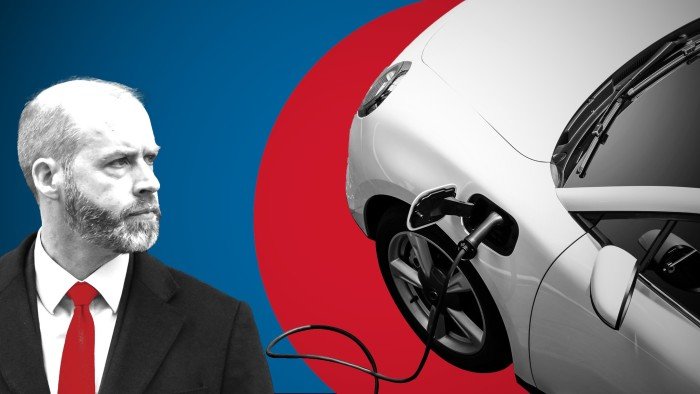
With electric vehicle sales stalling in the UK, ministers are preparing to press the reset button.
A new scheme this year was supposed to spur EV sales, but consumers remain reluctant to buy the cars in sufficient numbers.
Jonathan Reynolds, business secretary, is set to water down the existing rules with a rapid consultation set to be announced next week.
What is the problem with the existing EV mandate?
Carmakers in the UK are increasingly alarmed about the government’s “zero emission vehicle mandate” that requires 80 per cent of their sales to be zero-emission vehicles by the end of the decade.
The quota, based on China’s system, sets annual targets that rise each year with steep fines for manufacturers that miss them.
Companies including Volkswagen and Nissan have warned that the speed at which they are expected to ramp up EV production is not being matched by consumer demand.
Stellantis blamed the mandate for its decision to close its Luton van factory, putting 1,100 jobs at risk, while Ford also cited the scheme as it cut 800 jobs in a wider European restructuring.
EV sales made up 18.7 per cent of new car sales in the year to November, short of the 22 per cent required for 2024, though a range of carve-outs mean most carmakers will be able to avoid fines.
The target will rise to 28 per cent next year, 33 per cent in 2026, 38 per cent in 2027 and 52 per cent in 2028, 66 per cent in 2029 and 80 per cent by 2030.
Who is to blame?
An inevitable political tussle has broken out. The Conservatives have criticised Labour for not responding quickly enough to industry concerns about public demand in the past five months, with shadow business secretary Andrew Griffith calling the EV mandate “a jobs killer”.
But Labour has blamed the previous Conservative administration, in which Kemi Badenoch was business secretary, for setting the EV mandate in the first place — and then stifling public appetite for the vehicles.
In October last year, then-prime minister Rishi Sunak delayed the planned phaseout date for petrol cars from 2030 to 2035.
Even though the annual EV sales targets did not change, carmakers said the move signalled to consumers not to bother with the technology just yet — an argument since taken up by the Labour government.
“They changed the destination and kept the fines and the ramp-up and the thresholds exactly the same,” said Reynolds.
The two parties remain divided over exactly which non-electric vehicles can be sold between 2030 and 2035. While Labour wants only certain hybrids permitted, the Tories are happy for petrol and diesel models to remain on sale.
What will the government change?
Ministers are open to various ideas to help the industry and several new “flexibilities” are on the table.
One is to equalise the proportion of cars and vans included in the mandate, which would have a net effect of lowering the overall targets. Another is to let companies count British-made cars sold abroad in their sales targets.
Ministers are also keen to allow carmakers to sell Prius-style hybrid models — which use an engine and battery in parallel — in the UK until 2035. Unlike “plug-in hybrids”, which have larger batteries, “full hybrids” do not plug in to recharge. Toyota, which has two UK factories, is a major proponent of the technology.
A further option is to lower the £15,000 per car fine that currently applies where companies fail to hit their targets, but this would involve changing primary legislation. Although some carmakers have asked for fines not to apply until after 2026, this is unlikely to happen.
Ministers are also likely to resist changing the headline targets themselves, despite industry requests to soften them.
Meanwhile, existing flexibilities that will be expanded or extended are the “trading” loophole that allows carmakers to buy credits from rivals to avoid fines, and another “borrowing” loophole in which they can miss early targets but avoid fines by pledging to overachieve in future years.
At present the borrowing scheme is due to end in 2026, but this is set to be extended by a few years.
Will that be enough?
No amount of tweaking the scheme will address the core problem: consumers are not buying enough EVs.
Manufacturers are releasing ever-cheaper models to try and bridge the price gap with petrol cars, but many are already losing money on these sales and are reluctant to engage in an all-out price war.
The largest problem remains the public’s perception that there are not enough charging points — therefore making EVs unattractive for those without driveways or who regularly make longer journeys.
The National Audit Office found that the UK is on track for 300,000 public charging points by 2030 — but that only 15 per cent of points in England are in rural areas.
Ahead of next week’s launch, ministers are examining new demand-side measures to try to persuade consumers to buy more electric vehicles, including more state funding for charging points.
But motorway service area operators have complained that long delays in electricity grid upgrades needed for high-speed charging are holding up progress.
