
This article is an on-site version of our Europe Express newsletter. Premium subscribers can sign up here to get the newsletter delivered every weekday and Saturday morning. Standard subscribers can upgrade to Premium here, or explore all FT newsletters
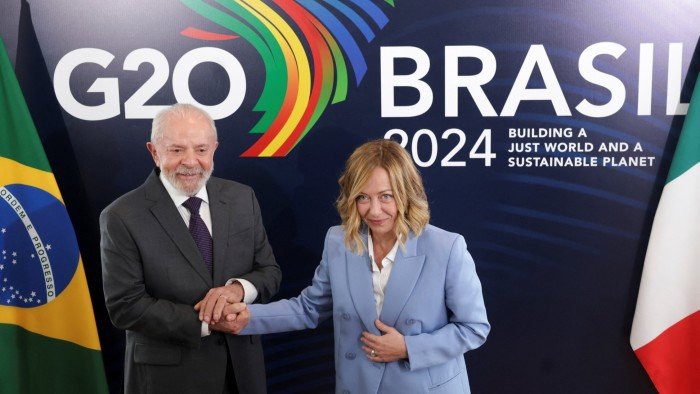
Good morning from Rio de Janeiro, where Europe’s most powerful leaders are gathering with global counterparts for a G20 summit overshadowed by Donald Trump and the US president-elect’s foreign acolytes’ preparations for his administration.
Today, I brief you on what to expect from the gathering, and Laura and our Moscow correspondent report on the gas battle between Austria and Russia.
Bonfire of the diplomacies
European leaders preparing for the G20 summit in Rio this morning are waking up to an uncomfortable new reality: transactional geopolitics is back.
Context: The gathering unites the world’s 20 biggest economies, and was formed to find joint solutions to big issues such as managing the global economy, climate change and development finance. From the European continent, France, Germany, Italy, Turkey and the EU are members; Spain is a permanent invitee.
Donald Trump, who will take control of the White House in just over two months, is not a fan of multilateral frameworks such as the G20. He prefers bilateral negotiations and quid pro quo arrangements. And his acolytes are already laying the groundwork for his regime.
Argentina’s ultra-libertarian President Javier Milei, who last week became the first foreign leader to meet Trump in person since his victory, has threatened to block the Rio summit’s joint conclusions due to references to taxing the super-rich, climate change policy and gender issues, officials said. He has pitched himself as Trump’s closest partner in Latin America and his ally in a global culture war against the so-called “woke” left.
That has dismayed European diplomats who see in Milei the impending shadow of Trump’s impact on other governments and the future crumbling of global pacts aimed at aligning economic policies in the spirit of compromise.
“This is simply not the sort of gathering likely to benefit from the impending change of politics in the White House,” said Ian Lesser, fellow at the German Marshall Fund.
Of equal concern to European capitals is a more permanent fracturing of groups like the G20, which has served as a bridge to developing nations such as Indonesia, South Africa and Mexico, and kept them loosely aligned with western countries.
In the more transactional world envisaged by Trump, where countries pick and choose their stance on individual issues depending on a narrow vision of national benefits rather than through multinational compromise, officials say rivals such as China and Russia could seek to strengthen alternative groupings and undermine western alliances.
“Many of these countries are very comfortable with essentially a non-aligned posture . . . and this has come back into vogue,” said Lesser. “It’s also clear that countries like Russia and China are looking to take advantage of that to build coalitions of their own.”
Chart du jour: Rightward swing

The German federal election on February 23 will determine the fate of Europe’s largest economy. Follow the FT’s poll tracker here.
Transitory
Austria has hit back at Russia after Kremlin-controlled Gazprom shut off its gas supplies to Vienna, raising fears about energy disruptions as temperatures cool in Europe, write Laura Dubois and Anastasia Stognei.
Context: Europe has mostly weaned itself off Russian pipeline gas following Moscow’s full-scale invasion of Ukraine. A handful of countries including Hungary, Slovakia and the Czech Republic are still buying some being pumped through Ukraine.
Austria was one of them — but Gazprom shut off supplies to its energy company OMV on Saturday, after an arbitration court ruled the Russian energy giant owed OMV €230mn.
“It is not surprising that Putin and his henchmen are once again using energy as a weapon,” said Austria’s foreign minister Alexander Schallenberg.
“The fact that Gazprom stopped its deliveries overnight because it didn’t like an arbitration court ruling shows once again the state of the rule of law in Russia,” Schallenberg said. “Agreements are only valid as long as they suit the Kremlin’s political calculations.”
Schallenberg insisted that Austria’s energy supply is secure, and storage facilities almost at capacity.
Warnings about Gazprom’s move sent European gas prices to their highest level in almost a year on Friday, as analysts feared disruptions to Europe’s overall supplies.
But Gazprom said yesterday that the overall daily supply to Europe via Ukraine would remain unchanged at 42.4mn cubic metres, according to news agency Tass, indicating that the amounts that Austria had been receiving — around 17 mcm per day — found new European buyers.
The transit contract through Ukraine is due to expire at the end of this year, as Kyiv has refused to negotiate an extension, meaning the remaining Russian supplies would run dry anyway.
Schallenberg said Europe needed to continue minimising its dependencies by working with “like-minded” countries. “Only in this way can we set the course for the future,” he said.
What to watch today
-
G20 leaders summit in Rio de Janeiro.
-
EU foreign ministers meet.
-
EU agriculture and fisheries ministers meet.
Now read these
-
Ratio rivals: Secret research by the European Central Bank shows capital requirements for big EU banks are much lower than for their Wall Street rivals.
-
Bombing Russia: Washington has given long-awaited approval to Ukraine to use long-range US missiles to strike targets across the border.
-
Plastic panic: European plastics manufacturers are closing plants as they struggle to compete with a global glut of cheap material.
Recommended newsletters for you
Trade Secrets — A must-read on the changing face of international trade and globalisation. Sign up here
Swamp Notes — Expert insight on the intersection of money and power in US politics. Sign up here
Are you enjoying Europe Express? Sign up here to have it delivered straight to your inbox every workday at 7am CET and on Saturdays at noon CET. Do tell us what you think, we love to hear from you: europe.express@ft.com. Keep up with the latest European stories @FT Europe
