
Last year, when Ryan Cunningham, a Silicon Valley investor, floated a trip to China in a WhatsApp group of robotics investors, the response was lukewarm. One person jokingly asked if he could smuggle a humanoid robot home.
This year, the jokes have given way to travel plans.
Cunningham, the founder of Edgerunner Ventures, a venture capital firm that backs energy and computing startups, is planning an April trip to China for 10 investors. Nearly every investor group chat he is in now trades notes on recent or upcoming excursions to China, he told Business Insider, as venture capitalists gauge China’s hardware prowess to see what American robotics startups are up against.
“The reason I want to bring them to China is because I want to take them by the shoulders and say, ‘Guys, if you want to get serious, this is what we should be learning from,'” said Cunningham, who visited Shanghai last year for the World Artificial Intelligence Conference, an annual gathering for the AI industry.
Cunningham is among a growing cadre of Silicon Valley investors heading east to see how China built its edge in robotics and other hardware. For many, the point is not to scout Chinese investments. It is to size up the rivals confronting their US portfolio companies.
The excursions range from private VC delegations to $10,000-a-head tours that pair factory visits with translators, five-star hotels, and dinners with local tech executives.
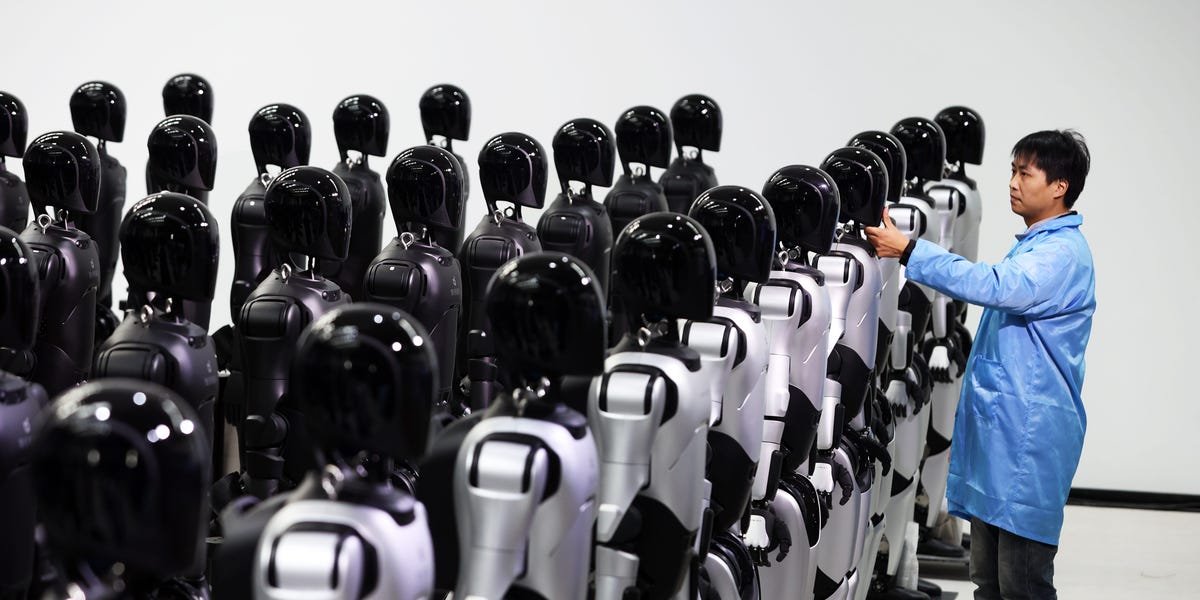
Behind the tours is the sobering realization that China has established a formidable lead in crucial parts of robotics, from manufacturing and supply chains to deploying machines and collecting the data needed to improve them.
Wan Xiang/Xinhua via Getty Images
Chinese companies Unitree and AgiBot together shipped 71% of the world’s humanoid robots last year, according to research firm Omdia. China also controls 63% of the key companies in the global supply chain for humanoid-robot components, according to the Mercator Institute for China Studies, a German think tank. Meanwhile, most American humanoids are still in development and not available off the shelf. Most US companies rely on Chinese suppliers for components or assembly, according to Stanford’s 2026 Emerging Technology Review.
The stakes are high for US investors pouring money into robotics and physical AI. They are betting that advances in AI, cheaper hardware, labor shortages, and the push to reshore manufacturing can mint the next generation of technology giants. Robotics, meanwhile, is increasingly viewed as a national-security concern. In July, the Federal Communications Commission banned new foreign-made “advanced robotic devices,” citing “unacceptable risks” to national security.
Robotics may be Silicon Valley’s latest obsession, but China has spent years building up its industry.
“The Chinese have been very hardware focused,” Wendy Chang, a senior analyst at the Mercator Institute for China Studies, told Business Insider. “They are trying to own the whole robotics supply chain.”
In a 2023 policy document, China’s government compared the potential impact of humanoid robots with that of computers, smartphones, and electric vehicles. It laid out a plan to deploy humanoid robots across the economy by 2027.
China’s head start has drawn American investors in for a bit of competitive snooping. In recent months, dozens of VCs, including investors from Eclipse, G2 Venture Partners, and Chemistry VC, have traveled to China. Partners from Founders Fund and Khosla Ventures have also made trips, The Information reported last month.
A reality check for Silicon Valley
Late last year, partners at Bay Area-based G2 decided they needed a clearer view of China. The firm, which spun out of Kleiner Perkins, invests in growth-stage companies building technology for physical industries, including energy, manufacturing, and transportation.
“We knew they were ahead, but it doesn’t really hit you until you’re on the ground,” said Neel Mehta, a G2 investor, who traveled to Shenzhen and Beijing with a colleague earlier this year.
Mehta and his colleague built their trip around Morgan Stanley’s China Summit in Shenzhen, which included field trips to robotics and autonomous-vehicle companies. They also arranged visits to Xiaomi, the consumer electronics giant that has expanded into electric vehicles, and to EV maker BYD.
For years, Mehta said, US investors had dismissed Chinese technology as lower quality. Conventional wisdom held that China might have an edge in manufacturing, but the US would always build better AI. Mehta returned to the Bay Area convinced both assumptions were wrong.
Tang Yanjun/China News Service/VCG via Getty Images
At a Xiaomi dealership in Shenzhen, Mehta saw the company’s flagship SU7 electric car, which starts at around $30,000.
“The quality and finish is everything you’d expect in a luxury car like Porsche, no exaggeration,” Mehta said. The car is not sold in the US, where Chinese EV imports face restrictions and a 100% tariff.
Mehta was also struck by China’s data-collection efforts. Robotics companies need large amounts of real-world data to train systems to perceive their surroundings and perform physical tasks. At one data-collection farm, he saw hundreds of workers stationed in pods around the clock, teleoperating robots to generate it at scale.
“If you think data is the core bottleneck in robotics, there’s a world in which they have better models than anyone else,” he said.
Rui Ma, who runs Tech Buzz China, a podcast and research platform covering China’s technology industry, told Business Insider that Silicon Valley’s renewed curiosity about China follows years of US-China tensions and a chill in cross-border investment. That has begun to change as powerful models from Chinese AI companies, including DeepSeek, Alibaba’s Qwen, and Moonshot AI’s Kimi, have made China’s technological gains harder to dismiss.
“It’s very specific to the DeepSeek moment,” Ma said, referring to the Chinese company’s 2025 release of an AI model that shook Silicon Valley. “People are like, ‘Oh wow, China actually has AI and other technologies worth paying attention to.'”
The DeepSeek wake-up call
Ma began organizing tours to China in 2019, but paused them during the pandemic. This year, she has seen an uptick in interest from Silicon Valley investors and has led two tours: one focused on AI and another on robotics.
“Most people are trying to understand how what’s happening in China impacts their portfolio,” she said.
The weeklong programs cost about $10,000 per person, which Ma said is comparable to executive education courses. From the moment participants land, her team handles every detail of the itinerary. Groups typically visit two or three cities, touring factories and joining fireside conversations with English-speaking tech executives.
“I like to take people to see things they’ll be reading about six months later,” Ma said. On a recent trip, she took participants to a brain-computer-interface company.
For Doon Insights, a California-based research and events company, growing investor interest in China is a business opportunity. The company is pitching investors and executives on a 12-day “Robotics Study Mission” in November, with stops in Shanghai, Changzhou, Shenzhen, and Beijing.
The itinerary includes visits to humanoid maker AgiBot, autonomous-air-taxi company EHang, and several robot component manufacturers, according to an itinerary viewed by Business Insider. Participants will also walk through Shenzhen’s Huaqiangbei electronics market — often called the “Silicon Valley of Hardware” — and visit automated farms and instant-noodle giant Master Kong. Each leg begins with an expert panel and includes dinners with local business and technology leaders.
“It’s direct access to the people and technology defining what is coming next out of China,” the itinerary boasts. Doon Insights declined a request for comment.
Weighing new risks
The trips to China are changing how investors evaluate US robotics companies. In April, Charly Mwangi, a partner at Eclipse, a venture firm that invests in companies building for the physical economy, and his colleagues left their work laptops at home and boarded a 14-hour Air China flight from San Francisco.
Mwangi, a former Tesla and Rivian executive, said the group was struck by China’s ability to turn ideas into physical products. “In the US, we’ve figured out vibe coding,” he said. “In China, they’ve figured out vibe manufacturing.”
Yet Mwangi said the robots’ cognitive abilities were far less impressive. At one company, a robot could dance and do martial arts, he said, but it could not pick up a bottle and put it in a trash can.
Both Eclipse and G2 are taking China much more seriously as they evaluate potential investments. After seeing the Chinese government’s control over the technology ecosystem, Mwangi believes that building their own robots is a matter of national sovereignty.
“Everyone starting now will have to leverage the Chinese supply chain, and then over time, very quickly start figuring out alternatives,” he said.
After presenting their findings from the China trip to the rest of the firm, Mehta said that G2 has begun weighing China-related risks in every potential investment.
“We’re thinking, five to 10 years from now, what is going to be the China equivalent?” he said. “And does the US version of the company have a durable advantage?”
Have a tip? Contact Rya Jetha via email at rjetha@businessinsider.com or Signal at rjetha.07. Use a personal email address and a nonwork device; here’s our guide to sharing information securely.
