
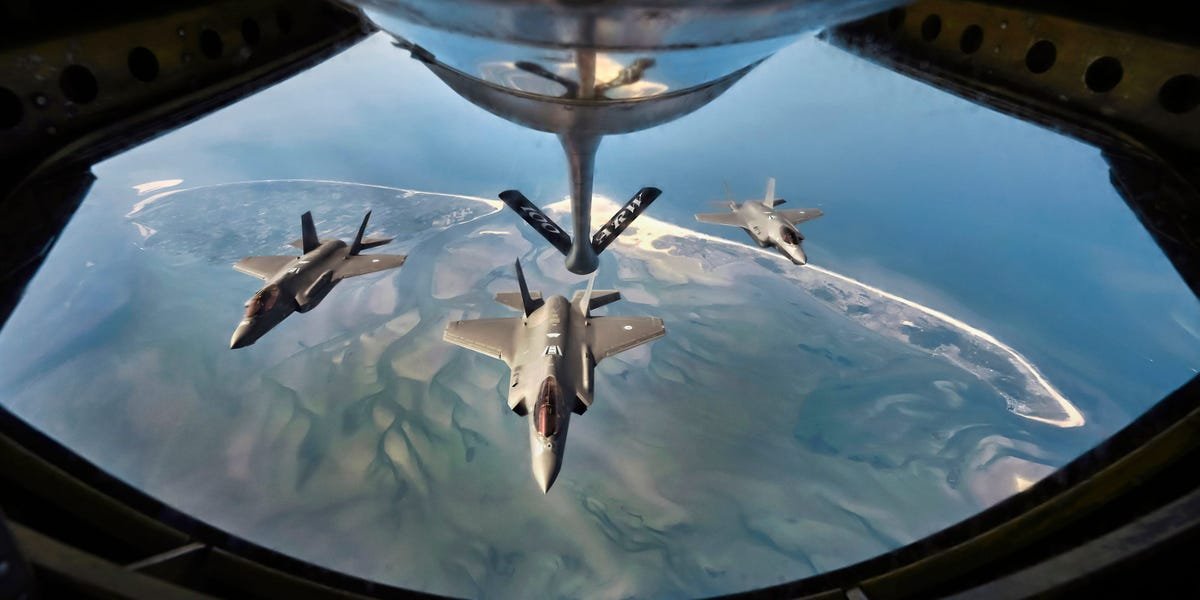
Lockheed Martin’s F-35 stealth fighter is one of the most advanced aircraft ever built — and the most expensive, given how many the US military plans to buy.
By its scale and state-of-the-art technology, it showcases the soaring costs America bears to build weapons at a time its rivals can do so more cheaply, threatening the US’s edge.
The fighter jet program is expected to cost $2.1 trillion over its lifetime through 2088, including the planned production of over 2,400 jets by 2049.
Designed as a fifth-generation aircraft that can replace multiple planes, carry out a wide range of missions, and avoid radar detection, the F-35 reflects a broader shift toward more complex, costly military technology.
Sustainment drives most of the F-35’s $2 trillion price
Norbert Voskens/SOPA Images/LightRocket via Getty Images
A single F-35 is not the most expensive aircraft in the US arsenal — it’s the program’s massive scale and projected 94-year lifespan that drive its cost.
The F-15EX Eagle II, for example, costs about $99 million for Boeing to produce, compared with roughly $90 million for the F-35. Other aircraft cost much more. Each B-2 Spirit stealth bomber costs an average of $2 billion.
Building the aircraft is only part of the total price. The majority of the F-35 program’s cost comes after production.
Sustainment — the cost of maintaining and repairing the aircraft over time — accounts for about 75% of the program’s total estimated cost, according to a 2024 Government Accountability Office report.
Keeping combat jets flying is inherently expensive, and a major driver is the spare parts needed to keep aircraft mission-ready.
That requires a constant flow of replacement components — and demand only grows as the jet accumulates wear and “lifecycle damage,” Paul Saunier, a retired Lockheed Martin engineer who worked on the F-35, told Business Insider.
Bloomberg/Getty Images
Because sustainment stretches over decades, the need for parts — and the logistics systems to deliver them — compounds over time, steadily pushing up the program’s total cost.
For instance, sustainment estimates increased from about $1.1 trillion in 2018 to roughly $1.58 trillion in 2023, according to the GAO, which attributed part of the rise to the longer period of flying for each aircraft. With each aircraft still well above the original sustainment target — $4.1 million for each Air Force plane — the expected cost to keep the fleet flying grows as more F-35s enter the US military’s flight lines.
A Lockheed Martin spokesperson told Business Insider over email that the company has worked to bring those costs down. While the cost to keep the entire fleet flying has increased, the annual sustainment costs per aircraft have actually fallen by roughly one-third over the past decade.
Structural cost pressures remain
John Keeble/Getty Images
Parts themselves are expensive, in part because they come from a limited pool of authorized suppliers.
Those manufacturers are often tied to the US defense industrial base, where production costs are structurally higher, as well as other advanced economies like the UK, Australia, and Canada.
American factories rely on higher-paid labor and face persistent worker shortages, which can push wages up further or slow production — both of which raise the price of parts. In the US alone, F-35 production supports an estimated 317,000 jobs.
Moreover, unlike consumer products like iPhones and steel, defense contractors can’t easily shift production to the lowest-cost manufacturers overseas, since US law requires prioritizing US-made items; these decisions are also driven by national security concerns. Parts for the F-35, for example, are produced in the US and in the countries of close allies approved to buy them.
Thierry Monasse/Getty Images
Scale also matters. The F-35 fleet is roughly 25 times larger than the F-15EX program and includes three different variants, helping drive its projected lifetime sustainment cost to over a trillion, compared with about $63 billion for the F-15EX.
The F-35 is also produced at a far higher rate than other Western fighter programs. Lockheed Martin delivers on average 150 jets annually, while competitors like Boeing’s F-15EX, Dassault’s Rafale, and the Eurofighter Typhoon produce a few dozen jets per year.
Lockheed Martin’s role in repairs draws attention from lawmakers
A 2025 GAO report found that the US military may not have the data rights needed to perform maintenance activities without an authorized contractor.
Because Lockheed Martin owns key intellectual property for the F-35, the government must rely on the company for some maintenance work, including software diagnostics and engine repairs.
MI News/NurPhoto via Getty Images
“The last thing our troops should be doing is waiting around for contractors who charge more for slower repairs,” US Army veteran and Congressman Pat Ryan told Business Insider.
Lawmakers from both parties want to address the issue. In July 2025, Senators Elizabeth Warren and Tim Sheehy introduced the Warrior Right to Repair Act, which would give the military access to weapons systems data and intellectual property.
“It’s giving control back to the military, ultimately back to the American people and taxpayers, that if we buy something, we should be able to fix it,” said Ryan, who serves on the House Armed Services Committee, which oversees the country’s annual defense budget.
The efficiency of IP-sharing may depend on the type of repair. Airmen would likely be able to perform more diagnostic tests, for example, but that’s a far cry from rapidly fabricating an advanced component, like a jet engine. The US government lacks its own in-house capacity to manufacture advanced jet engines, relying instead on specialized defense contractors like Pratt & Whitney, the prime contractor of the F-35’s powerful engine.
Nicolas Economou/NurPhoto via Getty Images
A Lockheed Martin spokesperson wrote that government customers already have access to the data needed to operate and maintain the F-35 globally, and that it is working with the Defense Department’s Joint Program Office to expand access to analytics tools, including predictive modeling, to improve maintenance efficiency. The company added that it has invested more than $2 billion in recent spending to boost capabilities and readiness across the fleet.
How decades of policy shaped today’s costs
The F-35’s price reflects a longer shift in how the US builds weapons.
During World War II, the US relied on mass production, including the rapid conversion of factories to wartime products like tanks and parachutes. A B-17 bomber cost about $200,000 in 1944 — roughly $3.5 million today (a far cry from the $100 million price tag for an F-35).
Factories like Henry Ford’s Willow Run plant produced aircraft at scale, sometimes as quickly as one bomber per hour. It takes around 18 months to produce an F-35 jet today.
Keystone/Getty Images
That model drastically shifted after the war. As weapons became more complex during the Cold War, the focus shifted from quantity toward advanced capabilities, driving up production costs. And as US companies consolidated, many came to focus wholly or largely on government clients rather than on commercial ones.
As the Cold War ended, political pressure to cut military spending grew and the vast standing force began to shrink. By 1997, major contractors had been forced to consolidate from 51 to five: Lockheed Martin, Raytheon (now RTX), Boeing, General Dynamics, and Northrop Grumman.
Paradoxically, this drove higher costs for weapons. In this system, the top contractors gained near-monopolies over entire classes of weapons: Bombers, submarines, aircraft carriers, and intercontinental ballistic missiles. “You might imagine that this leaves the government in a position of little leverage,” Shelby Oakley, director in the GOA’s Contracting and National Security Acquisitions department, told Business Insider.
Modern weapons programs also face delays. Early projections expected the F-35’s first delivery in 2008, but the aircraft was not delivered until 2011.
More recently, in 2023, F-35 deliveries were an average of 61 days late and grew to 238 days in 2024, largely due to a software holdup. Lockheed Martin resolved the issue the following year and, in 2025, delivered a record 191 planes, which included the previous backlog.
As defense spending continues to grow, the debate is not only about how much the US spends, but how that money translates into equipment, timelines, and long-term value for taxpayers and service members.
