
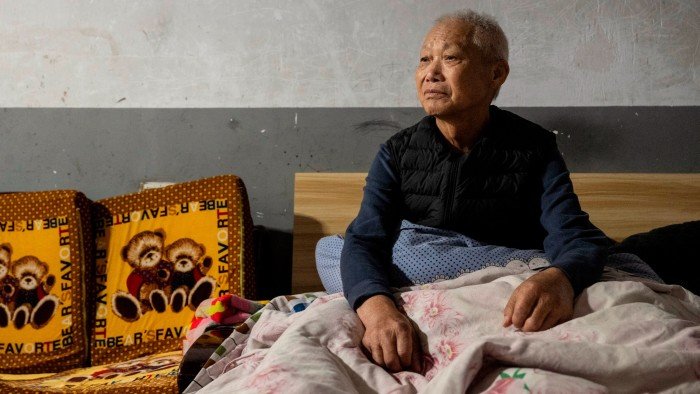
Wang Jinchen apologises for not standing up to greet visitors to his freezing bedroom in Mashihaiwang village in China’s central Hubei province.
Tucked under a tattered quilt, the 70-year-old farmer — who is wasting away from uremia, a condition caused by kidney failure — embodies a problem that is prevalent across China, and that has far-reaching implications for efforts to boost growth in the world’s second-largest economy.
Wang’s family and millions like them are suffering from “catastrophic health expenditure” — medical costs that have devastated their household finances.
Dialysis treatment three times a week costs Wang more than Rmb1,700 ($233) a month on average, of which his medical insurance covers less than a third. Wang and his wife Yuan Dinglai’s only regular income is a monthly pension of Rmb200 each.
“We cannot farm any more, I have to take care of him when he’s unwell,” said Yuan, offering a cup of hot water in his bare room with its flaking paint and medicines piled on the basic wooden furniture.

As China has grown richer over the past two decades, it has expanded healthcare coverage. About 95 per cent of its 1.4bn people are now covered by some medical insurance, up from around 13 per cent in 2003.
Chinese healthcare coverage for reproductive, maternal, newborn and child health and infectious diseases is comparable to those in high-income countries, according to a 2023 paper published in the Lancet medical journal.
But the system still lags developed countries in its coverage of chronic diseases such as diabetes or hypertension, wrote Winnie Yip, professor at the Harvard School of Public Health, and fellow authors from Chinese universities.
“Moreover, China has disproportionately high incidences of catastrophic health expenditure compared with countries with similar economic development,” the authors of the paper wrote.
Such cases are disastrous for family finances but also damaging for the wider economy, according to experts who believe that the need to prepare for potential health emergencies is one reason why Chinese households are among the world’s biggest savers.
While China touts socialism as its guiding ethos, the government has prioritised pouring funds into strategically important industries, such as high-tech manufacturing, as well as infrastructure. Welfare spending has increased, but remains lower than many peers. President Xi Jinping in 2021 warned of the need “not to fall into the trap of ‘welfarism’ that encourages laziness”.

Many experts argue that by directing more fiscal resources to areas that directly benefit households, such as healthcare, Beijing could stimulate economic growth.
Analysts will be looking for new stimulus measures to spur consumption, especially any targeting social welfare, at next week’s annual meeting of China’s rubber stamp parliament. Chinese government ministries did not respond to a request for comment.
“The lack of insurance coverage against [health crises] probably remains an important driver of precautionary savings,” said Eswar Prasad, professor at Cornell University and senior fellow at Brookings.
Despite China’s growing wealth, the proportion of families suffering catastrophic health expenditure has risen.
The Lancet study found that 21.7 per cent of households suffered catastrophic medical expenditure in 2018 as measured by out-of-pocket health spending greater than 10 per cent of total household consumption, up from 20.4 per cent in 2007. For rural households, the increase was sharper — to 27 per cent from about 18 per cent over the same period.
Overall “medical impoverishment”, a measure of how many people were driven below the poverty line by catastrophic healthcare expenditure, was steady at about 1.9 per cent in 2018, but rose slightly for rural residents.
By contrast, the global average incidence of catastrophic health expenditure of 10 per cent or more of total household spending was 13.2 per cent in 2017, the Lancet study found. In Russia and Malaysia, two countries with similar per-capita GDP to China, the ratio was 7.7 per cent and 1.5 per cent, respectively.
The causes of this rising incidence of catastrophic health expenditure are complex. China has been investing in healthcare at a higher rate than GDP growth. Life expectancy rose from 64 years in 1980 to 79 in 2022, according to World Bank data, matching that of the US.

But this has also increased demands on hospitals, driving up medical costs.
Doctors are requiring patients to undergo more expensive diagnostic tests, while patients are staying in hospital even for minor conditions. Hospitalisation rates had soared to levels 40 per cent higher than the global average, researchers said.
“Insurance coverage is expanding very fast but not fast enough to catch up with health expenditure growth,” said Yip of the Harvard School of Public Health.
Medical insurance in China, which is primarily administered by local authorities, does provide coverage for catastrophic healthcare expenditure but the quality of coverage varies depending on location, with wealthy cities such as Beijing and Shanghai able to fund much better care than rural areas in the poorer west. Coverage also varied between inpatient and outpatient treatment, Yip said.

To pay soaring medical costs, some patients have turned to crowd funding, though some such schemes have attracted controversy.
Last year, an online crowdfunding platform operated by Nasdaq-listed company Waterdrop, which is backed by internet group Tencent, was forced to recover funding from a 29-year-old cancer patient who had proudly showed off a newly purchased apartment to his followers after receiving donations. Waterdrop did not respond to a request for comment.
Others have fallen victim to scams, in which families are persuaded to invest in funds with the promise that it will be matched by donors and deliver high returns.
Zhang, the mother of a seven-year-old boy suffering from leukaemia, moved to a town near Beijing from Inner Mongolia so he could be treated in the capital.

Government healthcare plans cover only 20 to 50 per cent of the boy’s treatment. The family’s only income is from the father, who does low-paying takeaway food delivery and odd jobs. With healthcare costs of up to Rmb10,000 per month, the family borrowed money to invest in a donation scheme. But the organiser disappeared with the cash.
“It’s really tough now. If we don’t treat our son, he won’t make it,” said Zhang, who asked to be identified only by her surname.
The family of Xiang, a father from western Sichuan province, was cheated in a similar scam while raising money for his eight-year-old son, who is being treated at a Beijing hospital for two rare blood diseases.
Speaking in their barely furnished apartment on the capital’s outskirts, where his wife sprays visitors and supermarket deliveries with alcohol to protect their child who has low immunity, Xiang said they spent Rmb700,000 on a bone-marrow transplant in 2022. But after the boy contracted Covid in 2023, his body started to reject the transplant.
They now spend Rmb5,500-Rmb6,000 a month on medical bills and rely on relations for financial help.
“It’s not just our family — across China, there are millions of households with someone suffering from a serious illness,” Xiang said.
Back in Mashihaiwang village, Wang and Yuan said their three children try to help them financially but are also short of money after losing their jobs in China’s real estate crash. Wang raised some cash from a crowdfunding website, but the couple need more.
“If there isn’t enough money, then just let it be,” Yuan said. “There’s nothing to be done about it.”
