
Voters intuitively know that the economy has not worked well for most of us for decades. Democrats must offer them a transformative vision, and stick to it for as long as it takes.
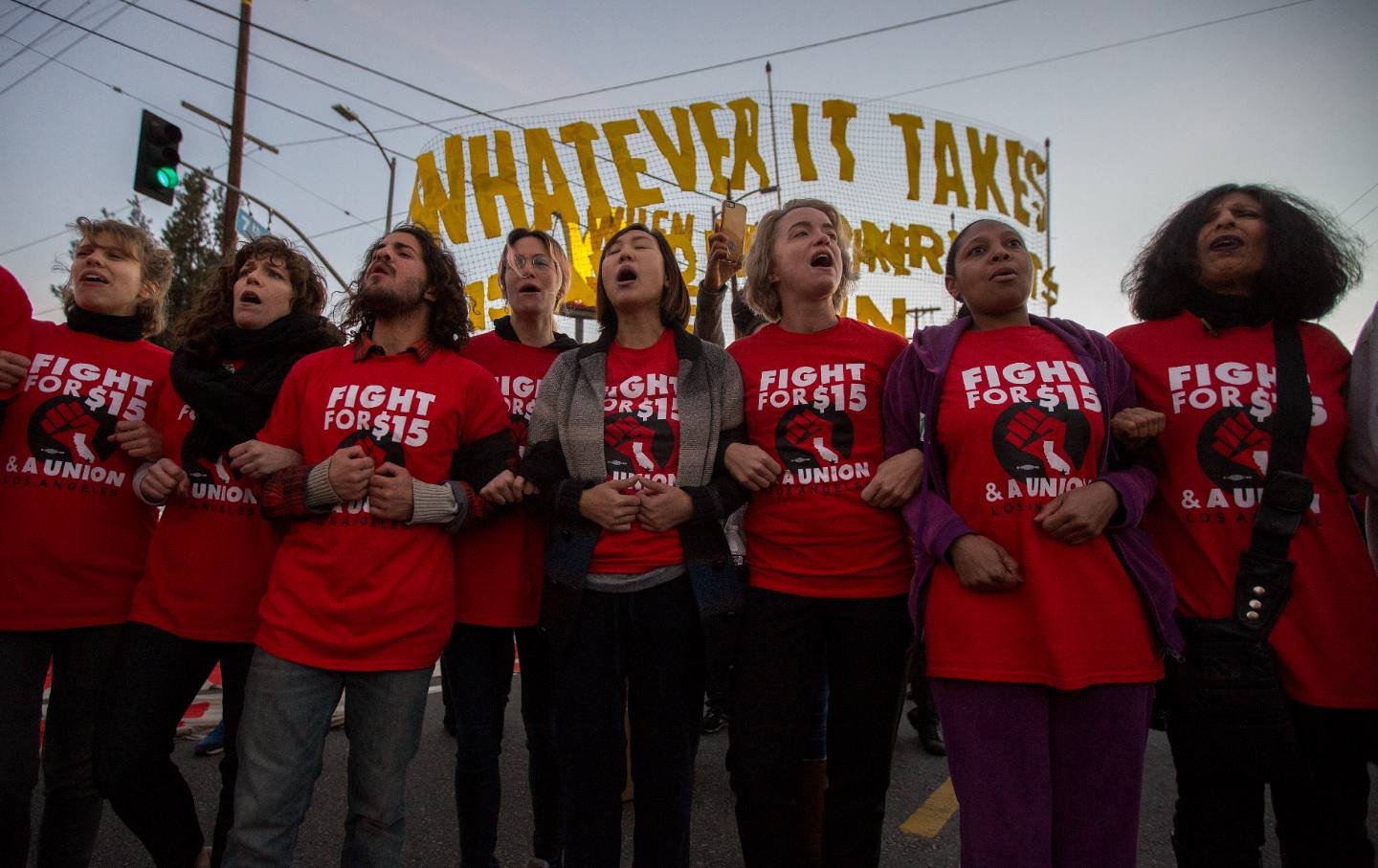
Striking McDonald’s restaurant employees demanded a $15 per hour wage and union rights during nationwide Fight for $15 protests in Los Angeles, California.
(David McNew / Getty Images)
Over a month since the presidential election, we’re awash in postmortems trying to explain Trump’s reelection, so it’s understandable that your head may be spinning. The real problem, though, is that many of these arguments are leading us in the wrong direction. They correctly diagnose that the economy drives voters’ decision-making, but they make simplistic arguments about how and why: the cost of groceries, say, or the failure of working people to vote in their own interests.
As our research on education and the economy shows, and as we have been arguing for several years, voters intuitively understand the fact that the economy has not worked well for most of us for decades, most prominently those of us without college degrees. We’ve each written books that highlight how too many Americans in leadership positions, especially Democrats, have for decades emphasized education and job skills as the answer to growing economic security instead of focusing on minimum-wage laws, union rights, progressive taxation, affordable housing, universal healthcare, and other policies that improve people’s livelihoods.
Indeed, in spite of the fact that Americans are currently the most educated we’ve ever been, half of all of all Americans say they are living paycheck-to-paycheck. In our home state of Wisconsin—which Trump won with the narrowest margin in the nation—we’ve seen the disaffection working people have with the economy swing elections repeatedly, and 2024 is no different.
A close look at voter data makes this clear. The partisan divide by income and educational attainment has increased dramatically in recent years. According to national exit polls from 2024, Trump won voters making less than $50,000 a year by three points, the first time a Republican has won the lowest income demographic since the advent of reliable exit polling, while Harris won a majority of voters making more than $100,000 a year. Harris won college graduates by 13 points, while Trump won non-college-graduates by roughly the same margin.
The Democrats have been losing white non-college-graduates for some time. But when we consider racial disparities in educational attainment in relation to voting patterns, there is an equally troubling pattern emerging: In 2016, Clinton won voters of color without a college degree by 56 points. In 2020, even with Biden’s over-performance relative to Clinton, Trump still narrowed the gap in this demographic to 46 points. In 2024, Trump closed the gap even further, to just 30 points (and only 24 points in Wisconsin). That’s massive. In 2024, whatever has turned white non-college-graduates off Democratic candidates is now happening for other racial groups, as well. And that’s really bad news for Democrats, considering that the majority of American adults don’t have a college degree.
What is the solution here? Though both of us fully believe in the promise of higher education (we’re professors!), Democrats cannot educate their way out of these trends. Our economy is dominated by low-wage, almost entirely nonunion, insecure jobs, and no amount of education and training can change this fact. As data from the Bureau of Labor Statistics shows, a significant majority of jobs in the United States only require a high school degree or less. Universal college education is not the answer to inequality and the economic insecurity of the population. The education system cannot change the labor market.
Current Issue

To win back working-class voters—particularly those with less formal education—Democrats must clearly commit to a vision and a narrative that prioritizes meaningful economic security for working people. In 2016 and 2024, Trump capitalized on the Democratic Party’s failure to offer a transformative economic vision for workers, especially for those without bachelor’s degrees. In 2016, of course, Hillary Clinton touted a supposedly strong economy, while Donald Trump assailed low unemployment numbers as “fake news.” Though the country was experiencing low unemployment at the time, Trump was right that the numbers belied a deep economic anxiety among working Americans.
Joe Biden was not the most pro-labor president of all time (and maybe not even since FDR), but his administration certainly made progress on shifting away from the neoliberal paradigm that has so devastated working people in the US. The Inflation Reduction Act and the CHIPS Act put the livelihoods of working people front and center. For a time, the Biden administration even dramatically reduced child poverty. His administration supported the Protect the Right to Organize Act (which would have been a true game changer for organized labor by stopping some of the worst practices employers use to slow or even halt the progress of collective bargaining). But it simply wasn’t enough. Corporate profiteering led to high inflation; the administration was unwilling to put all its capital into the PRO Act; and bold policies like the child tax credit went by the wayside.
However you want to assign the blame, the Biden administration was unable to move the needle for most working people. Kamala Harris largely campaigned on the achievements of Biden, and she also had a few laudable policy initiatives of her own. But her overarching theme—building an “opportunity economy”—seemed like a retread of 50 years of so many Democratic platitudes, and just didn’t allow working Americans to imagine much changing for them. Take, for instance, one of her most important initiatives, $25,000 in down-payment assistance for first-time homebuyers. It’s a great idea, but our housing crisis, combined with the low wages of so many workers, has priced so many people out of the market that it is hard to imagine buying a house, even with that help, as anything more than a pipe dream for many Americans, especially those making less than $50,000 a year. For them, they will continue to rent, and pay a large part of their meager paycheck to do it.
What Democrats must do, instead, is to offer a big transformative vision, and stick to it for as long as it takes to actualize it. Offering such a vision is not as daunting as it sounds. Rather, the Democrats need to tap into their own history of changing the nation’s economic tapestry, through traditions like the New Deal and Great Society, which made them a majority party for decades, to improve the livelihoods of the people who do all the work.
Democrats must craft a vision of economic rights that tells a story of how we got here and what we need to do. It needs to be big and repeated over and over. We suggest, as Harvey Kaye and Alan Minsky have proposed, a modern version of FDR’s economic bill of rights, which includes the rights to housing, universal healthcare, a job with a living wage; and tuition-free public education.
Crucially, labor unions must be a central component of this vision, and organizing around economic security must be central. It isn’t difficult to understand. Organized labor is enjoying its highest support in over 50 years, as roughly 70 percent of Americans (including almost half of Republicans) approve of unions.
The villain in this story is corporate America. Democrats can side with corporate interests, or they can win elections. But they cannot do both. As a mill worker once wrote to FDR: “Mr. Roosevelt is the only man we ever had in the White House who understood my boss is a son-of-a-bitch.” Democrats must invoke the FDR ethos, and for God’s sake, no Democratic candidate should ever call themselves a “capitalist” ever again.
Economic inequality and insecurity are typically framed in terms of inflation, and it’s true, the cost of nearly everything skyrocketed during Covid and never came down, despite inflation’s coming down to normal levels well over a year before the election. But inflation is largely a problem because so many workers have so few mechanisms—like collective bargaining—to ensure that they can keep, or purchase, a larger slice of what the economy produces.
Regardless, this election hardly realigned American politics. Remember that Trump was defeated in 2020 after offering absolutely nothing for working people as president. Rather, when we consider the last three presidential elections in tandem (each time the effective incumbent lost), it becomes clear that most Americans are voting, with desperation, for any political party that seems to prioritize their economic livelihoods.
The GOP certainly won’t deliver. The wealthy forces behind Trump have been fighting for decades against institutions and policies that actually improve people’s livelihoods: labor unions, Social Security, Medicare, and the Affordable Care Act, to name a few. We know that a second Trump administration will prioritize tax cuts for billionaires and gutting worker protections of every kind, beginning with collective bargaining rights created during the New Deal. So there is an opening for Democrats to win back power in 2026 and 2028.
Popular
“swipe left below to view more authors”Swipe →
Republicans have long understood the necessity of a strong labor movement for Democrats to be successful. That’s why, in our state, Governor Scott Walker and a Republican legislature effectively took away bargaining rights for public-sector unions in 2011, and constrained private-sector unions in 2015 by making Wisconsin a “right to work” state. Most Democrats in Wisconsin now understand this, which is why we are poised, after the work union members did to win a state Supreme Court election in April 2023, to overturn Act 10 in the courts, and why Democrats picked up seats in the state legislature here in spite of Trump’s win this year. Nationally, Democrats must do what they have done in Wisconsin: show up at our union meetings and picket lines and connect economic messages directly to those of unions, so working people can see their livelihoods connected with Democrats. Democratic candidates need to publicly and vocally show up to help organize new workers in unions, too, so we can build a more vibrant labor movement capable of building political power for the long term.
There is not one weird trick or talking point or celebrity endorsement Democrats can use to win back power. But we can do it. To become the majority party that they have been for much of the last 100 years again, Democrats must offer a true vision (and then win policies) that can tangibly improve the lives of all working people in a meaningful way.
More from The Nation
To mount an opposition under the coming Trump administration, the party needs new ideas—not the same establishment clinging to power.
To properly diagnose what went wrong, we need to look at the actual number of votes cast.
