
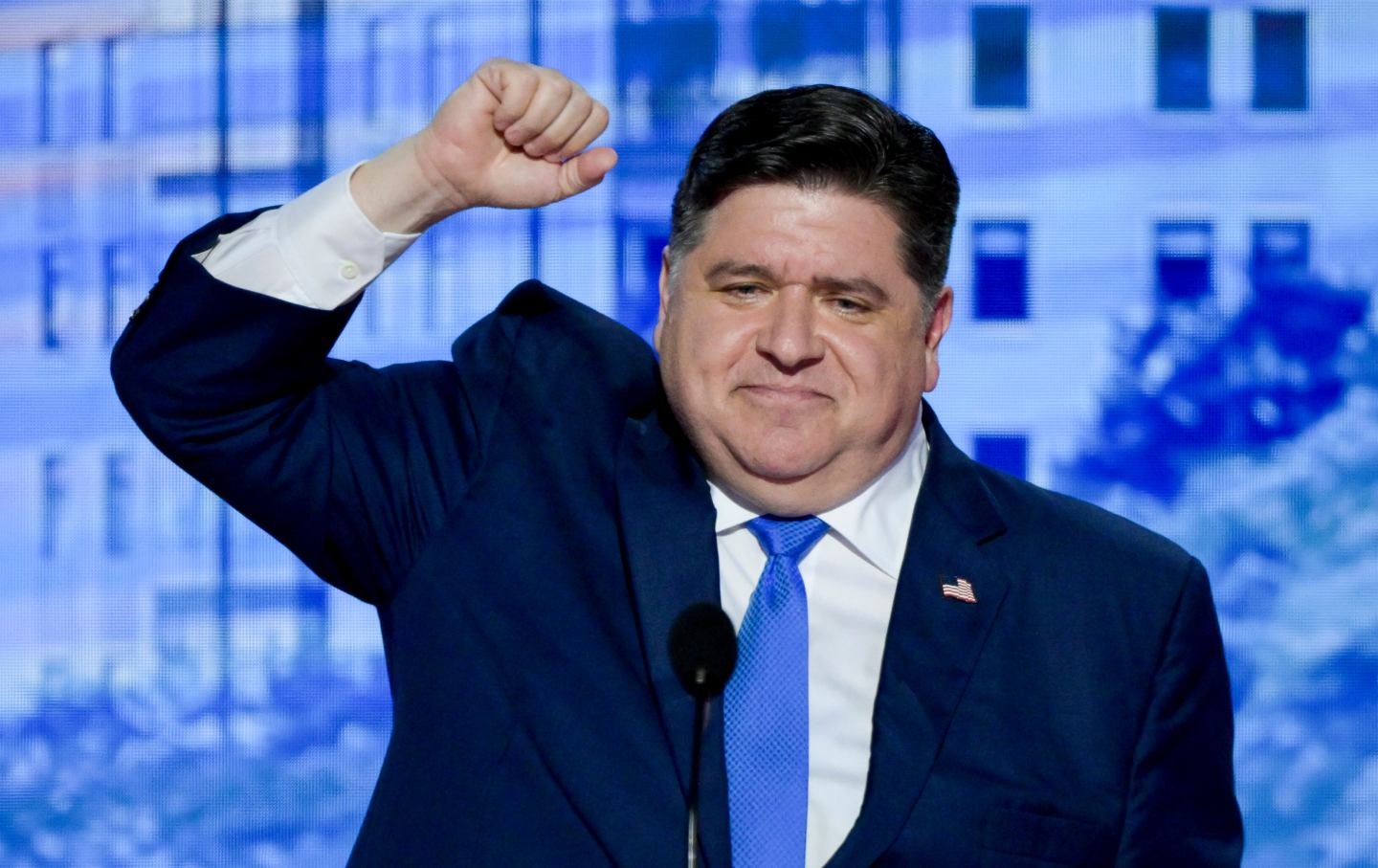
If we want to deploy actual power to block Trump’s vicious agenda once he takes control of the federal government, we will have to look to the states.
“To anyone who intends to come take away the freedom, opportunity, and dignity of Illinoisans, I would remind you that a happy warrior is still a warrior. You come for my people—you come through me.”
—Illinois Governor J.B. Pritzker
This remark at Governor Pritzker’s postelection press conference was the sole heartening thing I have heard since the debacle of November 5. Why?
Frederick Douglass famously asserted, “Power concedes nothing without a demand, it never has and it never will.” This maxim is usually invoked to stress the need for tenacity, as in the United Farm Workers’ “¡Sí, se puede!” (“Yes, we can!”), or the motto of African revolutionaries in the Portuguese colonies, “A luta continua” (“the struggle continues”), or the Wobbly martyr Joe Hill’s “Don’t mourn, organize.” But Douglass’s insight goes deeper. He understood that oppressive power will concede nothing except when confronted by a countervailing power; that moral righteousness and steadfast commitment avail little unless the oppressed grasp the necessary tools. The arc of justice does not bend by itself; it is bent—or not.
Certainly, resistance to MAGA will brew, but we need to be strategic about how to make that resistance effective. Progressives cannot afford to be like the proverbial French generals, always fighting the last war. In this case, the “last war” is the mass Women’s Marches of January 2017, the largest protests in US history—until the Black Lives Matter mobilizations in 2020! But today, when Trump has targeted dissenters and is itching to use federal and paramilitary forces against his opponents, those kinds of protests cannot be our only way to resist.
The question now is how to deploy actual power to block the vicious MAGA agenda once it takes control of the federal government.
In my view, we should take up one of the most effective forms of resistance to unjust authority in US history—fighting at the level of individual states and municipalities, where governors and legislatures, mayors and city councils act to protect their own citizens. Yes, I am talking about “states’ rights.”
Here we face a problem of historical memory. Throughout the 20th century, the term “states’ rights” meant the right of a state to disfranchise, segregate, exclude from public services, and deny basic physical safety to some of its own citizens. That was the constitutional rationale underlying Jim Crow from Virginia to Texas, how Chicanos were treated in the Southwest, and Native American peoples virtually everywhere. In 1948, South Carolina Governor Strom Thurmond led a walkout from the Democratic convention when the party finally endorsed civil rights. He convened a States’ Rights Democratic Party and swept four states (South Carolina, Mississippi, Louisiana, Alabama) as the only “Democrat” on the ballot.
Current Issue

Eight years later, 101 Southern Members of Congress issued the Southern Manifesto, damning the Brown v. Board of Education decision as a “clear abuse of judicial power” that would “encroach upon the reserved rights of the states and the people.” And Ronald Reagan sounded a loud dog-whistle on August 3, 1980, telling whites at the Neshoba County fair in Philadelphia, Mississippi—where the KKK had murdered civil rights workers James Chaney, Andrew Goodman, and Michael Schwerner in 1964—that “I believe in states’ rights…. And if I do get the job I’m looking for, I’m going to devote myself to trying to reorder those priorities and to restore to the states and local communities those functions which properly belong there.”
But there is also a powerful history of state and local resistance to injustice that we can draw on. As Kate Masur’s Until Justice Be Done: America’s First Civil Rights Movement, from the Revolution to Reconstruction and my The First Reconstruction: Black Politics in America from the Revolution to the Civil War document, in the half-century preceding Lincoln’s election, governors, legislatures, towns, and cities in much of the North resisted the legal claims of the slaveholding states, defending the rights of their citizens against “the Slave Power”—meaning the South’s domination of national politics. As this defiance spread in the 1850s, it effectively nullified the federal government’s ability to enforce the claims of slave-owners.
There is a further implication for our own time, when Republicans controlling red states seek to abrogate the citizenship of those deemed “other,’”whether immigrants, trans persons, or anyone not white. In the antebellum era, “states’ rights” meant that when a state granted citizenship to African Americans by enfranchising them if male, authorizing them to testify against whites in court, issuing passports to them (as Massachusetts did in the 1850s), and protecting them against slave-catchers via “personal liberty” laws, that state’s governor, legislature, and courts were deliberately confronting those states that refused citizenship to Black people.
Up until 1850, the central issue was the 1793 Fugitive Slave Act, which required states to comply with the Constitution’s specification that any “person held to Service or Labour in one State,” if escaping to another, must be returned. In the 1810s, legislators above the Mason-Dixon responded viscerally to well-organized kidnapping rings in the Chesapeake, which regularly abducted persons of color (especially children). In 1820, Pennsylvania passed the first “personal liberty” law, further strengthened by an 1826 act making it extremely difficult for a slave-owner to to reclaim his human chattels.
By the 1830s, an anti-slavery constituency formed among Northern Whigs led by the congressman (and former president) John Quincy Adams. It became popular to defy the South by refusing to extradite fugitives or persons charged with aiding escapes. A pattern was set in 1837–38 when Whig and then Democratic governors in Maine denied Georgia’s demand for the rendition of an enslaved stowaway and the captain of the ship on which he escaped.
The most famous instance of this de facto nullification was the “Virginia Controversy” of 1839–42, during which New York Governor William H. Seward resisted five Virginia governors demanding the extradition of three Black seamen, New York citizens, who helped an enslaved person to escape from Norfolk. Seward’s rationale here bears special notice for our time. He wrote one governor that extradition was valid in his state only if the supposed crime was “treasonable, felonious or criminal,” and it was “not a felony nor a crime” in New York to help someone escape from bondage, adding that “it is absurd in this State to speak of property in immortal beings, and consequently of stealing them, as it would be to discourse of a division of property in the common atmosphere.” Not only that. In 1840, he signed a bill mandating jury trials for alleged fugitives from slavery, and in 1841 approved legislation revoking the “nine months law” which permitted slaveholders to bring their chattels into the state.
Seward and his Ohio ally (later governor) Salmon P. Chase took the doctrine of a state’s right to guarantee liberty to the Supreme Court in 1842 and lost in Prigg v. Pennsylvania, when the court voided the conviction of a professional slavecatcher. But the Prigg decision also removed the requirement that state authorities cooperate in recapture. As a consequence, individual states and localities continued to turn a blind eye to “rescues” of captured fugitives, often by free Black folk.
Matters came to a head after passage of the Fugitive Slave Act of 1850. That draconian legislation repealed habeas corpus for all persons of African descent in the “free” states. The reaction across much of the North was violent outrage. In 1852, the Ohio congressman Joshua Giddings told a mass meeting, “I would sooner see every slave holder of the nation hanged then to witness the subjugation of northern freemen to such a humiliating condition. If this law continues to be enforced, Civil War is inevitable.”
Spectacular rescues ensued, from Christiana just above Pennsylvania’s border with Maryland (where a slaveholder was killed) to Syracuse’s “Jerry Rescue” and multiple confrontations in Boston. Powerful political figures like Massachusetts Senator Charles Sumner and Pennsylvania Representative Thaddeus Stevens defended the men arrested during these actions, whom juries proved singularly unwilling to convict.
Popular
“swipe left below to view more authors”Swipe →
Beginning in 1854, as the new Republican Party coalesced, eight Northern states passed stringent personal liberty laws. The resolution by Vermont’s General Assembly in 1858, following the Dred Scott v. Sandford decision, gives their flavor: “That all laws of Congress which recognize the right of property in man, or deprive any person of liberty without due process of law and a jury trial…are unconstitutional, void, and of no effect…. That these extra-judicial opinions of the Supreme Court of the United States are a dangerous usurpation of power, and have no binding authority upon Vermont, or the people of the United States.”
Dred Scott was the final straw, as it guaranteed slaveholders the right to take their human property anywhere in the United States and erased any possibility of Black citizenship. The Wisconsin legislature nullified it, and Maine’s Supreme Judicial Court followed suit when queried by the legislature whether Black Mainers could still vote as they had since the state’s founding. It was a short route from there to Lincoln’s election in November 1860 and then secession, when four of the slaveholding states cited the refusal to return fugitives as a central reason for leaving the Union. They had been met with power, and retreated.
What is the lesson of this history from our seemingly distant past? Constitutional scholars will likely declare it irrelevant, given more recent precedents, and no one can imagine that this Supreme Court—any more than the court led by Chief Justice Roger Taney that issued Dred Scott—will support states and cities that defy Trump. This is not a legal strategy, in any case—no more than resistance by New York or Ohio to the slave power’s domination was.
It is as political as could be: putting up a wall against oppression, securing a border for freedom, creating sanctuaries for the oppressed, refusing to cooperate with a government that validates cruelty via mass deportations of the undocumented and persecution of anyone involved in abortion or gender-affirming care.
That was the implication of what Governor Pritzker said: Now we must expand the zone of freedom state by state—by any means necessary. The fighting words of Vermont’s legislature in 1858 seem fresh: “Whenever the government or judiciary of the United States refuses or neglects to protect the citizens of each State in their lives and liberty, when in another State or territory, it becomes the duty of the sovereign and independent States of this Union to protect their own citizens, at whatever hazard or cost.”
We cannot back down
We now confront a second Trump presidency.
There’s not a moment to lose. We must harness our fears, our grief, and yes, our anger, to resist the dangerous policies Donald Trump will unleash on our country. We rededicate ourselves to our role as journalists and writers of principle and conscience.
Today, we also steel ourselves for the fight ahead. It will demand a fearless spirit, an informed mind, wise analysis, and humane resistance. We face the enactment of Project 2025, a far-right supreme court, political authoritarianism, increasing inequality and record homelessness, a looming climate crisis, and conflicts abroad. The Nation will expose and propose, nurture investigative reporting, and stand together as a community to keep hope and possibility alive. The Nation’s work will continue—as it has in good and not-so-good times—to develop alternative ideas and visions, to deepen our mission of truth-telling and deep reporting, and to further solidarity in a nation divided.
Armed with a remarkable 160 years of bold, independent journalism, our mandate today remains the same as when abolitionists first founded The Nation—to uphold the principles of democracy and freedom, serve as a beacon through the darkest days of resistance, and to envision and struggle for a brighter future.
The day is dark, the forces arrayed are tenacious, but as the late Nation editorial board member Toni Morrison wrote “No! This is precisely the time when artists go to work. There is no time for despair, no place for self-pity, no need for silence, no room for fear. We speak, we write, we do language. That is how civilizations heal.”
I urge you to stand with The Nation and donate today.
Onwards,
Katrina vanden Heuvel
Editorial Director and Publisher, The Nation
More from The Nation
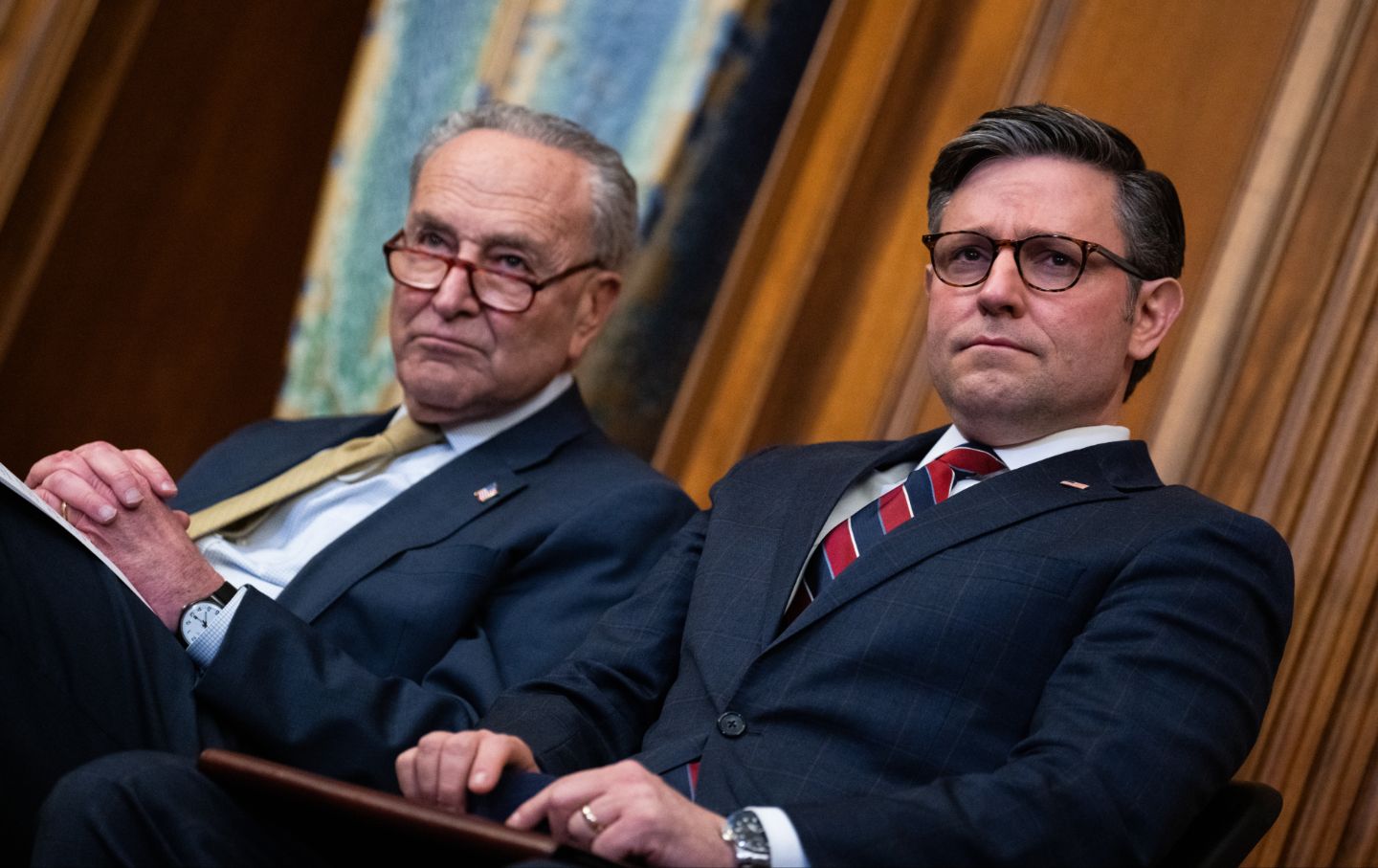
The House passed a bill aimed at giving the government sweeping powers to crush nonprofits and attack supporters of Palestine. Democrats need to stand firmly in its way.
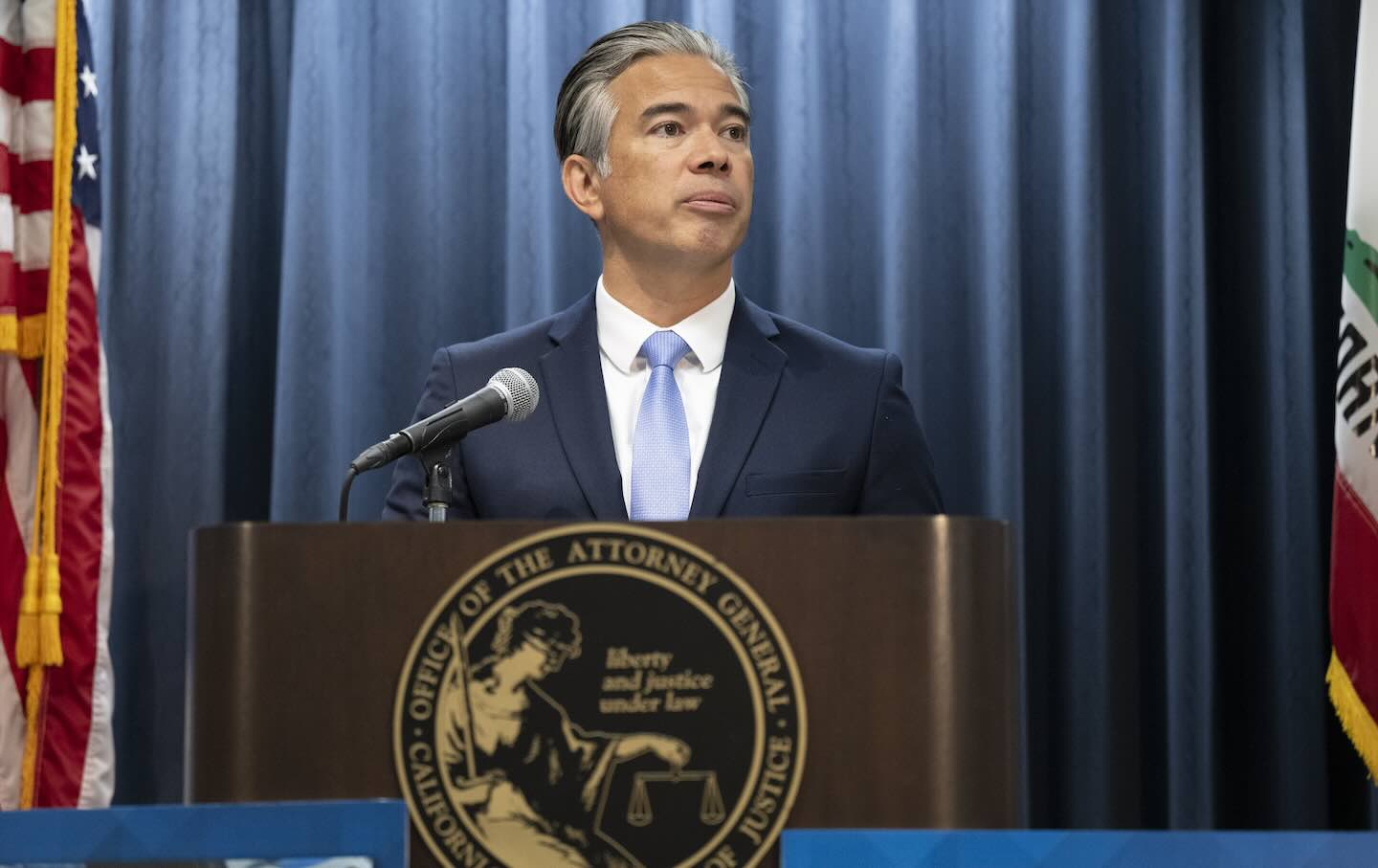
“We’ve thought about all the possibilities, and have prepared for every one of them,” said AG Rob Bonta, “and are ready to take action when there’s any unlawful activity.”

Forty-five minutes after CNN contacted Trump’s attorney general nominee about additional allegations of sexual misconduct, he was done.

State-level Democrats largely held their ground, even scoring key victories in battleground states—and under Trump, that’s going to matter.
He can pick a strident abortion opponent like Roger Severino, who wrote the Project 2025 chapter on HHS, as his number two.
