
Features writer
Jeffrey Gogo

Features writer

Share

Fact Checked by
Elena Bozhkova

Features Lead
Key Takeaways:
- W fancies itself as Europe’s response to U.S. dominance of social media.
- The platform aims to compete with X (Twitter).
- W boasts “free speech and data privacy at its core” but experts think it is anything but free or private.
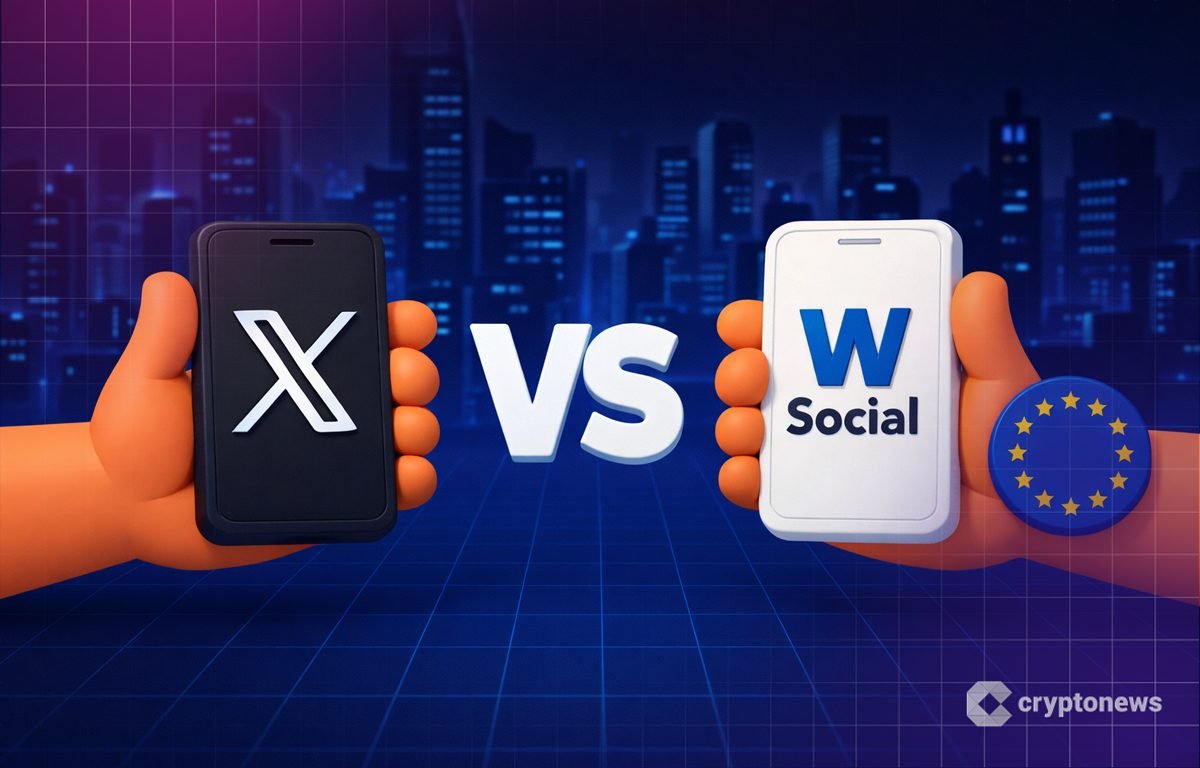
A Swedish firm launched a new social network called ‘W’ to compete with Elon Musk’s X (Twitter), but experts say the platform falls far short of the privacy standards that have become synonymous with the crypto sector.
W Social AB launched its eponymous platform at the World Economic Forum in Davos in January, describing ‘W’ as “a social network where people come before algorithms, and where free speech and privacy are real, not slogans.”
“W is articulating a sentiment many users share: trust online is eroding, feeds feel manipulative, and it is hard to tell what or who is real,” Fraser Edwards, CEO of decentralized identity network Cheqd, told Cryptonews.
“What users don’t share is the sentiment that mandatory verification of government-issued IDs is the solution,” he added, noting that almost 50% of Europeans don’t want social media to use mandatory proof of identity.
“Those findings reflect concerns that compulsory identification is seen less as a trust mechanism and more as a data and surveillance risk that raises barriers to participation in digital spaces.”
What Is W?
W is a privately owned social media startup, incorporated in Sweden. It is funded by private investors primarily from the Nordic region and limits its investors to Europeans. One of the biggest shareholders is the Swedish firm “We Don’t Have Time,” which controls 25% of W, its subsidiary.
Founders have pitched W as Europe’s response to U.S. dominance of social media, targeting X, a platform widely seen as the last bastion of free speech in a world that’s gone Orwellian, marked by government surveillance.
According to W Social cofounder and CEO Anna Zeiter, platforms like X are responsible for “systemic disinformation”, which is “eroding public trust and weakening democratic decision-making.”
“Many see the problem, far fewer are helping shape what comes next,” she posted on LinkedIn. “We believe there’s an urgent need for a new social media platform built, governed and hosted in Europe.”
W is that platform, Zeiter claims, boasting “free speech and data privacy” at its core. Only verified people can post on W. The idea is to curb fake accounts and to exclude bots that supposedly spread “disinformation and propaganda.”
Zeiter said W will host its data on “European servers owned by European companies.” It plans to use Proton, a Swiss encrypted email service provider, and UpCloud, a cloud computing platform based in Finland, according to industry media reports.
In contrast, American competitors such as X and Meta operate worldwide with infrastructure in multiple locations in the U.S., Europe and Asia.
For example, X has operations in the U.S. and Ireland. According to its website, X says user data “may be transferred to and stored in the United States, Ireland, and other countries where we operate, including through our offices, partners, and service providers”.
Zeiter spoke of W as a “better version of Twitter,” Bilanz reports. “Positive, respectful communication is to be promoted,” she said. The goal is to eliminate bots, fake accounts and Europe’s version of disinformation.
“Our mission is to create a platform that embraces quality journalism, open debate and real humans,” Zeiter added. The site will allow users to choose to receive a specific number of posts from different opinion filter bubbles.
W opened a public waitlist for beta testers and early adopters following a public response to the so-called “pre-launch” that Zeiter described as “far beyond [our] expectations.” Onboarding is expected to start in March.
Rivalry With Crypto Twitter
W comes as the European Union opened an investigation into “sexual abuse” images generated by X’s Grok AI under the bloc’s notorious Digital Services Act (DSA).
Meanwhile, W promises strict compliance with the EU’s data protection law, GDPR and DSA. W’s launch drew mixed reactions on X, with several people criticizing it as an extension of EU surveillance and censorship.
Zeiter gave short shrift to the concerns. She recently cited a LinkedIn post by Monnett, the European equivalent of Meta’s Instagram, calling on users to “log off Big Tech, log into Europe,” and said, “W(e) fully agree.”
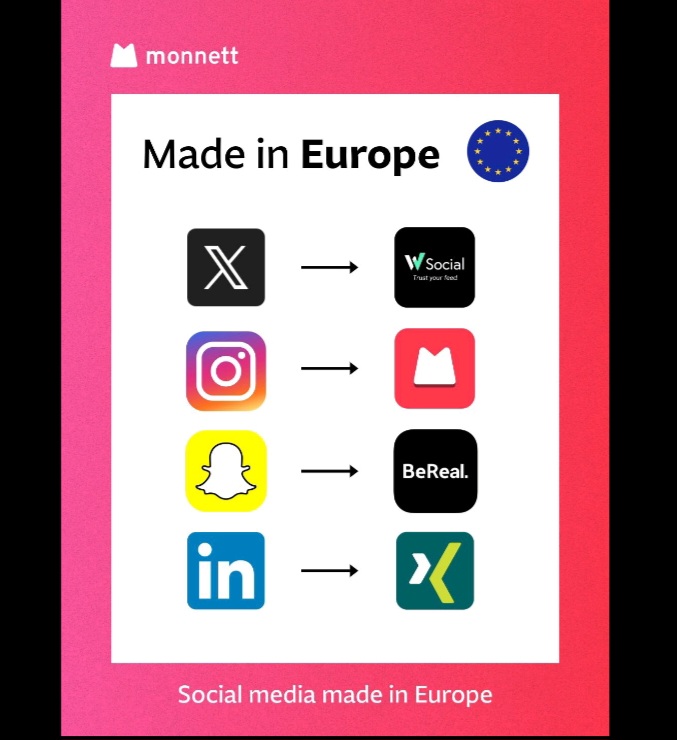
But could a Europe-hosted social media site truly threaten X, a top digital townsquare for crypto?
Emily Lai, chief marketing officer at social media agency Hype, said W’s difficulty in onboarding crypto communities is two-fold:
- X is home for a majority of crypto voices and has deep network effects.
- Crypto’s ethos of being cypherpunk, contrarian, and sovereign makes a WEF Davos-funded social media platform unlikely to be a compelling contender.
“Even with open decentralized social protocols or platforms like Lens, Farcaster, and Bluesky, the failure to fully onboard crypto communities at scale shows the network effects of X,” Lai told Cryptonews.
Edwards, the Cheqd CEO, is worried about the lack of pseudonymity on W, saying the feature isn’t a loophole. “It is a functional feature that enables global participation and engagement without gatekeeping…” he said.
“Platforms that require full identification as the price of trust will struggle to attract users and risk cutting themselves off from the audiences they need to scale. W is unlikely to compete with X on raw network effects…”
Edwards said W’s differentiation is built around “explicitly having stronger identity controls.” But “mandatory proof of identity poses real risks [on] data protection and surveillance,” he tells Cryptonews.
“Personal data can be misused, and access to digital spaces becomes harder for many legitimate users. The risk is that anonymity is treated as the problem, rather than harmful behaviour itself.”
Edwards suggested that improved moderation, digital education, and clear legal frameworks could serve W better, promoting “respect online without risking compromising freedom and privacy.”
He cited eIDAS 2.0, a new tool that he claims can “prove you’re a European citizen, human-ness or other eligibility without needing to disclose exactly who you are.”
