
Unlock the Editor’s Digest for free
Roula Khalaf, Editor of the FT, selects her favourite stories in this weekly newsletter.
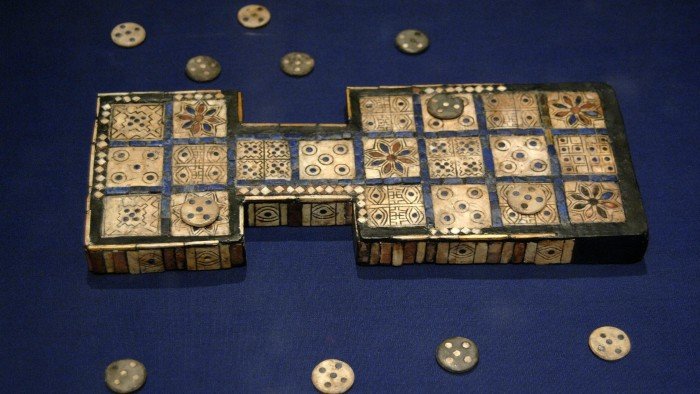
I am aware that this suggestion comes rather too late in the year to be useful, but here’s a gift idea for next Christmas: get the board game enthusiast in your life the Royal Game of Ur, the oldest playable board game in the world.
This ancient Mesopotamian game of strategy and movement is the earliest one whose rules have survived into the modern day, thanks to a tablet inscribed by a Babylonian astronomer in 177BC, and a painstaking work of reconstruction by the British Museum’s Irving Finkel. (You can see the original game pieces on display at the museum.)
Although the Royal Game of Ur is unlikely to supplant Twilight Struggle in our household (the latter is a thrilling game of cold war intrigue for two players in which I prefer to play as the USSR, while my partner generally opts for the Great Satan), seeing the original pieces on display always gives me a thrill. They bring an unexpected feeling of communion with those long dead, a shared sense of our common humanity in something as simple and as silly as playing a game.
Why do we game? Why will I spend quite so much of this festive period losing at Twilight Struggle to my partner, participating in endless rounds of Monopoly Deal (the addictive, fast-paced card game that adds some much-needed speed and verve to its statelier board ancestor), playing classic games on the Nintendo Switch or modern ones on the PlayStation? Why are ancient dig sites littered with backgammon sets and mancala pieces? Why do ancient urns depict Achilles and Ajax bent in concentration over some sort of dice game?
I think there are two answers. The first is that gaming is a lot of fun: whether you choose poker, Dungeons & Dragons, or Fifa, an evening with friends playing collaboratively — or competitively — over food and drink is an evening well spent. Whether in the present or as a break from that distant Trojan war, we all have a craving for joyful escapism.
But the second reason is that gaming doesn’t only entertain: gaming often reveals. The kindly aunt who, it turns out, becomes a vicious, win-at-all-costs type whenever they are playing Scrabble or poker. The arch-cynic who points out a possible triple word score to a younger relative. The friend who loves to gloat upon triumphing at a game of Chameleon. Yes, games amuse us but they also tell us truths about our characters that are often kept hidden.
Of course, one significant change between us and the ancient Mesopotamians is that there are now many more games that can be, and often are, played alone, thanks to the rise of home video games. Single-player games are not new either — jigsaw puzzles were being played at least as far back as the 18th century, while a version of “choose-your-own-adventure” novels (“to check the door, turn to page 24. To ignore the howls and go to bed, turn to page 122”) goes back to at least 1930.
Many modern games owe a conscious debt to both these genres. Games ranging from Tetris to Wordle are part of that very old puzzle tradition. Games as different as the gripping political thriller Suzerain or the brilliantly gory love story Slay the Princess are in many senses simply more complex choose-your-own-adventure novels.
But the crucial difference is that never before have we been able to log exactly how long we spend playing puzzles or flicking through these books. We entertained ourselves, we may have learnt something about our own preferences, but we didn’t learn very much about one another. Today, thanks to the extensive data gathered by the various games consoles, and digital distribution platforms such as Steam, we now know a huge amount about the choices we make in games.
Some of those are not particularly interesting: I don’t think the decisions that people make about how to set up their team in Football Manager reveal all that much about the human condition.
But others are. Games do, I think, tell us something about ourselves when the choices we make in them are between good and evil. Take video games such as I Was A Teenage Exocolonist, or Baldur’s Gate 3, where you can choose between villainy or heroism.
The two games and the backgrounds they came from are very different: I Was A Teenage Exocolonist was created by a small studio run by a husband and wife, while Baldur’s Gate 3 is made by a company that spans multiple countries. They have two things in common: the first is that both are brilliant uses of an afternoon. The second, and more important, is that in both games, more players seem to choose good over evil. Around twice as many, I believe, calculating from the achievements for the “good” endings rather than the “bad” ones on Steam. Indeed, the ranks of those choosing evil are often fattened by people (myself included) who have already played it once and want to see what happens when they make bad choices instead.
In the real world, of course, history tells us that, in addition to our long love of games, we are more than capable of choosing cruelty over kindness. But it still says something positive, I think, that our idealised selves are more likely to choose good.
stephen.bush@ft.com
