
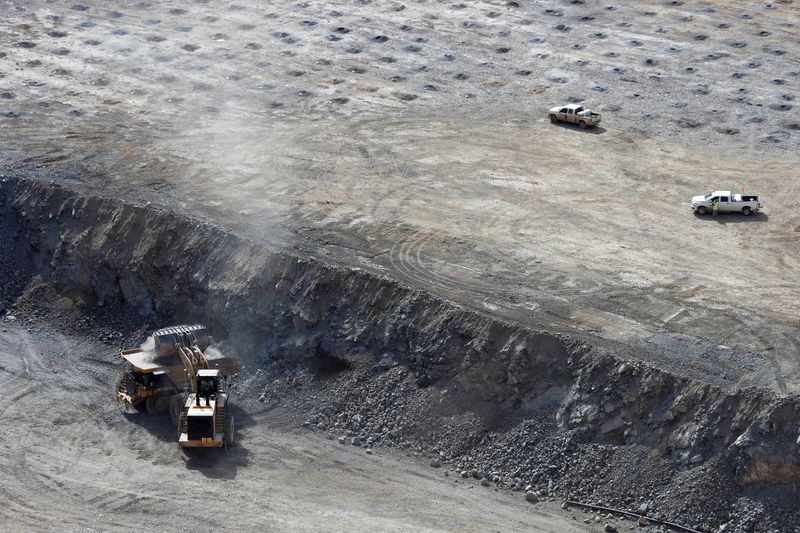
© Reuters. FILE PHOTO: A wheel loader operator fills a truck with ore at the MP Materials rare earth mine in Mountain Pass, California, U.S. January 30, 2020. Picture taken January 30, 2020. REUTERS/Steve Marcus
By Ernest Scheyder
ALEXANDRIA, Louisiana (Reuters) -Start-up tech firms are racing to transform the way rare earths are refined for the clean energy transition, a push aimed at turbocharging the West’s expansion into the niche sector that underpins billions of electronic devices.
The existing standard to refine these strategic minerals, known as solvent extraction, is an expensive and dirty process that China has spent the past 30 years mastering. MP Materials, Lynas Rare Earths and other Western rare earths companies have struggled at times to deploy it due to technical complexities and pollution concerns.
Rare earths are a group of 17 metals used to make magnets that turn power into motion for electric vehicles, cell phones and other electronics. While U.S. scientists helped develop solvent extraction for rare earths in the 1950s, radioactive waste from the process gradually made it unpopular in the United States.
China began to rapidly expand in the industry starting during the 1980s and now controls 87% of global rare earths refining capacity, according to the International Energy Agency. That prowess has helped propel the country’s economy to the second-largest in the world.
Emerging Western rivals now offer the tantalizing prospect of processing the minerals in faster, cleaner and cheaper ways, if they can successfully launch.
“The existing rare earths refining process is a nightmare,” said Isabel Barton, a mining and geological engineering professor at the University of Arizona. “That’s why there are so many companies promising new methods, because we need new ones.”
Interviews with nearly two dozen industry consultants, academics and executives show that if one or more of these novel processing technologies succeed as hoped by 2025, they could slash reliance on Chinese rare earths technology and its toxic by-products while also bolstering plans by Western firms to charge premium prices for the strategic minerals.
While none have launched commercially – and some industry consultants and analysts question whether they will be able to do so soon – a cadre of firms are pushing forward with aggressive development plans.
On a former U.S. Air Force base in Louisiana, Ucore Rare Metals aims to process rare earths by mid-2025 using a technology known as RapidSX that it says is at least three times faster than solvent extraction, produces no hazardous chemical waste and requires only a third of the physical space.
“Our goal is to re-establish a North American rare earths supply chain,” Michael Schrider, Ucore’s chief operating officer, said during a visit to the site.
Formed in 2006, Ucore initially planned to mine a rare earths deposit in Alaska. But the company changed tack in 2022 to focus on refining, not mining, a pivot born from what two executives said they saw as a flaw in the West’s strategy to weaken China’s minerals dominance by trying to master both steps simultaneously.
Ucore, which has been testing its process with Pentagon funding, is in talks now with 17 mining companies to buy lightly processed supplies of rare earths known as concentrate, ship them to the Port of New Orleans, then truck them to a 80,800-square foot warehouse that will be outfitted with the RapidSX technology beginning in January.
Rare earths miners increasingly say they are content to focus on digging up rock – rather than compounding their operations with the added step of processing.
“Mining companies should focus on finding new deposits,” said Luisa Moreno, president of Defense Metals, which aims to open a rare earths mine in British Columbia within four years and is interested in licensing Ucore’s technology. “You probably should let refining be handled by others that specialize in that.”
Rainbow Rare Earths plans by 2026 to deploy rare earths refining technology in South Africa developed by its Florida-based partner K-Technologies that uses a process known as continuous ion exchange, used by some lithium producers.
Startup Aether is developing nanotechnology that programs proteins to selectively bind with and extract rare earths from ore deposits.
In Norway, privately-held REETec says its proprietary refining process emits 90% less carbon dioxide than solvent extraction and should be operational by late 2024.
And privately-held Phoenix Tailings earlier this year began refining small amounts of rare earths in Massachusetts using a process that it says is free of emissions and waste.
“There are technologies that can be developed that are far better than solvent extraction,” said Robert Fox, a scientist at the U.S. Department of Energy’s Idaho National Laboratory. The lab last month agreed to research new refining techniques for privately-held U.S. Critical Materials, which is developing a rare earths deposit.
SKEPTICISM
Despite the hunger for new refining techniques, industry consultants warned that manufacturers may be expecting too much and too soon from this so-far unproven group of nascent technologies, especially given the world’s aggressive electrification targets.
Ucore’s technology, for example, has never worked at commercial scale and is not expected to gain patent protection until next year, a timeline that industry consultants flagged as a cause for concern given strong rivalries for intellectual property.
“The time horizon needed to develop all these new refining technologies will be longer than many expect,” said Frank Fannon, a minerals industry consultant and former U.S. assistant secretary of state. Talks of production within a few years “creates a false sense of security for policymakers.”
Yet the need for alternatives is rising, especially in the wake of Beijing’s decision earlier this year to curb exports of germanium, graphite and other metals. That has sparked concerns that rare earths could be next.
Fannon and several U.S. politicians have called for Western governments to create central rare earths processing hubs, a plan already being pursued by Canada.
In Saskatchewan, government scientists are working to launch their own rare earths processing technology after attempts to buy Chinese technology sputtered in 2020.
“We looked at existing technologies and said, ‘There’s a better way of doing this,'” said Mike Crabtree, CEO of the Saskatchewan Research Council (SRC), which is funded by the provincial government. “We wanted to put our own spin on it.”
Using artificial intelligence, the company designed processing equipment it believes is more efficient than Chinese rivals. Rather than needing up to 100 people to run, as with traditional solvent extraction, the SRC estimates that only four people will be needed to run its plant, which it hopes to open by the end of 2024.
While the SRC’s goal is to spur mining across Canada, Crabtree said he is open to licensing the technology for use anywhere in the world.
“This entire sector as a whole needs to grow outside of China in order to support the energy transition,” he said.
Crabtree and the SRC expect their facility to cost more to build than Chinese rivals but less to operate, a function of their desire to make processing equipment that has no waste and recycles acid and other key chemicals.
And while MP Materials and others have struggled to tailor their processing equipment to specific geological deposits, SRC, Ucore and others say they believe their new refining processes will be able to process the critical minerals from multiple locations across the globe.
“These new sources for rare earths are going to be paramount if we’re going to reach global net zero targets,” said Steve Schoffstall of the Sprott Energy Transition Materials ETF, which holds shares in several rare earths companies.
Shares of Ucore rose more than 6% on Monday in Canadian trading after the Reuters story, while shares traded over-the-counter in the United States gained nearly 8%.
– For daily comprehensive coverage of COP28 in your inbox, sign up for the Reuters Sustainable Switch (NYSE:) newsletter here.
