
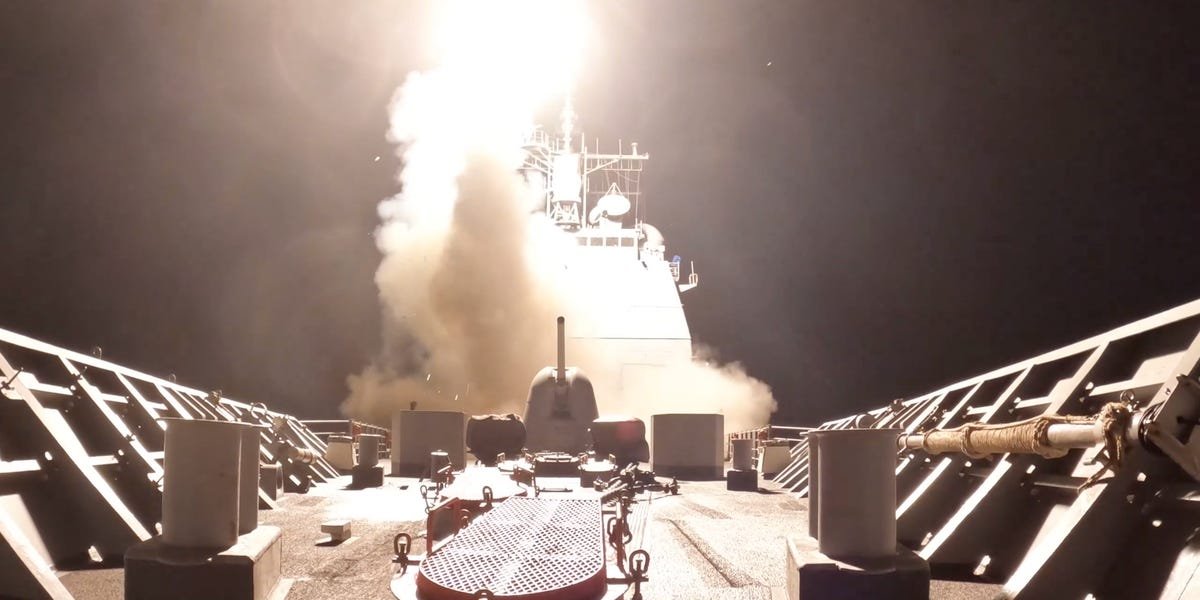
The US Navy’s exhausting shootout with the Iran-backed Houthis has given American military planners a clearer view into the complexities of high-tempo air defense operations.
The Red Sea conflict, now in the second month of a cease-fire, has been a heavy strain on the Navy, stressing warship crews and draining critical munitions. Though this fight has been a challenge, leaders within the service believe that it is but a taste of what a future war against China, which has far more sophisticated missiles than the Yemeni rebels, would look like.
And it’s not just the missiles. Rather, it’s a range of factors that would make a China confrontation significantly more difficult, but the Navy is learning key lessons from the Red Sea that it could apply to a future fight.
“In a lot of ways, the Red Sea — it’s a knife fight in a phone booth,” Cdr. Cameron Ingram, the commanding officer of the USS Thomas Hudner, told Business Insider aboard the Arleigh Burke-class destroyer during a recent underway in the English Channel.
“The geography is extremely tight, and that geography operating that close off of China-controlled territory would be very, very challenging,” he said.
“That would be a much more long-distance fight,” Ingram said. “Also, their long-range surveillance and tracking is much more advanced. Their intelligence community is much more advanced. And so there are still a lot more complexities and challenges that would make it very difficult in a China fight.”
US Navy photo by Mass Communication Specialist 2nd Class Jonathan Nye
Since October 2023, the Houthis have launched hundreds of missiles and drones at Israel and international shipping lanes off the coast of Yemen, specifically in the Red Sea and the Gulf of Aden.
Related stories

Business Insider tells the innovative stories you want to know
Business Insider tells the innovative stories you want to know
Navy warships and aircraft operating in the region have shot down many of the Houthi weapons, from drones to anti-ship missiles, in self-defense and in defense of Israel and merchant vessels. Thomas Hudner is one of America’s ships with confirmed kills.
These interceptions — sometimes leveraging multimillion-dollar missiles to take down drones worth only thousands of dollars — have strained US stockpiles and raised concerns about readiness for potential future armed conflicts. In the case of China, which has been described as America’s “pacing threat,” naval air defense capacity is a priority; a potential conflict between the two would likely unfold primarily at sea.
China maintains a formidable arsenal of anti-ship weapons, including ballistic and cruise missiles, that are vastly more capable than what the Houthis have been employing, making it imperative that the Navy has enough interceptor missiles on hand; however, it has already expended hundreds of these battling the rebels.
Ingram said a China war would be challenging and complex for the Navy because of Beijing’s advanced weaponry, long-range surveillance and tracking, and intelligence operations.
“That environment will have to be fought at a different level,” he explained, adding that it would see engagements at longer distances than what the Navy experienced in the Red Sea.
Lessons learned
Official US Navy photo
The Navy has learned a great deal about air defense from the Red Sea conflict and tested by unprecedented engagements against dangerous threats such as anti-ship ballistic missiles.
Ingram spoke highly of the Aegis Combat System, which uses computers and radars to help warships track targets and intercept them. He said it has “operated probably better than most of us expected it to, as far as success rates of engagements.”
The Red Sea conflict has also informed the Navy about its magazine capacity, reloading capabilities, and munitions inventory. The sea service has changed its firing policy and reconsidered the amount of ordnance warships ought to expend in attempts to neutralize a threat.
A big focus area is trying to drive down the cost ratio for air defense missions. Using a $2.1 million Standard Missile-2 to intercept a $20,000 drone isn’t on the right side of that curve, but Ingram argues that it can be worth it to protect a $2 billion warship and hundreds of lives. The challenge, however, is sustainability.
The US and its NATO allies have demonstrated in the Red Sea that they can use cheaper air defense alternatives to take down the Houthi threats. American fighter jets, for instance, used guided rockets. Ingram said the Navy is working to bring the cost difference between threat and interceptor “a little bit closer to parity.”
Ingram added that there is increased attention being directed at warships’ five-inch deck guns, which have a much deeper magazine capacity than a destroyer’s missile-launching tubes and have served as viable means of air defense in the Red Sea.
“If I can stay in the fight longer by shooting five-inch rounds, especially at a drone, maybe I should do that and save my higher-capacity weapons systems for larger threats,” he said.
Rearming is another consideration. US warships have to travel to a friendly port with the necessary supplies to get more missiles, which takes up valuable time and keeps vessels off-station for extended periods. This could be a major issue in a high-tempo Pacific conflict. However, the Navy is looking to close the gap with its reloading-at-sea capabilities.
Ingram credited the Red Sea fight as being a resounding air defense success story that could affect China’s calculus and military planning. On the home front, the conflict has given the Navy more confidence in its weapons systems and accelerated the development of its tactics, techniques, and procedures.
Ingram said it’s difficult to predict what the future will look like, “but I think there are a lot of things that everyone has to consider based on what the Red Sea has been over the last 18-plus months.”
