
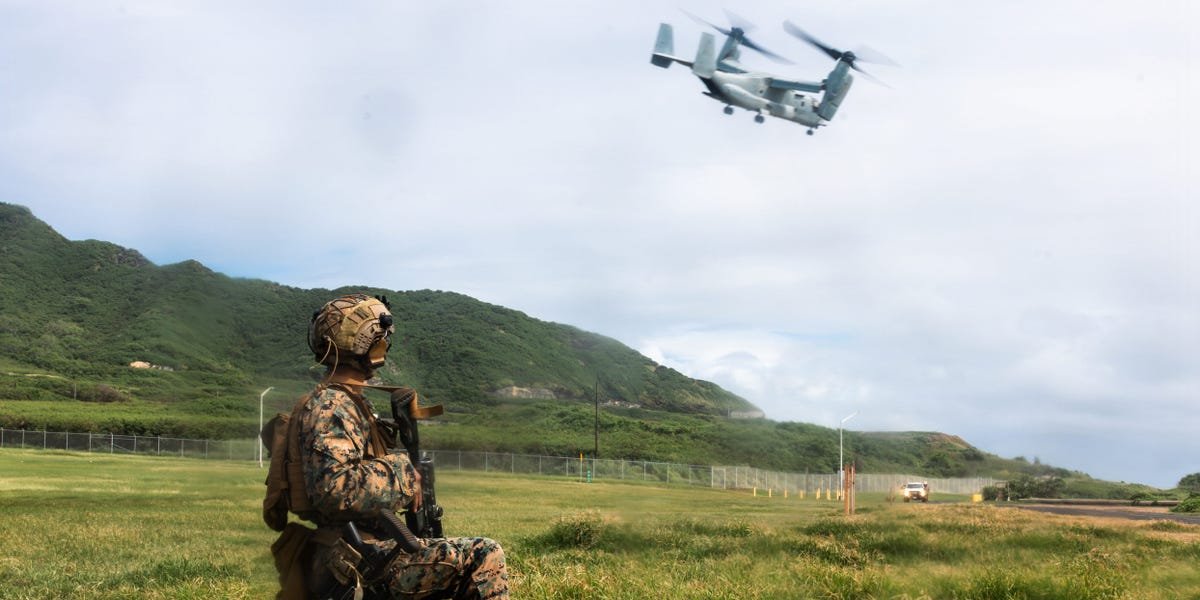
US Marines have been rehearsing how to spread out and relocate their command and control in the vast Indo-Pacific region, while still maintaining the ability to make battlefield decisions quickly.
Modern conflicts have shown that large, centralized command posts are vulnerable to enemy detection and attack. The US and other Western militaries are learning that their command-and-control networks will need to be dispersed, concealed, and capable of being moved quickly to survive.
Earlier this month, Marines with the 3rd Marine Littoral Regiment, 3rd Marine Division, completed a five-day exercise in Hawaii that tested how quickly they could establish and maintain command and control from dispersed positions, according to a Marine Corps release.
During the training, the Marines set up independent command nodes and conducted “aggressive displacement drills” that required them to relocate quickly via ground vehicles and MV-22B Osprey aircraft. These nodes oversaw missions including littoral combat, reconnaissance and counter-reconnaissance, countering air and surface threats, and coordinating with partner forces.
“Between physically moving, managing rapid battle handovers, and coordinating simultaneous activities across our units, this was a great rep at validating our ability to disperse and still maintain the fight,” said Marine Corps Chief Warrant Officer 2 Cameron Carver, the senior watch officer during the exercise.
The Marines and other armed services have been practicing this dispersed force posture in preparation for a potential conflict in the Indo-Pacific.
In such a war, an adversary could leverage sensors and faster kill chains to detect critical command posts and target them with missiles and drones. If these nodes are fixed and overly centralized, these attacks could severely harm commanders’ ability to make battlefield decisions.
US Marine Corps photo by Sgt. Jonathan Beauchamp
The US Army has designed its new Next Generation Command and Control system, or NGC2, with that threat in mind.
In tests, soldiers have experimented with command posts that can be packed into vehicles and moved in 30 minutes or less, while concealing them from detection both in the environment and the electromagnetic spectrum.
Soldiers told Business Insider at an exercise earlier this year that the transition to dispersed command nodes was initially jarring. These nodes were designed to not only maintain connection with one another across distances but also to continue gathering information and making decisions during setup or on the move.
Some command nodes also had built-in redundancy. For example, if one was acquiring targeting data for a certain location and was discovered by an enemy, another node could pick up where it had left off.
During the recent Marine Corps training exercise, when command-and-control nodes had to stop what they were doing and relocate, there was a handoff to other command posts to make sure operations continued without pause, the service said.
Carver said in the Marine Corps release that the recent training exercise “brought our staff out of predictable headquarters settings and required our planners to operate in distributed environments.”
And the shift from fixed operations toward dispersal and mobility for increased survivability is one that extends beyond command and control.
US officials have said in recent years that large air bases are vulnerable targets to drones and missiles, requiring dispersal and concealment. In the Indo-Pacific, US forces have also tested operating aircraft in austere locations, like taking off from rugged fields.
The Air Force regularly conducts this kind of training, while the Marines run through expeditionary basing practices.
While the US military is rehearsing these concepts in training, the war in Ukraine is showing what it looks like for real. Both Ukrainian and NATO officials have said that mobility, redundancy, and survivability in command and control are becoming essential to the fight as Russian forces target high-value command centers.
