
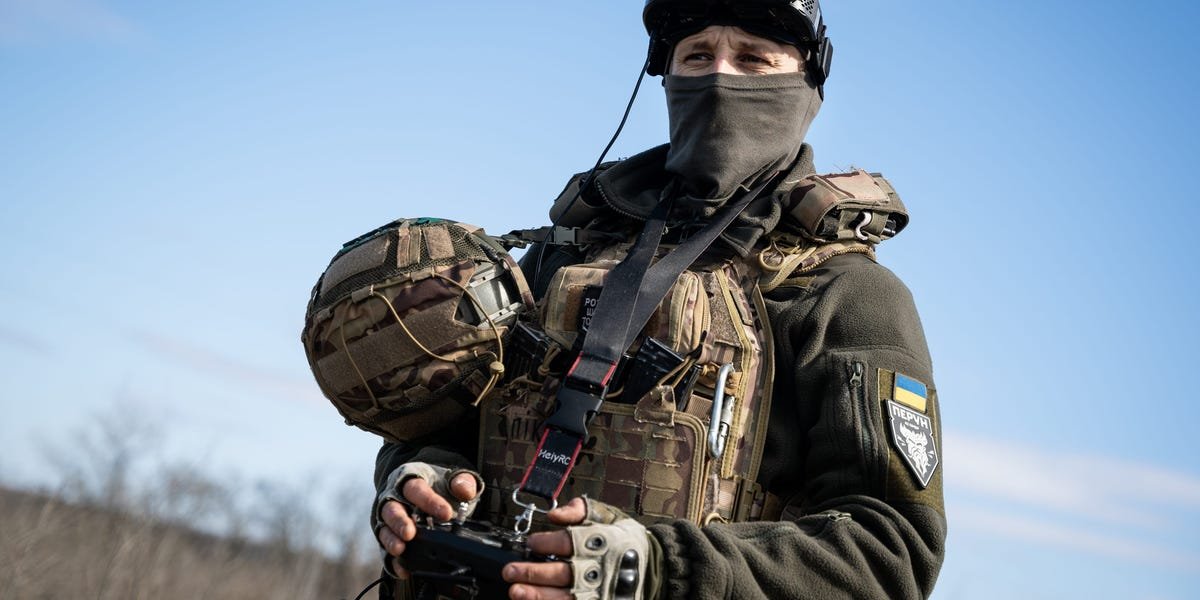
Ukraine’s soldiers want drones and robots that can handle more of the flying and driving themselves, letting one operator oversee multiple systems instead of manually controlling each one.
Ukraine’s rapidly expanding arsenal of aerial drones and ground robots has become central to its fight against Russia’s larger military. Defense technology companies say they’re increasingly automating certain tasks while keeping humans responsible for decisions about using force.
In practice, that means shifting more routine work from the operator to the drone. Newer systems can increasingly navigate, return to base, and help identify targets independently, allowing operators to focus on other tasks, from target confirmation to swarm control.
Mykyta Rozhkov, the chief business development officer at Ukrainian defense technology company Frontline Robotics, told Business Insider that his company’s innovation has come from soldier’ requests.
“Our soldiers are coming to us with a request of: ‘How can you provide us with the capability to have different robots controlled by one person?’ or ‘Can we make a shift of our UAV pilots easier?'”
The company responded to these requests by developing software that lets drones handle more of the flight themselves, including traveling to and from an area of interest with minimal input.
“In the new version of a drone that we produce right now and supply, there is an autonomy layer installed in the drone itself,” Rozhkov explained. “So it can go autonomously to the area of interest, then come back with basically one button.”
A “pilot can bring the system home with a push of a button,” and the drone can figure out the shortest way back, he said.
Frontline Robotics
Autonomy is also being built into the company’s product updates. The latest version of its Linza drone — the 3.0 released this year — has more onboard autonomy, so it can operate when GPS is unavailable because of Russian electronic warfare.
It puts less “mental demand on a soldier so they can do more stuff.” It took eight months to develop, but it offers “a huge upper hand,” Rozhkov said.
Frontline’s Zoom reconnaissance drone also has AI navigation, so it can work when it loses satellite navigational signals.
These changes, likewise, were driven by soldier feedback, the executive said. Unlike many Western defense firms, Ukrainian companies often work directly with soldiers, even talking to them from the front lines over FaceTime and listening to their insights.
The broader shift toward artificial intelligence and autonomy is also a priority for Ukraine’s government. Ukraine’s defense ministry said in August that units were using “more than 70 different systems powered by AI and computer vision technologies to strike enemy targets.”
And it said that the aim is to eventually have 100% of drones on the front line equipped with computer vision and AI capabilities.
Since Russia launched its full-scale invasion in 2022, battlefield technology has moved from one pilot fully manually controlling one drone, to AI helping pilots find targets and providing autopilot capabilities, to now enabling one operator to oversee multiple drones while AI assists with basic tasks, like flying and driving, and helps take over when Russian electronic warfare cuts the connection.
Wojciech Grzedzinski/For The Washington Post via Getty Images
Former defense minister Mykhailo Fedorov predicted last month that “we will reach a stage where autonomous drones will fight autonomous drones.”
A host of Ukrainian companies are pursuing that vision, and some are working toward larger swarms of autonomous weapons that can communicate with one another.
Achi, the CEO of Ukrainian defense firm Ark Robotics, told Business Insider that the evolution toward a single pilot controlling many drones is “kind of a prerequisite to be successful in the total drone warfare that is coming to all of us.”
The defense technology company is developing a system that allows thousands of aerial drones and ground robots, including those not made by Ark Robotics, to work together with minimal human intervention, and enables an operator to be thousands of kilometers away.
Achi said that to have the advantage on the battlefield, “you need these asymmetrical systems that allow you to work with multiple drones at the same time.”
Ukraine’s combat systems need to be able to work amid Russia’s heavy electronic warfare. Ukraine’s Twist Robotics makes hardware and software that allow drones to navigate and track designated targets when Russia disrupts GPS. It does that “by default” because the problem is so common, co-founder Rostyslav Olenchyn told Business Insider.
Most of the company’s products have AI assistance, allowing the drone to “accomplish the mission” even if an operator makes a mistake or loses control.
How much autonomy is in use remains somewhat limited by both technical and ethical constraints. Many companies and experts describe what is often portrayed as autonomy as exaggerated in practice, resembling advanced automation rather than independently acting AI.
Ukraine says it has not removed human oversight.
Its defense ministry said last month that “algorithms are now being entrusted with critical combat tasks, ranging from navigation and object identification to autonomous target engagement. However, the final decision on target selection and engagement is made by a human operator.”
It said it will keep humans in the loop on principle, and while technology helps to identify a target, “the final decision to engage remains with a human, while the system’s level of autonomy is limited based on the potential cost of an error.”
Ukraine is rapidly advancing to match Russia’s volume and allow its human soldiers to stay farther from the fight. Rozhkov described the general trend as “trying to get people outside of the danger zone.”
