
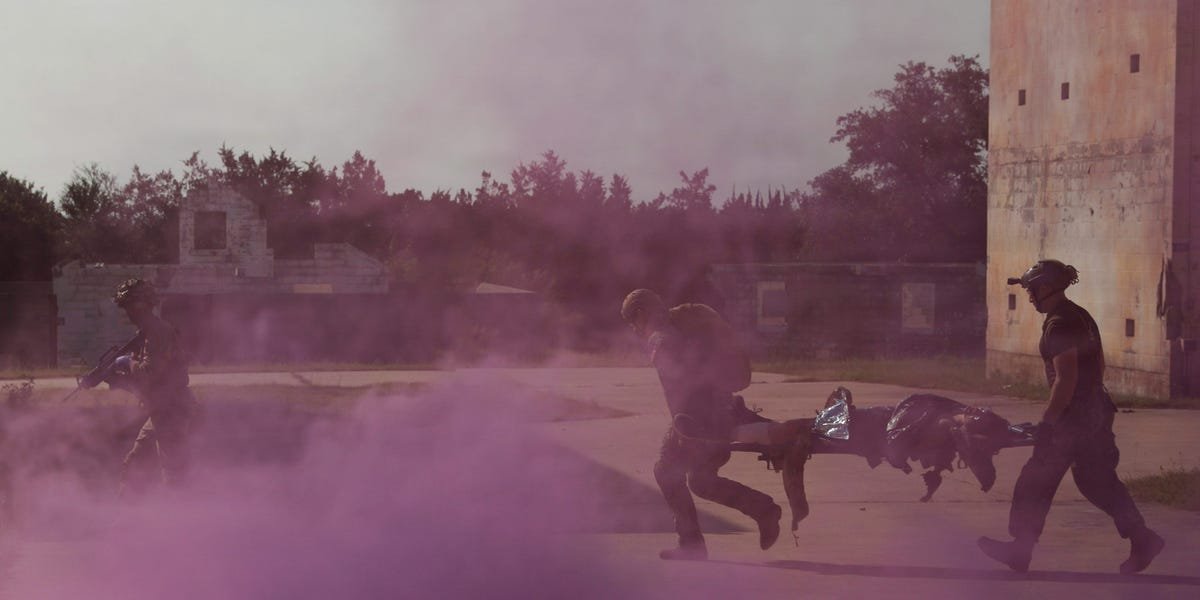
For years, troops relied on handwritten cards and bulky manuals for battlefield medical guidance. Now, Ukrainian and US developers are building and testing AI tools to help when there isn’t a medic nearby and evacuation isn’t an option.
Battlefields increasingly shaped by drones have pushed troops into small, dispersed teams that may be far from medical care when someone is wounded.
“As the tactical environment limits the ability to move, then we have to provide care wherever we are,” said retired military trauma surgeon Travis Polk, who leads the University of Pittsburgh’s Center for Military Medicine Research. His team has developed a tool to address what he called a “tactical mismatch,” where wounded troops may be far from the medical care they desperately need.
Another tool, the Tactical Aid Assistant app known as ALICE, was developed by Ukrainian trauma surgeon Roman Kuziv, the commander of the eastern Medical Forces and Sustainment Group, and is now being tested by medics at facilities near the front.
Kuziv told Business Insider the app uses Google’s Gemini platform to guide a user through a trauma response. A soldier can photograph an injury, answer follow-up questions, and immediately receive relevant tactical combat casualty care protocol.
“Many times under the stress and under the environment of the war, they make the mistakes about how to treat themselves or how to treat their friends,” Kuziv said.
Airman 1st Class Maria Gonzalez Garduno/US Air Force
One potential use for an app like this is helping users reassess tourniquets, the tight bands used to stop severe bleeding. Amid the chaos of combat, it can be hard for troops to remember when a tourniquet was applied and track how long it has been on.
Deciding whether a tourniquet can safely be removed requires more than knowing when it was applied, though, said Stacy Shackelford, an emergency medicine and surgery professor and former director of the military’s Joint Trauma System. Making that call requires judgment about the wound and patient condition that is difficult to teach in basic first-aid training, let alone through an app.
Still, additional knowledge where there might previously have been none has certain advantages, she said. “Even if you focused on just taking off tourniquets in Ukraine, that would make a huge impact on their system,” Shackelford said.
ALICE has separate modes for medics and non-medics, Kuziv said, and has voice prompts to help distressed users follow the appropriate protocol even under intense strain.
The US tool being developed at the University of Pittsburgh is tackling the same problem, but with a key difference. It is designed to work entirely offline.
Trauma specialists and researchers there began developing FieldCare GPT — an experimental chatbot that will eventually receive a more permanent name — after Ukrainian counterparts expressed the need for fast, low-signature medical guidance that would not hallucinate when put to use in a real emergency, said Nam Tran, a clinical chemist and senior technical director for the school’s Computational Pathology and AI Center of Excellence.
Spc. Luciano Alcala/US Army
“They can’t log into the internet to get ChatGPT. They can’t radio for help,” Tran said. “They need a chatbot that is accurate and fast enough to be able to pull knowledge from medical texts” on battlefield injuries.
Cellphones, radios, and other powered electronics produce electromagnetic signatures that enemy forces can potentially detect and use for targeting. The growing sensor threat on the modern battlefield makes low-emission tools increasingly important.
FieldCare GPT runs locally on a high-performance laptop and draws on military medical references, including the 75th Ranger Regiment Medic Handbook, Tactical Combat Casualty Care guidelines, and other combat trauma texts. A user can type or dictate a description of an injury, and the chatbot responds with step-by-step guidance tied back to those source documents, Tran said.
Each project illustrates a difficult technological tradeoff. ALICE is built around photographing a wound with follow-up questions, which could help a stressed user with little medical knowledge reach the right trauma protocol. FieldCare GPT does not currently rely on image identification, prioritizing instead the ability to function in a communications-denied environment.
FieldCare GPT is laptop-based because smaller devices cannot yet support such a sophisticated chatbot without significant performance compromises, Tran said, though Pittsburgh’s team is working toward a version that could eventually use a laptop as a mobile server for smaller devices. Image analysis is particularly demanding, he added, especially when accounting for complications like poor lighting, blood, clothing, dirt, and catastrophic injuries.
When it comes to developing these apps, the stakes for getting the guidance wrong are high. Kuziv and Tran stressed that their respective apps aren’t meant to replace medical personnel or training. Instead, they are intended to help troops care for wounded teammates — or themselves — when medics and evacuation aren’t available. An untrained service member may find themselves controlling catastrophic bleeding, applying a chest seal to a gunshot wound, or having to follow other established battlefield trauma protocols. These are not the sort of procedures an untrained person unless there is no other option.
Staff Sgt. Mikayla Fritz/US Army
Shackelford said she sees these developmental AI tools as “decision assist,” a way to augment memory or help with difficult choices. “I think it’s great. It’s definitely needed,” she said of tools used within a medic’s training and scope of practice.
While she cautioned that outcomes might become more uncertain when tools push inexperienced users beyond their training, she also said they could still be preferable to simply telling a non-medic facing an emergency, “Okay, you’re on your own,” especially if that person has basic first-aid training.
The Ukrainian battlefield has erased guarantees of quick casualty evacuation, Polk said, a dramatic shift from two decades in which US troops fighting post-9/11 wars in the Middle East could often expect rapid evacuation.
The US military is now actively preparing for prolonged casualty care, potentially stretching days or even weeks, during which medics or non-medical troops may need to provide care for far longer before the wounded can be evacuated.
FieldCare GPT has been tested against 200 prompts related to battlefield injuries and shown to military personnel. Researchers are preparing more hands-on testing with service members to see how ordinary users ask questions and where the chatbot fails when they can “run with it and see the wheels come off,” Tran said, acknowledging that there is a difference between prompts from academics and medical experts and those from troops.
ALICE is similarly being tested by Ukrainian medics, who are identifying gaps for developers to address, Kuziv said.
“The technology is there,” Tran said of efforts to field such potentially lifesaving apps. “We just need to make sure we meet the needs of a soldier.”
