
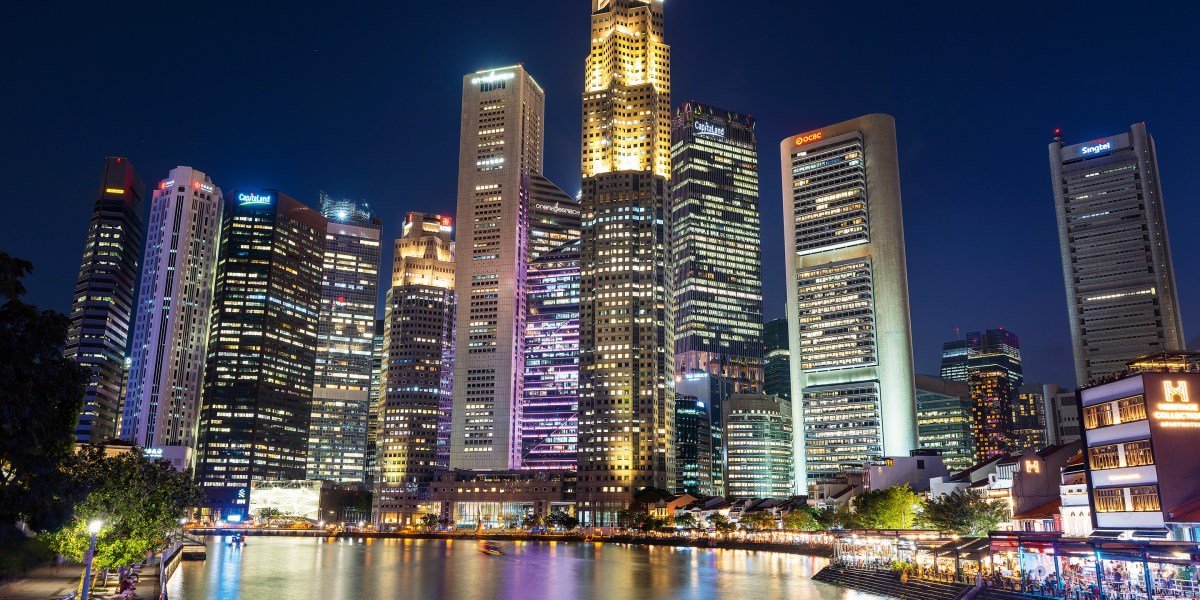
Mere minutes after the Associated Press declared the U.S. presidential election for Donald Trump, Singapore’s prime minister, Lawrence Wong, took to the social media platform X to offer his congratulations.
“I look forward to taking our partnership to even greater heights,” Wong’s official account posted. “We hope to welcome you back to Singapore soon!”
The past few years have been good for Singapore, and things stand to get better. The island nation occupies a key position in the region, maintaining close ties to China and the U.S. even as the two powers decouple their economies amid rising tensions.
Singapore’s recent growth as a financial center has often come at the expense of Hong Kong, its longtime peer and rival that has been pulled closer to Beijing in recent years. And the return of Trump to the White House could tip the scales even further toward Singapore, as the incoming president threatens to tighten the screws on China.
Trump’s election is a “net positive for Singapore, net negative for Hong Kong,” says Devadas Krishnadas, a former Singapore government official and CEO of the Future-Moves Group, a consulting firm. He predicts U.S. funds will shy away from Hong Kong and its close links to China, and instead continue their march to Singapore: “Singapore will be seen as the only safe place in Asia for U.S. and European capital.”
Foreign capital from around the world is rushing into Singapore’s financial institutions, attracted by political stability, a lenient tax regime, and relative neutrality. Assets under management in Singapore rose to $4.1 trillion in 2023, ahead of the $3.9 trillion managed in Hong Kong.
Singapore’s race with Hong Kong to be the preeminent financial center of Asia is led by its Big Three banks: DBS Bank, United Overseas Bank (UOB), and OverseaChinese Banking Corp. (OCBC).
Led by CEO Helen Wong, OCBC—the oldest of the Big Three—perhaps best characterizes the country’s banking sector and best reveals how Singapore navigates this new future.
“OCBC is maybe the most representative of the Singapore banking sector,” says Michael Makdad, senior equity analyst at Morningstar. “DBS is larger in Greater China, but less outside Singapore, whereas UOB has a larger presence outside Singapore but less in Greater China. OCBC has both.”
Chinese capital remains a major part of OCBC’s business. Southeast Asia is China’s largest trading partner, having replaced the EU in 2020. Bilateral trade between China and Southeast Asian countries reached $912 billion in 2023.
“Singapore will be seen as the only safe place in Asia for U.S. and European Capital.”
DEVADAS KRISHNADAS, CEO, Future-Moves Group — Singapore
But China’s investment in Southeast Asia is changing, says Tommy Xie, OCBC’s chief China economist. “Mining used to be the largest sector receiving investment from China around 10 years ago,” Xie says. “But now the share has really diminished. Manufacturing is one of the largest right now.” And much of the money is in Singapore, which Xie says accounts for just over half of the Chinese money flowing into the region.
Singapore has also become a safe haven for Chinese companies navigating an increasingly unfriendly world. The Southeast Asian country is a good launching point for Chinese companies trying to diversify their supply chains throughout the region in a “China Plus One” strategy. And some startups, like fast-fashion platform Shein, have quietly established headquarters in Singapore due, at least in part, to hopes that a non Chinese home base might be more palatable to Western investors.
If Singapore is going to surpass Hong Kong as a financial hub, core to its strategy is wealth management. The government offers tax incentives to single-family offices that set up shop in the city. As of August, there are now 1,650 such offices receiving these tax breaks, up from 400 at the end of 2020.

Ore Huiying—Bloomberg/Getty Images
Wealth management generated $2.9 billion for OCBC in the first nine months of the year. The company has designated “Asian wealth” as one of its four business areas; just over a third of the bank’s income is derived from wealth management. Earlier this year, Wong pledged to invest an additional $192 million in the cities of Hong Kong and Macau, and its private bank unveiled a target to grow Hong Kong assets under management by 50% by the end of 2026.
That could be challenged by the new Trump administration. Both the first Trump administration and the Biden administration imposed sanctions and financial controls on China—first on individual companies, then on entire sectors. Expanded controls under a new Trump White House will force Singapore’s banks to stop working with certain customers and sectors.
OCBC sees the pullback of U.S. banks from Hong Kong as an opportunity to win new customers. During a trip to the Chinese city earlier this year, Wong noted that “more and more of the Hong Kong customers choose to talk to us, instead of talking to their Western counterparts.”
OCBC’s official founding dates to 1932, when three local banks merged amid the Great Depression. The oldest of those predecessor banks dates to 1912, giving OCBC over a century’s worth of history in the Southeast Asian city.
That same bank, Chinese Commercial Bank, opened a bank branch in Xiamen—then known as Amoy—in China’s Fujian province in 1925. That branch survived through the civil war and the Communist takeover, giving OCBC almost a century of uninterrupted operations in China, rare for a foreign bank.
For decades, OCBC was the largest of Singapore’s banks, but it’s since been eclipsed by DBS Bank; today DBS holds around $587 billion in total assets, compared with $448 billion for OCBC.
With $18.4 billion in revenue in 2023, OCBC ranks No. 12 on Fortune’s inaugural Southeast Asia 500 list, which ranks the region’s largest companies by revenue. (DBS, with $25.6 billion in 2023 revenue, sits at No. 10, while UOB is No. 11 with $19.7 billion.)
OCBC also holds a majority stake in Great Eastern, the city’s largest life insurance provider, and offers private banking through the Bank of Singapore, acquired from ING in 2009. In 2014, OCBC also snapped up Wing Hang Bank, a Hong Kong bank, giving it a foothold in both the Chinese city and the Greater Bay Area, a Chinese project to knit together the cities of the Pearl River Delta.
Sixty-two percent of OCBC’s revenue is generated in its home base of Singapore. Much of its non-Singaporean revenue comes from two major sources. Southeast Asian markets, primarily Malaysia and Indonesia, contribute 19% of the bank’s revenue; Greater China, a catch-all term that encapsulates mainland China, Hong Kong, and the island of Taiwan, generates an additional 13%.
Helen Wong took over as OCBC’s CEO in 2021, the first female chief executive in the bank’s history and the first woman to lead a Singaporean bank. She is No. 17 on the Fortune Most Powerful Women list for 2024: the second-highest-ranking executive from Asia, after Luxshare Precision Industry founder Grace Wang. Wong is also on the inaugural Fortune Most Powerful People list, at No. 71.
Yet Wong’s roots lie in Hong Kong. Born there in 1961, she graduated from St. Paul’s College, one of the city’s most prestigious schools, then from the University of Hong Kong.
Wong’s first banking job was with OCBC, as a management trainee, in 1981; she quickly became the bank’s first China desk manager. She eventually moved to HSBC, starting a decades-long career that culminated in becoming the bank’s chief executive for Greater China in 2015.
She returned to OCBC five years later, joining as its deputy president and head of global wholesale banking in 2020. A year later, the board gave her the nod to become the next chief executive, specifically pointing to her China experience.
Hong Kong remains Singapore’s closest competition. The Chinese city has struggled in recent years owing to the aftereffects of its tough COVID-zero policy, concerns over Beijing’s encroaching jurisdiction, and a sluggish Chinese economy.
But Hong Kong officials now think they’ve turned a corner and are offering new incentives to attract the world’s wealthy, with a goal of luring 200 more family offices by the end of 2025. UBS predicts Hong Kong could overtake Switzerland as the world’s largest hub for cross-border finance as early as 2026.
Hong Kong’s IPO pipeline, while far from the highs of just a few years ago, is also showing signs of a revival as Chinese companies like appliance manufacturer Midea launch bumper listings in the city.
Singapore’s capital markets, by comparison, are “a complete joke,” says Devadas, the consultant. Singapore “is not even in the same ballpark as Hong Kong,” even after the latter’s stock market took a beating in the wake of the pandemic. In the first three quarters of the year, Singapore drew just one IPO; Hong Kong drew 45. Singapore’s government has now set up an official task force to tackle the problem.
Hong Kong’s recovering stock market helped the city overtake Singapore as Asia’s leading financial center on a ranking from the China Development Institute, a China-based think tank.
Yet Singapore’s government is “unconcerned” about potential competition from Hong Kong, Devadas says. “They don’t see it as a zero-sum game.”
“What’s good for Hong Kong is good for Singapore,” Devadas says, noting that the things that support a healthy Hong Kong economy—like a healthy Chinese economy—benefit Singapore, too.
“But the reverse isn’t necessarily true,” he says. Singapore can tap into other regions much more easily than Hong Kong can, without the baggage of being tied to China.
OCBC, for its part, isn’t picking between the two. “They are both resilient, international financial centers attractive to international investors and businesses,” Wong writes to Fortune. Hong Kong is key to the bank’s China plans; Singapore to its ASEAN expansion.
Still, geopolitics could make life trickier for Singapore, even if Washington doesn’t pressure the Southeast Asia country directly. Trump’s promise to impose broad tariffs on all imports entering the U.S. could upend the global trading system, hitting a trade-focused economy like Singapore’s.
But Trump’s election also brings opportunities. Greater pressure on China will encourage more Chinese companies to invest in Southeast Asia—and provide even more opportunities for Singapore’s banks, like OCBC, to benefit from those flows. “With more Chinese manufacturing coming [to the region], it must benefit a bank like us,” Wong told analysts during OCBC’s earnings call on Nov. 8, when the bank unveiled record net profits for the year thus far.
“Everyone comes to Singapore first to start a company,” she said.
This article appears in the December 2024/January 2025: Asia issue of Fortune with the headline “Shifting fortunes.”
