
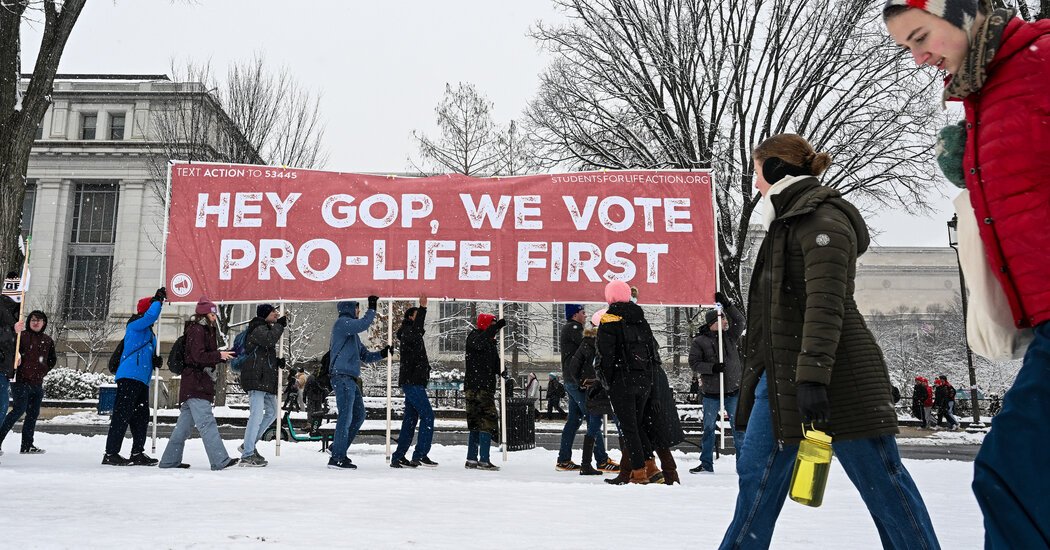
Allies of former President Donald J. Trump and officials who served in his administration are planning ways to restrict abortion rights if he returns to power that would go far beyond proposals for a national ban or the laws enacted in conservative states across the country.
Behind the scenes, specific anti-abortion plans being proposed by Mr. Trump’s allies are sweeping and legally sophisticated. Some of their proposals would rely on enforcing the Comstock Act, a long-dormant law from 1873, to criminalize the shipping of any materials used in an abortion — including abortion pills, which account for the majority of abortions in America.
“We don’t need a federal ban when we have Comstock on the books,” said Jonathan F. Mitchell, the legal force behind a 2021 Texas law that found a way to effectively ban abortion in the state before Roe v. Wade was overturned. “There’s a smorgasbord of options.”
Mr. Mitchell, who represented Mr. Trump in arguments before the Supreme Court over whether the former president could appear on the ballot in Colorado, indicated that anti-abortion strategists had purposefully been quiet about their more advanced plans, given the political liability the issue has become for Republicans.
“I hope he doesn’t know about the existence of Comstock, because I just don’t want him to shoot off his mouth,” Mr. Mitchell said of Mr. Trump. “I think the pro-life groups should keep their mouths shut as much as possible until the election.”
The New York Times reported on Friday that Mr. Trump had told advisers and allies that he liked the idea of a 16-week national abortion ban but that he wanted to wait until the Republican primary contest was over to publicly discuss his views.
It’s unclear whether Mr. Trump will pursue turning that idea into a more concrete proposal. He has not publicly embraced a national ban, which would be unlikely to win sufficient support in Congress. Such legislation would also affect only a small fraction of abortions, given that nearly 94 percent happen in the first trimester, before 13 weeks of pregnancy, and would present obstacles for women who experience severe complications later in pregnancy.
Since Roe v. Wade was overturned in the Dobbs decision in 2022, many leading anti-abortion groups have pushed Mr. Trump to endorse a national abortion ban at 15 weeks of pregnancy, which they are casting as a politically moderate position. Some anti-abortion activists, who have been among Mr. Trump’s strongest supporters, privately say that although they would support a federal abortion ban, they see little chance that such legislation would become law in the next few years. They are examining other options.
In policy documents, private conversations and interviews, the plans described by former Trump administration officials, allies and supporters propose circumventing Congress and leveraging the regulatory powers of federal institutions, including the Department of Health and Human Services, the Food and Drug Administration, the Department of Justice and the National Institutes of Health.
The effect would be to create a second Trump administration that would attack abortion rights and abortion access from a variety of angles and could be stopped only by courts that the first Trump administration had already stacked with conservative judges.
“He had the most pro-life administration in history and adopted the most pro-life policies of any administration in history,” said Roger Severino, a leader of anti-abortion efforts in Health and Human Services during the Trump administration. “That track record is the best evidence, I think, you could have of what a second term might look like if Trump wins.”
Policies under consideration include banning the use of fetal stem cells in medical research for diseases like cancer, rescinding approval of abortion pills at the F.D.A. and stopping hundreds of millions in federal funding for Planned Parenthood. Such an action against Planned Parenthood would cripple the nation’s largest provider of women’s health care, which is already struggling to provide abortions in the post-Roe era.
The organizations and advocates crafting these proposals are not simply outside groups expressing wish lists of what they hope Mr. Trump would do in a second administration. They are people who have spent much of their professional careers fighting abortion rights, including some who were in powerful positions during Mr. Trump’s administration.
In his first term, Mr. Trump largely outsourced abortion policy to socially conservative lawyers and aides. Since he left office, some of those people have remained in Mr. Trump’s orbit, defending him in court, suggesting policy plans well beyond issues like abortion and attending events at Mar-a-Lago, his private club and residence in Florida.
Frank Pavone, an anti-abortion activist whom Pope Francis removed from the priesthood for “blasphemous communication,” said he had discussed abortion policy at several poolside receptions at Mar-a-Lago.
“When I’m there at Mar-a-Lago,” he said, “I get strong affirmation from everyone I meet there for my work.”
Mr. Trump has not publicly addressed the extensive list of possible anti-abortion executive actions or the enforcement of the Comstock Act. Yet, Mr. Trump’s official blessing may not matter if his former aides and their networks are returned to key positions in the federal bureaucracy.
“The question will then become what can be done unilaterally at the executive branch level, and the answer is quite a bit,” Mr. Mitchell said. “But to the extent to which that’s done will depend on whether the president wants to take the political heat and whether the attorney general or the secretary of Health and Human Services are on board.”
Abortion opponents are enmeshed throughout the ecosystem of organizations that are suggesting policies for the next conservative administration. Russell T. Vought, a former senior Trump administration official who ran the Office of Management and Budget, is celebrated by the anti-abortion movement for successfully blocking funds for Planned Parenthood during the Trump administration. He now runs a think tank with close ties to the former president that has backed arguments in a Supreme Court case attempting to undo the 2000 approval of mifepristone, a widely used abortion medication.
Some activists and former aides have tried to downplay their plans. Speaking at a church in Gallup, N.M., last spring, anti-abortion activists rallied the crowd to support a local ordinance that would require compliance with the Comstock Act but referred to the law solely by its statute number, 18 U.S.C. 1461 and 1462.
In a plan released by a coalition that has been drawing up America First-style policy plans, nicknamed Project 2025, the Comstock Act is also referred to only by the statute number.
“Following the Supreme Court’s decision in Dobbs, there is now no federal prohibition on the enforcement of this statute,” the plan states. “The Department of Justice in the next conservative Administration should therefore announce its intent to enforce federal law against providers and distributors of such pills.”
The plan also cites the statute number in a footnote justifying its recommendation that the F.D.A. stop “promoting or approving mail-order abortions in violation of longstanding federal laws that prohibit the mailing and interstate carriage of abortion drugs.”
Students for Life, an anti-abortion group, is not actively pushing Mr. Trump for a gestational ban, at any number of weeks. The group is instead focused on executive actions and changing policies though federal agencies, which they view as both more effective and more politically achievable. “This is probably the first election where D.O.J., H.H.S., F.D.A. are big-ticket items,” said Kristi Hamrick, a strategist for the group.
When a donor in Ohio recently expressed concern that Mr. Trump personally did not care about ending abortion, Kristan Hawkins, the president of Students for Life, offered reassurance. “We haven’t come across a campaign staffer yet who doesn’t share our values,” she said of Mr. Trump’s campaign.
Some allies think a second Trump administration could move even faster than before to advance anti-abortion measures because Roe is no longer a roadblock.
As president, Mr. Trump in 2019 announced a 440-page rule that strengthened “conscience protections” for health care workers who opposed abortion on religious grounds. The measure allowed medical providers to refuse care if it conflicted with their personal beliefs, and it took over a year to put in place. But at the time, Mr. Severino said, H.H.S. had to consider comments against the rule noting that abortion was a constitutional right under Roe.
“Those arguments are now gone,” Mr. Severino said. “You cannot say that it is a federal constitutional right to abortion, so that would simplify the rule-making process significantly.”
Similarly, limits to fetal tissue research could also come much more quickly. “It took longer than necessary to get a resolution on that,” he said. “The vetting and the testing and the argumentation has been done already once before.”
Polling indicates that plans banning or severely restricting abortion would most likely be deeply unpopular. Since Roe fell, support for legalized abortion has gained support. Only about 8 percent of American adults oppose abortion with no exceptions.
Biden administration officials say they have reached the limits of their powers to restore federal abortion rights. They have pushed Congress to pass legislation that would restore federal abortion rights, but the legislation has repeatedly failed to garner enough support in the Senate.
For more than a decade, Republicans have been trying to enact a federal ban on abortions after 20 weeks. That legislation, too, has failed to gain enough traction to pass.
“Congress isn’t going to pass a ban, but the Comstock Act is already on the books,” said Mary Ziegler, a law professor and a historian of abortion at the University of California, Davis. “As interpreted in this way, it doesn’t have any exceptions — it applies at conception. It’s any abortion, full stop.”
Ms. Ziegler said such an action would certainly face litigation from liberal groups and abortion providers that could end up before the country’s highest court.
Even the advocates are uncertain how far the courts and the public will allow them to go. Some groups have argued for immediate enforcement of Comstock. Others are more cautious about how to enforce it in a politically palatable way. Mr. Mitchell said he believed the enforcement of Comstock would have to ensure provisions to protect the life of a pregnant woman and to address how to care for miscarriages.
The Comstock Act made it a federal crime to send or deliver “obscene, lewd or lascivious” material through the mail or by other carriers, specifically including items used for abortion or birth control. The 1973 ruling in Roe, which recognized a federal right to an abortion, largely relegated the law to constitutional history.
Beyond reactivating the Comstock Act, conservatives believe they can roll back much of what the Biden administration has done to try to protect abortion rights. One example is a plan to eliminate guidance from the Biden administration requiring federally funded hospitals to perform lifesaving abortions, even in the 16 states with near-total bans. They also float ideas about how the Justice Department could direct U.S. attorneys not to prosecute people who violate laws prohibiting the obstruction of clinic entrances.
Republican gains in the courts could help lock in their goals. Many executive actions are undone or redone when a new administration takes power. But former officials, including Mr. Severino, are hopeful that the Supreme Court will rule soon to eliminate the Chevron deference, which he said could allow regulations they enact to remain in place even if a Democratic president were elected in the future.
Abortion rights leaders have little doubt that a second Trump administration would go as far as possible to limit abortion rights and access. While their organizations are publicly hammering Republicans for embracing national bans, they quietly worry more about the damage Mr. Trump could materially do to their cause through executive actions.
“He’s trying to masquerade in public as a moderate,” said Mini Timmaraju, president of Reproductive Freedom for All, formerly NARAL Pro-Choice America. “It’s mind-blowing that anyone would imagine he wouldn’t do worse in a second term.”
She added, “He’s going to do whatever Jonathan Mitchell wants.”
