
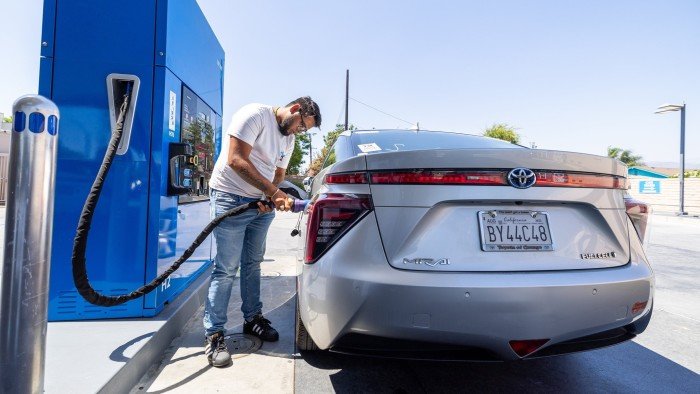
In 2014, Toyota’s then-president Akio Toyoda said he had “seen the future” and that the release of the Mirai, the company’s flagship hydrogen vehicle, would mark a “turning point” for the automotive industry.
After selling just 27,500 hydrogen cars over the following decade, the world’s biggest carmaker is no longer so certain. “I can’t say for sure that it’s a bright future for hydrogen,” Hiroki Nakajima, chief technology officer at Toyota, told reporters at the Fuji Speedway racetrack in Japan in November.
But even as most other major carmakers have gone full in on EVs, Toyota believes that ultimately hydrogen will still carve out a significant role in decarbonising transport.
“If we give up on this technology, then we risk giving up on the future,” said Nakajima.
As part of a pivot to hydrogen-powered trucks, buses and vans, Toyota unveiled a prototype hydrogen-electric hybrid van in November, which it says is the first of its kind and will be tested in Australia.
Toyota is also working with Isuzu Motors to mass produce a light-duty hydrogen fuel cell truck later this decade and has secured deals to supply hydrogen buses in Tokyo, Strasbourg and Madrid.
“On all levels, hydrogen has been a failure for passenger cars,” said James Hong, head of Asia energy transition and commodities at Macquarie Capital. “Where we still haven’t got an answer yet is on commercial vehicle or stationary energy storage demand.”

Hydrogen fuel cells generate electricity through chemical reactions between hydrogen and oxygen, leaving nothing but water vapour coming out of the tailpipe. As well as generating zero carbon emissions, hydrogen-powered vehicles are quicker to refuel than EVs and, for heavy vehicles, have a longer driving range.
Despite government support in countries around the world, the hydrogen ecosystem remains small, with few large projects to produce the fuel reaching construction.
As a result, hydrogen fuel cells are not mass-produced and costs have stayed high. A hydrogen version of Toyota’s upmarket Crown car model costs ¥1mn ($6,500) more than one equipped with a new hybrid system.
Meanwhile, prices of EVs have been driven down by fierce competition in China and breakthroughs in battery technology. “When you now have a technology that already works, is super cheap, and is good enough — lithium-ion batteries — you have to question the necessity for investing in a whole new supply chain,” said Sam Adham, analyst at the CRU Group consultancy.
Toyota is trying to encourage hydrogen adoption through its truckmaking subsidiary Hino Motors. In 2023, Hino and rival Mitsubishi Fuso Truck and Bus Corporation said they were merging to “seek economies of scale” and focus on hydrogen. However, the deal has been delayed, with the companies citing regulatory approvals needed and a certification scandal.
The company has teamed up with other rivals to share development costs, mirroring broader alliances being struck across the industry to fight back against Chinese competition. It has formed or is discussing pacts with South Korea’s Hyundai and Germany’s BMW, both of which have made significant investments in hydrogen-powered cars.

“A few years ago, people were more positive about hydrogen for trucks and buses,” said Anne-Sophie Corbeau, a hydrogen expert at the Centre of Global Energy Policy.
“It will be a question of cost and the availability of trucks and buses. The jury is still out, but every year, the electric solution is gaining an advantage.”
Lee Ho-geun, professor of future vehicles at Daeduk University, said that Hyundai made a loss of Won30mn ($22,000) on every unit of its flagship hydrogen Nexo SUV, despite receiving Won36mn in government subsidies on each vehicle.
However, it still made sense for the companies to pursue hydrogen vehicle development in the long term because of the proprietary technologies it had already developed, he said.
“Margins on EV sales will always be limited by the need to buy or license battery technology from other companies, whereas with hydrogen vehicles they don’t have to pay any royalties,” said Lee.
A lack of fuelling infrastructure in Japan and abroad remains an issue. Oil major Shell announced last February that it would shut all of its hydrogen refuelling stations in California, the state where fuel cells are most popular in the US. In response, Mirai owners filed a class-action lawsuit against the company in July for misleading them on the availability of hydrogen fuel.

The failure of hydrogen-powered cars to go mainstream has not only been a setback for Toyota and Hyundai after pouring billions of dollars into the technology, but also for Japan and Korea, which have pinned their decarbonisation strategy on the fuel.
Toyota has said it needs to roll out its hydrogen products in co-ordination with government initiatives to roll out infrastructure for the alternative fuel. “This is not a chicken and egg problem. It’s more like the relationship between honey and a bee,” said Nakajima, explaining that vehicles and infrastructure needed to be delivered simultaneously.
Despite the setbacks, Toyota insiders said they had not given up on hydrogen for passenger cars, with Toyoda discussing a partnership last October with his counterpart at traditional rival Hyundai to advance fuel cell vehicles.
They drew parallels to the decade of patience needed before hybrid sales took off and validated their bet on the Prius, which was first sold in 1997.
“This is what Toyota does,” said Hong. “It’s big enough to sustain multiple bets, even those that have a low chance of paying off.”
