
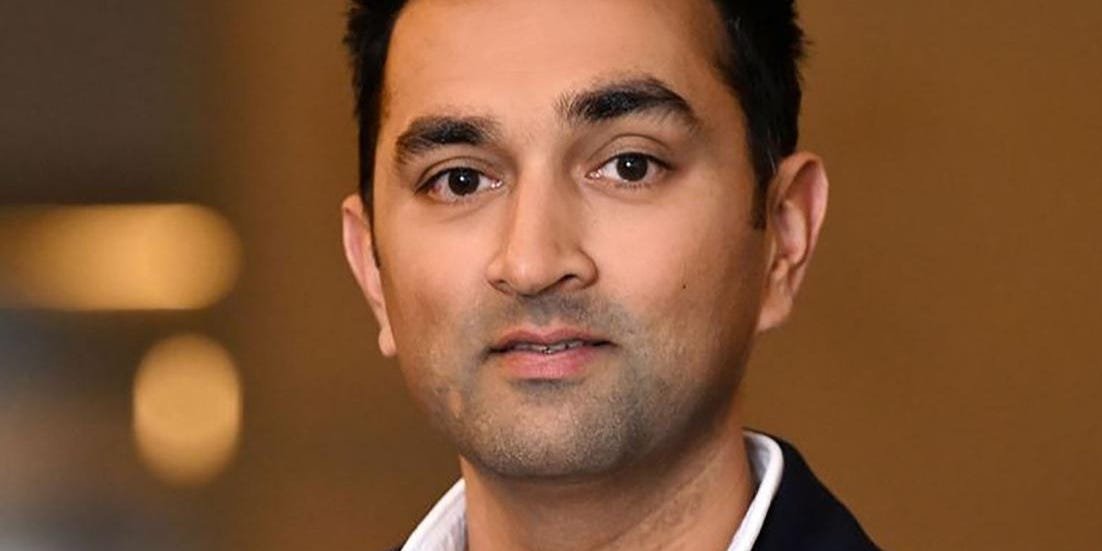
Not many people can say they’ve made partner at Goldman Sachs. Even fewer can say they did it at the age of 31.
Kunal Shah can say both.
Shah joined Goldman Sachs as an analyst in the firm’s trading business in 2004 and rose to partner in about a decade. Last January, he was promoted to two new roles: co-CEO of Goldman Sachs International and global co-head of fixed income, currencies, and commodities. Based in London, he also holds a seat on the bank’s overarching management committee.
As part of a new series of Q&As we’re kicking off with some of Goldman Sachs’ top executives, Business Insider had the chance to sit down with Shah to discuss Europe’s tech sector, Goldman’s presence in the Middle East, and what the financial industry’s embrace of AI means for newcomers’ careers.
Here’s our conversation with Shah, edited for length and clarity.
What do you recall from those early years, and how did senior bankers mentor you during your ascent?
After graduation, what struck me when I hit the trading floor as a full-time analyst was that I had access to the then-partners, even when I was just a new kid on the trading desk. When I became a partner, I found the interconnectedness — your ability to make a call to any partner anywhere in the world, offering a clear baseline of trust — amazing.
I would call out Ashok Varadhan, who I have worked with since day one, and who is now the firm’s co-head of global banking and markets. I first met him when he agreed to meet for a coffee when I was a fresh analyst and visited New York for my training in 2004. He was already a partner, but he took the time to connect, and we stayed in touch when I hit the trading floor in London. He would listen to my views and he welcomed debates around risks or initiatives.
From him, I learned to have a laser focus on risk management, but also a willingness to take and scale risk where there is opportunity in the business.
As new analysts hit the desk this summer, how do you see AI affecting the long-term outlook for bankers and traders?
Junior talent are inherently tech-savvy, and they don’t have the legacy of why we do things in a certain way. They can see how to disrupt us.
Even when I was an intern, people were telling me, “Don’t rotate into fixed income trading desks — it’s all going to get automated.” A lot of the administrative tasks that junior people used to do were no longer needed because we were able to leverage technology and tools to achieve scale.
For me, AI is just another natural extension of that. More of the mundane work — whether that’s making presentations, building Excel models, or booking trades — doesn’t need to be done in the same way.
The bottom-up experimentation I see across the whole organization is powered by the tools we’ve released. Once you equip your people with these tools, they can experiment and find things that could be game-changing.
If young people come in with the mindset of actually helping us to disrupt things, and to embrace the change, I think the experience they can have in this industry can be phenomenal.
You’re at the helm of Goldman Sachs International as co-CEO of GSI and global co-head of FICC. What’s the most interesting facet of being in those seats right now?
The common thread across both roles — and the thing I love most about them — is that no day is the same.
Working in FICC means you’re right at the intersection of politics, macroeconomics, geopolitics, and how each of these interact at the micro level with different sectors and markets. Part of the job is balancing long-term strategic views with the constant flow of markets. Even now, if you look at this moment in time, there is uncertainty around commodity markets and you need to watch how that feeds into the monetary policy decisions of central banks, asset allocation shifts and more. There is almost consistency in the uncertainty, and that is inherently exciting to work amidst.
As co-CEO of Goldman Sachs International, I have been exposed to a much broader range of clients across the firm. Across the region, we’ve got around 29 offices — which means we have people, we have clients, and we have interactions with key policymakers, regulators, finance officials, and central bankers.
The US appears to be leading in AI investment and infrastructure. What’s your outlook for the EMEA tech landscape, and how is that changing?
Over the last decade, the number of unicorns in the broader European context has tripled. The tech space in EMEA is much broader than people realize.
In terms of capital markets being US-centric — there is definitely an element there when you’re talking about the hyperscalers, and this huge amount of AI-related debt issuance we’re seeing. Many of those large tech platforms are quite US-centric. But I wouldn’t say exclusively.
You can remember companies like DeepMind and others very much coming out of the tech ecosystem in Europe.
We are witnessing what is arguably the largest investment cycle in history, with our research teams estimating that hyperscaler capex could reach between $700 billion and $725 billion in 2026 alone.
While the US and China lead the LLM race, we also see a distinct competitive edge for the EMEA region at the AI application layer. European entrepreneurs are taking core models and building specialized, high-value software to solve industry-specific problems in robotics, autonomous drones, and smart factories.
As the conflict in Iran continues, how do you view the potential impacts of the Middle East conflict for Goldman’s international businesses?
We have five offices in the region — in Abu Dhabi, Dubai, Doha, Riyadh, and Kuwait — and over 100 people. In the past 12 months alone, we announced our office opening in Kuwait, a new office in Riyadh, and the onshoring of our private wealth business there. We are active across advisory, financing, markets and as an asset manager and investor.
The countries in the Gulf Cooperation Council have managed the situation very well so far, both from maintaining a safe environment but also ensuring that the countries continue to operate with a good sense of as much normality as possible given the situation.
Once we move beyond the current conflict, the renewed focus on infrastructure and resilience will bring other opportunities for us to help our clients, and our presence there enables our ability to do so.
