
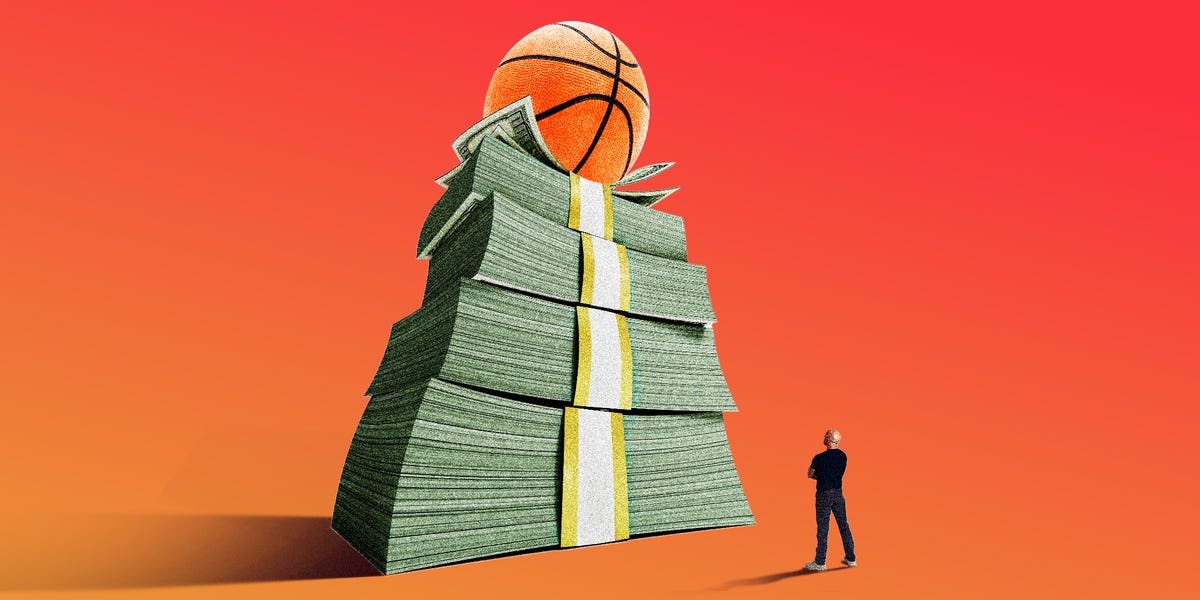
This is the way sports are supposed to feel — exhilarating, nerve-racking, occasionally heartbreaking. The World Cup is here. The NBA playoffs have been thrilling. Baseball season is in full swing. The stakes feel extremely high, but in reality, it’s all rather inconsequential. Most fans know that, deep down, but acknowledging it is no fun. Sports are one of the few mass cultural events we have left — a giant, multi-billion-dollar business in which people have invested not just their money, but their hearts.
The issue there is the business of it all — sports are a capitalist endeavor, which is easy to forget, given the emotions involved. As much as it’s an amazing time to be a sports fan, it’s also a miserable time to be a sports fan. Following your favorite teams requires a maze of streaming subscriptions. Tickets for major events are prohibitively expensive, and stadiums are shifting their focus to luxury customers. Sporting organizations insist these moves are good and necessary to sustain the business, but in their relentless pursuit of growth, they’re forgetting what made sports so valuable in the first place: the masses.
It’s not just bad for fans, this outsize commercial zeal could end up being bad for leagues: There’s a limit to just how hard they can squeeze people. Probably.
Sports fandom in the US is an increasingly complicated, expensive endeavor.
“As fans, we love sports, and that can be monetized, and that can be exploited in all kinds of ways to ever greater costs,” says Michael Serazio, a communications professor at Boston College and the author of “The Power of Sports: Media and Spectacle in American Culture.”
Technology and the proliferation of various streaming platforms mean people can view more live sports than ever, but it’s also made the process of switching on a game a nuisance. To watch the NFL, fans need a dizzying combination of broadcast television, cable, Peacock, Netflix, Amazon, Paramount+, and/or YouTube TV. Add it all up, and you could shell out hundreds of dollars to keep up with your team. The league says that 87% of its games are available for free on a broadcast network. Some critics say that’s a dubious claim, and even if taken at face value, the un-free 13% is a pretty decent chunk. And trying to teach your elderly father how to set up Netflix to watch the Detroit Lions is not how many people want to spend their Christmas.
If you get the city to pay for it, then the sky’s the limit.
Then there’s the in-person experience. Take the eye-popping FIFA World Cup ticket prices, which have caused major backlash. According to data from SeatPick, which aggregates tickets across secondary markets, prices have come down as the event has grown closer, but the average ticket for games was still well above $2,000 in major hubs like New Jersey, Miami, and Mexico City as the tournament was set to begin.
The shakedown isn’t limited to once-every-four-years events like the World Cup: the nosebleeds at Madison Square Garden for the NBA Finals cost thousands of dollars. Yes, some of this is regular old supply and demand — a team in the richest city in the US making the finals for the first time in over 25 years is bound to have some ticket inflation. But it’s frustrating for ordinary fans to be effectively locked out.
The sticker shock is only set to get worse. Across leagues, teams are redesigning their stadiums to prioritize luxury suites, premium clubs, and high-end hospitality experiences that cater to wealthy fans and corporate customers. Because in the US stadiums are funded in significant part by public tax dollars, facilities are increasingly elaborate compared with European venues, where teams usually pay for the whole thing themselves and are therefore more budget-conscious.
“If you get the city to pay for it, then the sky’s the limit,” says Andrew Zimbalist, a professor emeritus of economics at Smith College and the author of multiple books on business and sports. “Ticket prices go up because the stadium changes, it becomes more of a luxury venue than a normal venue.”
From the leagues’ standpoint, the model is generally working out. After all, when you get 30-plus owners into a room together, all with different interests and priorities, there’s one thing they can agree on: making more money.
“There’s a certain myopia,” Zimbalist says.
John Ourand, a sports correspondent at Puck, tells me that team owners and sports executives have long been wary about pushing fans too far and ultimately shooting themselves in the foot, but thus far, they don’t see any evidence that it’s having an effect on fandom. TV ratings are largely up, attendance is fine, and those pricey World Cup seats will ultimately be filled.
“They think that ticket prices for games generally have been too low historically,” Ourand says. The leagues are looking at prices for other events, such as concerts, and they’re also taking cues from resellers — if a scalper can flip a ticket on the secondary market for triple the price, why not set the number there in the first place?
As for broadcasting, deals with a slew of media companies are win-win for both sides. For traditional networks, the games represent a lifeline for an otherwise dying business. For streamers, it’s a way to get users in the door — once your dad gets a Netflix account to watch a football game, maybe he discovers other content on the platform or just forgets to cancel. Victor Matheson, a sports economist at Holy Cross, tells me the NFL revolutionized the model of marketing media rights when it made a deal with then-newcomer Fox to broadcast games in the 1990s, wresting some games away from the then “Big Three” — CBS, ABC, and NBC. For the network, football was essentially a loss leader.
“They basically said, ‘We’re willing to way overpay for the NFL, and we’re never going to get this back by selling advertising during NFL games, but we’ll get it back because all of these stations are going to add Fox,'” he says. Fox then got people hooked on “The Simpsons” and “The X-Files” and sold ads there. The blueprint continues to this day.
Ourand adds that having all of these media deals means each network and platform has a vested interest in pushing the leagues, which may offset the impact of alienating some fans by scattering the rights.
“Instead of actually cutting people out, you have Warner Brothers Discovery that’s marketing the NHL, you have Disney that’s marketing the NHL,” he says. “They want to get these big media companies to market the games, which paradoxically will draw in more casual fans because they’ll be able to see it a little bit more often.”
Sports leagues have for decades benefited from a simple arrangement: make a widely available product, cultivate generations of fans, and reap the rewards over their lifetimes. Now, they’re looking for a quicker cash-in. Fandom isn’t going to collapse all at once, but by wringing every dollar out of fans, leagues risk slowly chipping away at their bases, sacrificing long-term health. Pricing out current fans risks losing future generations of fans, and the casual-interest-to-die-hard fan pipeline drying up.
Take boxing as a cautionary tale. A century ago, it was one of the great three American sports, along with horse racing and baseball. Into the 1970s, Muhammad Ali was arguably the most famous athlete in the world. Then, boxing matches started moving to a pay-per-view model, meaning people had to pay extra to watch, and it turns out many weren’t willing to pony up.
“All of a sudden, there were no fans of boxing anymore, and no one would claim that boxing is one of the big sports,” Matheson says.
A league like the NFL may seem too big to fail now — it’s saturated the US market so much that it’s looking internationally for growth. But that status may not be permanent. Some casual fans may grow tired of the rigamarole of tuning in, or get so frustrated by high ticket prices that they stop attending games live. Just look at what’s required for a single team, such as the Green Bay Packers: One analysis found catching all of the coming season’s games will require seven streaming platforms and $500, and regular-season tickets run hundreds of dollars. Packers fans are dedicated, but that’s a lot. What’s more, participation in youth and high school tackle football has fallen over the last couple of decades. Kids don’t grow into fans of sports they don’t watch or participate in.
Sports are the last remaining monoculture, and relatively easy access is essential to that. With increasing fragmentation and monetization, that gravity will eventually dissipate, maybe not next quarter, but perhaps next decade.
There’s a fundamental con when it comes to sports fandom, which is that you love your team tremendously and your team couldn’t care less about you.
To be sure, people have been fretting over a sports bubble for years — Stefan Szymanski, a professor of sport management at the University of Michigan, remembers being asked about it in the early ’90s. “What I’ve always said is, ‘There’s no bubble here, this is immensely popular, people love this stuff, and in some ways, it’s historically been underpriced, and what businesses are doing to it are really extracting as much of the value as they can from our love of sports,'” he says. In spite of the long history of doomerism, this moment might be different, he concedes, and the leagues could finally be crossing the line or at least getting close to it.
Bets that Disney and Amazon might reach more casual fans who use those platforms may also mean a diminishing depth of engagement for any given fan, he says. The same goes for social media and the internet — people can easily catch clips and highlights, but are Gen Z and Gen Alpha really sitting down to watch full two-hour games? Or is it on in the background as they scroll on their phones alone on the couch? Yes, sports gambling and fantasy sports may have bettors tuning in to games they’d normally skip, but they also change the nature of their interest in the event. They don’t really care if their team wins — they care who makes the next free throw.
This might be a moment of awakening for fans. For many leagues and owners, you’re extras on TV to fill in stadiums and a customer to be sold to advertisers. The NCAA may argue that expanding March Madness from 68 to 76 teams is about giving more fans the opportunity to enjoy the tournament or about discovering a better champion. While that may be true, in part, it’s also pretty clearly about creating more inventory — more games, more airtime, more advertising opportunities.
“There’s a fundamental con when it comes to sports fandom, which is that you love your team tremendously and your team couldn’t care less about you,” Serazio says.
This is what growth mentality and a profit focus demand. It’s why professional leagues from the NHL to the WNBA have embraced sports betting, why FIFA tried its hand at banning fans from bringing water bottles, why New York axed watch parties outside MSG so the president could attend an NBA finals game. It’s why US Open tennis aficionados — not generally a destitute crowd — have been astonished at the price tag for entry this year.
Matheson tells me what we’re seeing is the “enshittification” of sports, a phenomenon first coined by Canadian writer Cory Doctorow, in which companies entice people with high-quality offers and then make the product worse over time in the name of short-term financial gain.
“As soon as people love it, then you figure out how to monetize it, which then destroys what people loved about it in the first place,” he says.
All is not lost in sports. We’ve just forgotten the point. Sports became valuable precisely because they belonged to everyone. It would serve leagues to remember that.
Emily Stewart is a senior correspondent at Business Insider, writing about business and the economy.
Business Insider’s Discourse stories provide perspectives on the day’s most pressing issues, informed by analysis, reporting, and expertise.
