
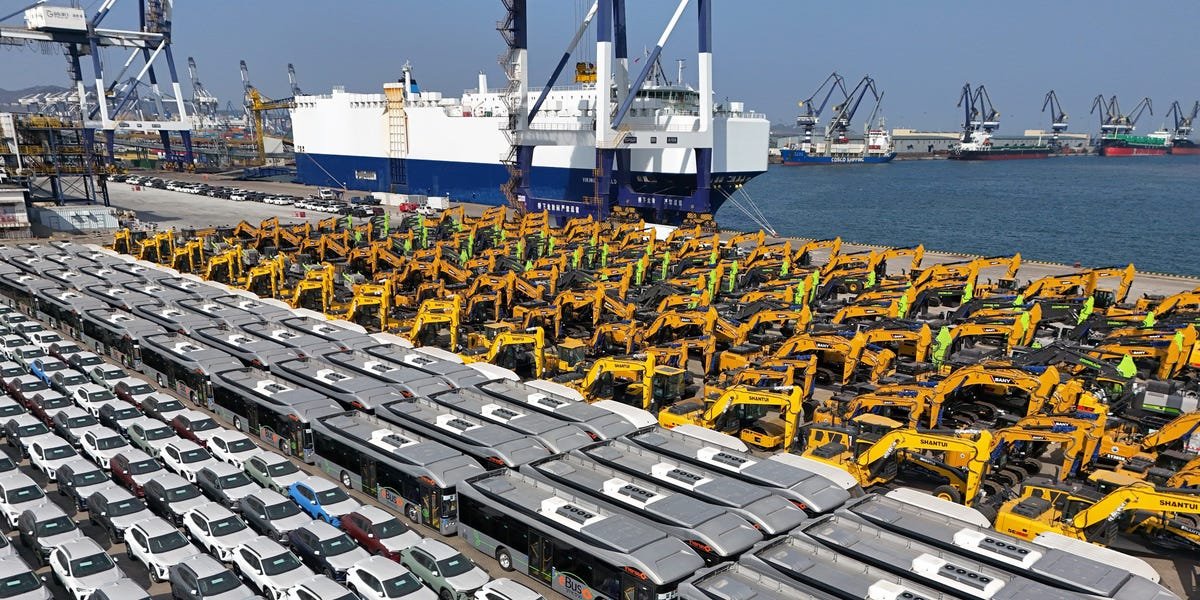
- China is pivoting to new growth drivers in solar cells, electric vehicles, and lithium-ion batteries.
- This could create “China shock 2.0” that impacts other economies around the world.
- The US, EU, and other nations are strategizing to counter China’s emerging dominance in these industries.

China’s economy is undergoing a painful transition as Beijing tries to steer it out of a post-COVID slump and a real-estate debt crisis.
Chinese leader Xi Jinping’s administration is championing what it calls the “new three” industries of solar cells, electric vehicles, and lithium-ion batteries to drive its economy.
It’s already manufacturing and exporting these goods aggressively.
In particular, China’s manufacturers are pumping out so many solar panels that the resulting global glut and price crash are prompting people to line their garden fences with the once-prized product.
This is just one of the industries the world is bracing for in the next phase of the “China shock.”
What happened in China shock 1.0?
“China shock” was a term coined by David H. Autor, David Dorn, and Gordon H. Hanson in a 2016 paper about the country’s economic rise and its impact on the world’s trade and labor markets.
Once mired in poverty, Communist China started its economic reforms in 1978 when it opened up its economy and allowed for more private enterprise.
The country’s growth was breakneck, with GDP growing over 80 times since then.
That growth was driven by rapid industrialization, which propelled China into the position of the world’s factory. Its massive manufacturing sector churned out millions of products that it exported at low cost.
The world welcomed China into its fold, heralding an age of globalization that companies from the US and elsewhere profited from. At the time, policymakers were of the view that the East Asian giant would become more open economically and politically as a result of this integration.
Consumers, too, benefited from low inflation.
However, this trend came at a huge cost for communities in the US and elsewhere that were dependent on manufacturing. Swathes of workers lost their jobs to China.
This is the “China shock.”
How Beijing could be creating China shock 2.0
Now, China is targeting three new strategic industries that the rest of the world is also eying.
This time, though, Western countries are not letting Beijing get its way so easily — especially since China is aiming to develop its own supply chain ecosystem in these areas.
“The advanced economies are facing the combined impact of China’s moderating medium-term GDP growth on global demand as well as competition from China’s new wave of industrialization,” Rajiv Biswas, an international economist and the author of “Asian Megatrends,” told Business Insider.
This development doesn’t stem only from China’s push into manufacturing the end products in the fields of EVs, lithium-ion batteries, and solar cells. The country is also developing global supply chains for critical raw materials, such as rare earths, that will supply these industries.
“Consequently, the industrial economies of the OECD nations are facing new economic challenges from China’s strategic competition in these key growth industries,” Biswas said.
Such competition is even keener now due to deflation in China— which has become the only major economy in the world dealing with negative consumer prices.
Meanwhile, China’s slowing economic growth also means it’s not buying as much from other countries, ratcheting up trade tensions.
Last year, China’s imports of goods from the rest of the world fell by 5.5% from a year ago, official data shows.
What is the US and the rest of the world doing about China shock 2.0?
The world isn’t going to be caught flat-footed by China’s emerging dominance in hot new industries this time.
“It is likely that strategic competition between the US, EU, and China will continue in the long-term in areas of advanced manufacturing technologies,” said Biswas.
Many companies are already diversifying supply chains away from China for a range of products.
The US is taking steps to boost chip manufacturing at home. The CHIPS Act provides $52 billion in subsidies for production, research, and workforce development. The US Inflation Reduction Act is also boosting investment in clean energy.
On April 2, the Department of Energy announced a $75 million investment to develop a research facility to strengthen the domestic supply chains of critical minerals.
Meanwhile, US Treasury Secretary Janet Yellen is in China for meetings with top Chinese officials. The Treasury said in a press release announcing her visit that she will be “pressing Chinese counterparts on unfair trade practices and underscoring the global economic consequences of Chinese industrial overcapacity.”
At a Suniva solar cell plant in Georgia on March 27, Yellen said she was “concerned about global spillovers from the excess capacity that we are seeing in China” that have now hit new energy industries like solar, electric vehicles, and lithium-ion batteries.
The European Union, too, is taking steps to protect its domestic manufacturing in emerging key industries.
In October, the European Commission launched a probe into whether EV imports from China benefited from illegal subsidization that in turn, threatens to damage the EU’s EV manufacturers. If this is found to be true, the EU could impose tariffs on these imports. The EU investigation is ongoing.
The EU has also established the European Chips Act to boost domestic chip production.
After all, it’s once bitten, twice shy.
“People like me grew up with the view: If people send you cheap goods, you should send a thank-you note. That’s what standard economics basically says,” Yellen told the Journal in an interview published on Wednesday. “I would never ever again say, ‘Send a thank-you note.'”
What is China’s response to the West’s moves?
China is framing the US response as a move to contain its growth.
“The US side has adopted a string of measures to suppress China’s trade and technology development,” Wang Wenbin, a spokesperson for the Chinese foreign ministry, said at a regular press conference on Wednesday.
“This is not ‘de-risking,’ but creating risks. These are typical non-market practices,” Wang added.
He also said China’s exports of EVs, lithium-ion batteries, and solar cells have risen due to the “international division of labor and market demand” thanks to the global energy transition to more sustainable energy sources.
China is also de-risking by increasingly trading with Southeast Asia, where there is a burgeoning middle class, said Biswas, the economist. Other large developing markets China is targeting include Africa and Latin America, he added.
Last year, China exported more goods to Southeast Asia than to the US for the first time ever, according to a Bloomberg analysis of Chinese customs data published in January — signaling a change in global trade flows amid the changing geopolitical landscape.
The US presidential election campaign season this year is likely to heat up some trade issues, Nomura economists wrote in a note on March 15.
“We reckon China’s export price deflation and overcapacity in a number of strategically important sectors might cause trade tensions to escalate later this year, and possibly beyond,” the Nomura economists added.
