
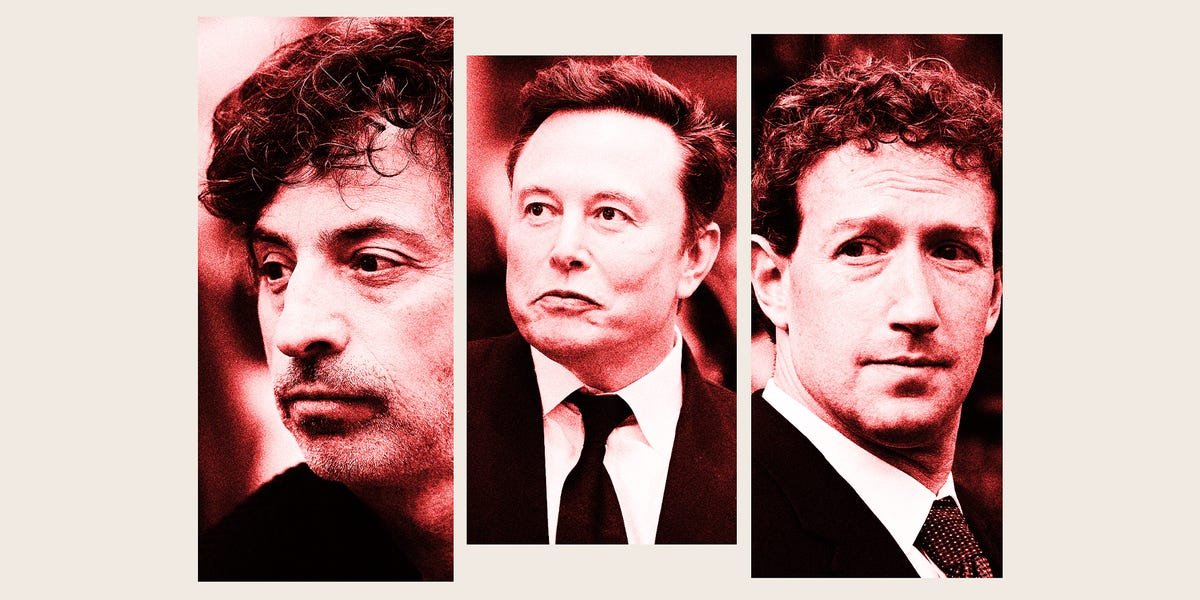
For many in the tech industry, the midterms landed like a hangover after a two-year bender. In the sober light of day, their flirtations with MAGA and extravagant spending may now seem embarrassing. Yet for Silicon Valley’s billionaire class, there’s still reason to keep the champagne flowing after the election — because it still pays to be rich.
California voters have rejected prop 40, a landmark initiative to impose a one-time 5% tax on billionaires in the state. They also seem to favor a countermeasure, prop 42, that would hamstring any future attempts to tax financial assets —the kind that separate the rich from the really rich. (Votes are still being tallied.) That people in the most progressive state with the highest wealth inequality in the country made such decisions in the bluest national election in recent history is either a failure of populism, or a victory of free enterprise, depending on who you ask. On X, Mike Solana of Peter Thiel’s Founders Fund heralded Prop 40’s apparent defeat succinctly: “Eat shit, communists.”
More than 200 billionaires live in California. Cumulatively, they hold an estimated $2.3 trillion in wealth, a sum that UC Berkeley economist Gabriel Zucman notes is roughly equivalent to the combined annual income of every single resident in the state. Soon, there could be dozens more, as companies like Anthropic and OpenAI prepare world-historic IPOs. (Anthropic’s alone could mint close to a thousand centimillionaires.) Wealth for these people is not a matter of salary, but of assets. Most fortunes in the tech industry remain in company equity, which is untaxed until shares are sold. That has allowed some of the richest people in the state to avoid paying much in income tax: Billionaires like Mark Zuckerberg, Larry Ellison, and Larry Page all famously take $1 salaries.
“The way this system works is they can literally create gigantic fortunes without paying tax,” says Tom Steyer, an investor and former gubernatorial candidate, and one of the few billionaires to come out in support of the billionaire tax. “We know where we need to go, which is a fairer tax system.”
Prop 40 offered one such alternative. Supporters argued that it would mark a long overdue correction, and still allow billionaires to remain very, very rich. “The poorest billionaire in California will make about $300 million this year. If we pass the CA wealth tax, he will only make $235 million,” Saikat Chakrabarti, a former Stripe engineer and political adviser, wrote on X. Critics argued that asking billionaires to pay cash on their paper wealth would ruin the tech economy, forcing them to sell off parts of private companies, and inspiring an exodus from the state. Earlier this year, the investor Balaji Srinivasan noted on X that Larry Page, Sergey Brin, Elon Musk, and Peter Thiel had already “exited the failed state of California,” and Y Combinator CEO Garry Tan warned that should a billionaire tax pass, many startup founders would choose not to come to California at all.
If prop 40 is “not the way to skin the cat, don’t come back and tell me there’s no way to skin the cat,” says Tom Steyer.
The would-be victims of the billionaire tax feared those outcomes enough to form a coalition, which included prominent names in tech — Brin, Patrick Collison, Eric Schmidt, and John Doerr among them. Together, they spent more than $300 million to defeat the measure (including a reported $148 million ad campaign), the most ever spent by one side on a single ballot initiative. Supporters, by comparison, spent about $2 million on ads. “The disparity in money in this thing was too high,” says Cooper Teboe, a political strategist in Silicon Valley. “There was a genuine marketing gap.”
Money isn’t everything. In Texas, where sometimes trillionaire Elon Musk spent nearly $500 million trying to keep Republicans in office, voters turned around and elected a Democratic governor for the first time since 1991, and a Democratic Senator who made reining in data centers a major part of his message. Both of those campaigns were modeled on the idea of a “top versus bottom” rather than “left versus right” politics — that is, an alignment over class interests above all else.
The zealous interest from both sides of prop 40 — and the fact that some 46% of voters in California favored the tax despite what many saw as significant flaws — are signs that conversations about wealth taxation are just getting started. Most Americans think billionaires don’t pay enough in taxes, according to a national survey from last year; one study found that 73% of Americans would favor a “special additional tax on billionaires.” In April, a Pew survey found that 60% of people believed that corporations and very wealthy people did not pay “their fair share” in taxes.
That’s led some proponents of a wealth tax to shift their gaze nationally. Indeed, some of prop 40’s detractors, including Governor Gavin Newsom, made the argument that they would rather tax wealth federally than on the state level. Other opponents, who had grievances with the details of prop 40 — like what its actual fiscal impact would be, how the state would assess wealth, and where all of that hypothetical money would actually go — have come out in support of wealth taxes in general. Steyer, who supports the idea of a federal tax on billionaires, says that if prop 40 is “not the way to skin the cat, don’t come back and tell me there’s no way to skin the cat.”
Having a plan for taxing the ultra rich “becomes almost a prerequisite for whoever ends up as the dominant 2028 candidate,” says Teboe. “The war continues.”
Business Insider’s Discourse stories provide perspectives on the day’s most pressing issues, informed by analysis, reporting, and expertise.
