Close Menu
    What's Hot

    Why ‘AI Is Amazing’ and ‘AI Is Our Doom’ Sound Like the Same Thing

    February 24, 2026

    ZachXBT Insider Trading Report Targets Major Crypto Firm in 2 Days

    February 24, 2026

    Bryan Johnson Says He Wants an AI Agent to Read, Filter His Social Media Feed

    February 24, 2026
    Facebook X (Twitter) Instagram
    Hot Paths
    • Home
    • News
    • Politics
    • Money
    • Personal Finance
    • Business
    • Economy
    • Investing
    • Markets
      • Stocks
      • Futures & Commodities
      • Crypto
      • Forex
    • Technology
    Facebook X (Twitter) Instagram
    Hot Paths
    Home»Money»The Nobel Peace Prize Winner the Year You Were Born
    Money

    The Nobel Peace Prize Winner the Year You Were Born

    Press RoomBy Press RoomOctober 11, 2025No Comments30 Mins Read
    Facebook Twitter Pinterest LinkedIn Tumblr Email
    Share
    Facebook Twitter LinkedIn Pinterest Email


    2025-10-10T18:28:44Z


    Facebook


    Email


    X


    LinkedIn


    Reddit


    Bluesky


    WhatsApp


    Copy link

    lighning bolt icon An icon in the shape of a lightning bolt.


    Impact Link


    Save
    Saved


    Read in app

    This story is available exclusively to Business Insider
    subscribers. Become an Insider
    and start reading now.

    Have an account? .
    • The Nobel Peace Prize has been recognizing global strides in peace-making since 1901.
    • Famous recipients range from the Dalai Lama to Barack Obama.
    • The 2025 winner is María Corina Machado, a Venezuelan politician and activist.

    It’s been 124 years since the first Nobel Peace Prize was handed out to one of the cofounders of the Red Cross and the founder of the first French Peace Society.

    Since then, activists, politicians, diplomats, authors, humanitarian organizations, and political prisoners from across the world have been awarded the Nobel Peace Prize.

    This year’s winner, María Corina Machado, is the leader of the democracy movement in Venezuela, which is currently under autocratic rule.

    Here’s who has won the Nobel Peace Prize every year it has been awarded, from 1901 to 2025.

    Shelby Slauer and Melina Glusac contributed to a prior version of this article.

    1901: Henry Dunant and Frédéric Passy


    Henry Dunant and Frédéric Passy

    Dunant and Passy.


    ullstein bild/ullstein bild/Getty Images; Ann Ronan Pictures/Print Collector/Getty Images

    Dunant and Passy split the very first Nobel Peace Prize between the two of them.

    Dunant won for founding the International Committee of the Red Cross in 1863. Passy received the honor for founding the first French Peace Society (Société Française pour l’arbitrage entre nations) in 1878.

    1902: Élie Ducommun and Charles Albert Gobat


    1902 nobel peace prize winners

    Ducommun and Gobat.


    Public domain

    Ducommun mainly won for his work at the International Peace Bureau, at which he served as the honorary secretary-general, but the Nobel Prize website states that, in his spare time, he “prepared programs for international peace congresses, published resolutions, and corresponded with promoters of peace.”

    Gobat won “for his efforts to bring popularly elected representatives from various countries together at meetings and congresses.” He also knew Ducommun well — when he died, Gobat took over as the secretary-general for the International Peace Bureau.

    1903: William Randal Cremer


    William Randal Cremer

    Cremer.


    Hulton Archive/Getty Images

    Cremer was nicknamed the “Master of Arbitration,” which is why he received the award. Through his work with the International Arbitration League, he sought to solve conflicts through discussion, not war.

    1904: Institute of International Law


    founders of the international law office

    Founders Gustave Rolin-Jaequemyns and Gustave Moynier.


    Public domain

    The Institute of International Law, a nongovernmental organization based in Belgium, received the 1904 Nobel Peace Prize due to its success in persuading countries to use arbitration to deal with conflict, and for convincing countries to accept the rules of law during wartime.

    1905: Bertha von Suttner


    Bertha von Suttner

    Von Suttner.


    Hulton Archive/Getty Images

    Von Suttner was the first woman to be awarded a Nobel Peace Prize. She won for her work with the Austrian Peace Society, which she established in 1891. She also wrote one of the most influential anti-war novels, “Lay Down Your Arms,” in 1889.

    1906: Theodore Roosevelt


    theodore roosevelt

    President Roosevelt.


    AP Photo

    Roosevelt was the first American (and first statesman) to win the award, which he received for negotiating peace treaties in the Russo-Japanese War, ensuring its end in 1905, and resolving a dispute with Mexico using arbitration.

    1907: Ernesto Teodoro Moneta and Louis Renault


    nobel peace prize winners 1907

    Moneta and Renault.


    Public domain

    Moneta founded the Lombard Association for Peace and Arbitration in 1887, which believed in disarmament. He also edited the newspaper Il Secolo, which regularly called for pacifism.

    Renault was a professor of international law. He spoke at numerous conferences, including two peace conferences at The Hague, where he solidified his place as a prominent figure in the arbitration movement. Renault was also the French government’s advisor in foreign policy and international law.

    1908: Klas Pontus Arnoldson and Fredrik Bajer


    nobel peace prize 1908 winners

    Arnoldson and Bajer.


    Public domain

    Arnoldson won the Nobel Peace Prize for his efforts to reconcile Norway and Sweden. He also founded the Swedish Peace and Arbitration League.

    Bajer founded the Danish Interparliamentary Group in 1891 and was a lifelong believer in peace and arbitration. He’s also been credited with laying the groundwork for the International Peace Bureau.

    1909: Auguste Beernaert and Paul Henri d’Estournelles de Constant


    Auguste Beernaert and Paul Henri d'Estournelles de Constant

    Beernaert and d’Estournelles de Constant.


    bildagentur-online/uig via Getty Images; M. Rol/ullstein bild/Getty Images

    Beernaert won the Nobel Peace Prize for “inter-parliamentary work and [appearances] at the international peace conferences at the Hague in 1899 and 1907.” He was also the prime minister of Belgium from 1884 to 1894.

    D’Estournelles also won the prize in 1909. He was the founder and president of a French parliamentary group for voluntary arbitration, and the founder of the Committee for the Defense of National Interests and International Conciliation.

    1910: Permanent International Peace Bureau


    henri la fontaine

    Belgian diplomat Henri La Fontaine.


    Hulton Archive/Getty Images

    The International Peace Bureau is a Swiss organization that “campaigned for disarmament and for the use of mediation and arbitration in the solution of international disputes.” It’s still active today with 300 member organizations in 70 countries.

    1911: Tobias Asser and Alfred Fried


    nobel prize 1911 winners

    Asser and Fried.


    Public domain; Imagno/Getty Images

    Asser co-founded the Institute of International Law, the first organization to win the Nobel Peace Prize. But it was “his work in the field of private law” that was most important to his win.

    Fried co-founded the German Peace Society and founded Die Friedenswarte, a German peace publication.

    1912: Elihu Root


    elihu root

    Root.


    Hulton Archive/Getty Images

    Root was both the US secretary of war and secretary of state. He was also the first president of the Carnegie Endowment for International Peace.

    Root was awarded the prize “for having pursued the aim that conflicts between states must be resolved by arbitration.”

    1913: Henri La Fontaine


    Henri La Fontaine

    La Fontaine.


    Interim Archives/Getty Images

    La Fontaine was the first socialist to win the prize — he won for being the “effective leader of the peace movement in Europe.” He was president of the International Peace Bureau and “organized a world conference for international organizations,” whose purpose was to “create ‘an intellectual parliament’ for humanity.”

    1917: International Committee of the Red Cross


    red cross 1910

    The Red Cross in 1910.


    Topical Press Agency/Getty Images

    The Red Cross was the only recipient of the Nobel Peace Prize during World War I. It won because it “undertook the tremendous task of trying to protect the rights of the many prisoners of war on all sides, including their right to establish contacts with their families.”

    1919: Woodrow Wilson


    Woodrow Wilson

    President Wilson.


    Tony Essex/Hulton Archive/Getty Images

    Wilson won the prize for founding the League of Nations, which was a dream many previous winners had shared.

    1920: Léon Bourgeois


    Léon Bourgeois

    Bourgeois.


    Hulton Archive/Getty Images

    Ex-secretary of state and former president of the French parliament, Bourgeois was a major figure in the development of the League of Nations. It was his passion project to see an international court established at The Hague, which he saw through.

    1921: Hjalmar Branting and Christian Lange


    nobel peace prize 1921

    Branting and Lange.


    General Photographic Agency/Getty Images; Public domain

    Branting was “a leading figure in the struggle for equal rights and social justice in Sweden” and a strong supporter of the League of Nations.

    Lange was also the secretary-general of the Inter-Parliamentary Union and went on to become part of the Nobel Committee in 1934.

    1922: Fridtjof Nansen


    Fridtjof Nansen

    Nansen.


    Hulton Archive/Getty Images

    In 1922, Nansen was appointed the first High Commissioner for Refugees, putting him in charge of the exchange of 400,000 prisoners of war. His work on their behalf, as well as on behalf of many starving refugees, won him the prize.

    1925: Austen Chamberlain and Charles G. Dawes


    nobel prize winners 1925

    Chamberlain and Dawes.


    London Stereoscopic Company/Getty Images; General Photographic Agency/Getty Images

    Chamberlain received his prize for his work on the Locarno Pact, an agreement that saw Germany, France, Belgium, Great Britain, and Italy guarantee peace in western Europe.

    US Vice President Dawes, on the other hand, won for “having contributed to reducing the tension between Germany and France after the First World War.”

    1926: Aristide Briand and Gustav Stresemann


    nobel prize winners 1926

    Briand and Stresemann.


    Hulton Archive/Getty Images; General Photographic Agency/Getty Images

    Briand, a professor and founder of the League for Human Rights, and Stresmann, ex-high chancellor and foreign minister, split the award — they both won for their work on the Locarno Pact, which helped ease tension between France and Germany after World War I.

    1927: Ferdinand Buisson and Ludwig Quidde


    nobel peace prize 1927

    Buisson and Quidde.


    Hulton Archive/Getty Images

    French foreign minister Buisson and German professor Quidde,  who later became president of the German Peace Society, split the prize evenly — they received it for their contributions to the reconciliation of France and Germany after World War I.

    1929: Frank B. Kellogg


    frank b kellogg

    Kellogg.


    Central Press/Getty Images

    US Secretary of State Kellogg received the prize for his part in initiating the Kellogg-Briand Pact of 1928, an international agreement that had signatory states promising not to use war to resolve disputes. 

    1930: Nathan Söderblom


    Nathan Söderblom

    Söderblom.


    Carl Simon/United Archives/Universal Images Group/Getty Images

    Söderblom was the first clergyman to receive the Nobel Peace Prize. The archbishop and former theology professor is credited with moving the Universal Conference on Life and Work forward, which worked to fight nationalism, racism, and the oppression of minorities.

    1931: Jane Addams and Nicholas Murray Butler


    Jane Addams and Nicholas Murray Butler

    Addams and Butler.


    AFP/Getty Images; Bettmann/Getty Images

    Addams, an American known as the “mother” of social work, received the honor for founding the Women’s International League for Peace and Freedom and for being an outspoken opponent of entering World War I.

    Butler, an American philosopher and diplomat, as well as president of Columbia University and president of the Carnegie Endowment for International Peace, won for “his efforts to strengthen international law and the International Court at the Hague,” as well as his support of the Kellogg-Briand Pact of 1928.

    1933: Norman Angell


    Sir Norman Angell

    Angell.


    Fred Morley/Keystone/Getty Images

    Angell remains the only Nobel Peace Prize winner to have won for writing a book — he wrote “The Great Illusion,” which explored the relationship between war and any potential national or economic advantage it may bring about. He was also celebrated for his work as an educator and for his support of the League of Nations.

    1934: Arthur Henderson


    Arthur Henderson

    Henderson.


    Topical Press Agency/Getty Images

    British politician Henderson earned the prize for his work with the League of Nations, specifically for being “one of the principal architects behind the organization’s disarmament conference.”

    1935: Carl von Ossietzky


    Carl von Ossietzky

    Von Ossietzky.


    ullstein bild/ullstein bild/Getty Images

    Ossietzky’s win was inherently political — the German pacifist was arrested for treason when he reported that Germany was secretly rearming itself, explicitly going against the Treaty of Versailles. Part of the international campaign to get him released was awarding him the Nobel Peace Prize.

    1936: Carlos Saavedra Lamas


    fDR and Carlos Saavedra Lamas

    President Franklin Delano Roosevelt with Lamas.


    Keystone-France/Gamma-Rapho/Getty Images

    Lamas, an Argentine academic and politician, won the prize for three main reasons.

    First, he deserves much of the credit for Argentina’s joining the League of Nations. Second, he was important in the League’s “condemnation of Italy’s war on Ethiopia.” Lastly, he was honored for his contributions to peace between Paraguay and Bolivia after the Chaco War.

    1937: Robert Cecil


    The Viscount Cecil of Chelwood

    Cecil.


    General Photographic Agency/Hulton Archive/Getty Images

    English statesman Cecil won the prize for his work with the League of Nations. He was integral to the formation of the organization’s rules.

    1938: Nansen International Office for Refugees


    Fridtjof Nansen

    Fridtjof Nansen.


    ullstein bild/Getty Images

    The Nansen International Office for Refugees won the prize for its work with aiding refugees, specifically for its work with Armenian refugees who were driven out of Turkey.

    The organization won 16 years after their namesake, Fridtjof Nansen won as an individual.

    1944: International Committee of the Red Cross


    red cross 1958

    Members of the Ottershaw Red Cross division.


    G. R. Greated/Fox Photos/Getty Images

    The Red Cross won its second Nobel Peace Prize for service during World War II.

    1945: Cordell Hull


    cordell hull

    Hull.


    Hulton Archive/Getty Images

    Hull, known as the longest-serving secretary of state — he held the position for 11 years — won the prize for his work as the “father of the United Nations,” an organization that was founded after World War II.

    1946: John Mott and Emily Balch


    John Mott and Emily Balch

    Mott and Balch.


    Bettmann/Getty Images

    Mott was the head of the Young Men’s Christian Association (the YMCA) and won for contributing “to the creation of a peace-promoting religious brotherhood across national boundaries.”

    Balch, an American economist and sociologist known for tackling social issues such as poverty, child labor, and immigration, became a Nobel Laureate for leading the Women’s International League for Peace and Freedom.

    The US, however, saw her as a “dangerous radical.”

    1947: Friends Service Council and American Friends Service Committee


    American Friends Service Committee

    James G. Vail, the foreign service secretary of the American Friends Service Committee.


    Robert Kradin/AP Images

    These two Quaker organizations shared the prize. They both carried out humanitarian work during World War I and II, but their 1947 win was the “Nobel Committee’s recognition both of pioneering work in the international peace movement and of humanitarian work carried out without regard for race or nationality.”

    1949: Lord John Boyd Orr


    John Boyd Orr

    Orr.


    Fox Photos/Hulton Archive/Getty Images

    Orr was president of both the National Peace Council and the World Union of Peace Organizations, and in 1945, he was elected the director-general of the FAO (Food and Agriculture Organization).

    1950: Ralph Bunche


    ralph bunche

    Bunche.


    Derek Berwin/Fox Photos/Getty Images

    Bunche, an academic and diplomat, was the first African-American person to receive the Nobel Peace Prize. He won it for “having arranged a cease-fire between Israelis and Arabs during the war, which followed the creation of the state of Israel in 1948.”

    1951: Léon Jouhaux


    Léon Jouhaux

    Jouhaux.


    Central Press/Hulton Archive/Getty Images

    Jouhaux, the French trade union leader, joined the elite Nobel Laureate club for his “work for social equality and Franco-German reconciliation.”

    1952: Albert Schweitzer


    Albert Schweitzer

    Schweitzer.


    L. Blandford/Topical Press Agency/Hulton Archive/Getty Images

    Writer and physician Schweitzer earned the award for founding Lambaréné, a missionary hospital, in the African country of Gabon with his wife.

    1953: George C. Marshall


    george c marshall

    Marshall.


    Keystone/Getty Images

    The Marshall Plan is what won Marshall, the former US Secretary of State, this honor. The Marshall Plan was the US’s response to the widespread devastation of World War II in Western Europe — it provided more than $15 billion to finance rebuilding projects.

    1954: Office of the United Nations High Commissioner for Refugees


    unhcr

    Kathleen Courtney (right), President of the United Nations Association, with Gerrit Jan van Heuven Goedhart, the United Nations High Commissioner for Refugees.


    Fred Ramage/Keystone/Hulton Archive/Getty Images

    The United Nations High Commissioner for Refugees (UNHCR) received the prize in 1954, four years after the creation of the UNHCR. The organization was honored for its work with refugees after World War II, the cause for which it was originally created.

    1957: Lester Bowles Pearson


    Lester Bowles Pearson

    Pearson.


    Fox Photos/Getty Images

    Pearson received the prize when, as Canadian secretary of state for external affairs, he found a solution to the Suez Crisis.

    Great Britain, France, and Israel launched an attack on Egypt in 1956 in an effort to remove its president, without informing the United States, and Pearson won support to send a United Nations Emergency Force to separate the groups.

    1958: Georges Pire


    Georges Pire

    Pire.


    Keystone-France/Gamma-Keystone/Getty Images

    Pire, a Belgian Dominican friar, received the prize for his work with refugees in Europe. Throughout the 1950s, he set up villages of small houses for European refugees and founded an organization in 1957 that undertook development projects in other parts of the world.

    1959: Philip J. Noel-Baker


    Philip J. Noel-Baker

    Noel-Baker.


    Topical Press Agency/Hulton Archive/Getty Images

    When World War I began, Noel-Baker, a British politician and diplomat, was convinced the private armaments industry was largely responsible for the outbreak of war. For the rest of his life, he worked toward disarmament, including efforts to prevent nuclear war between the United States and the Soviet Union.

    1960: Albert Luthuli


    Albert John Lutuli

    Luthuli.


    Bettman/Getty Images

    Luthuli became president of the African National Congress in 1952 and was the spokesperson of a campaign against South Africa’s racial segregation policy.

    The Nobel Committee’s decision to award him the Nobel Peace Prize for his nonviolent campaign for civil rights in South Africa was important because it showed that the committee had joined the movement against apartheid.

    1961: Dag Hjalmar Agne Carl Hammarskjöld


    Dag Hjalmar Agne Carl Hammarskjöld

    Hammarskjöld.


    AFP/Getty Images

    Hammarskjöld is the only Nobel Peace Prize winner to have been awarded it posthumously. He won for his work as the secretary-general of the United Nations. He organized a peacekeeping force in the Middle East after the Suez Crisis and committed to peace during the civil war in the Congo.

    1962: Linus Carl Pauling


    linus carl pauling

    Pauling.


    AP

    Pauling had previously received the Nobel Prize in Chemistry in 1954.

    He received the Nobel Peace Prize in 1962 for his opposition to weapons of mass destruction, having acted as one of the primary forces behind a nuclear test ban treaty between the United States, the Soviet Union, and Great Britain that went into effect in 1963. 

    1963: Comité international de la Croix Rouge (International Committee of the Red Cross) and Ligue des Sociétés de la Croix-Rouge (League of Red Cross Societies)


    red cross

    The Red Cross.


    AP Photo/Helmuth Lohmann

    The Red Cross won its third Nobel Prize in 1963 for the 100th anniversary of its founding. It’s the only organization to have won three Nobel prizes.

    1964: Martin Luther King, Jr.


    Martin luther king jr

    King Jr.


    AP

    King Jr. won for his lifelong work for civil rights and social justice and his nonviolent campaign against racism.

    A year after his 1963 “I Have A Dream” speech in front of 250,000 demonstrators outside of the Lincoln Memorial in Washington, DC, President Johnson signed the Civil Rights Act of 1964.

    1965: United Nations Children’s Fund (UNICEF)


    unicef representatives 1956

    UNICEF members.


    Evans/Three Lions/Getty Images

    According to the Nobel Committee, UNICEF’s work helped promote solidarity between nations, reducing the divide between rich and poor states and the danger of war.

    1968: René Cassin


    René Cassin

    Cassin.


    KEYSTONE-FRANCE/Gamma-Rapho/Getty Images

    Cassin, a French judge, is referred to as the “father of human rights,” as he was the brains behind the UN commission that drew up the Universal Declaration of Human Rights of 1948.

    1969: International Labour Organization (ILO)


    ILO nobel prize

    Members of the ILO at the White House.


    AP Photo/Pool

    The International Labour Committee won a Nobel Peace Prize 50 years after it was formed. The ILO continues to strive to improve working conditions and social rights of employees.

    1970: Norman E. Borlaug


    Norman E. Borlaug

    Borlaug.


    AP

    American agronomist Borlaug is known as the “father of the green revolution.”

    He worked for decades in Mexico during the ’40s and ’50s to make the country self-sufficient in grain and succeeded by 1956. He developed a strain of wheat called “dwarf wheat,” which was high-yielding and disease-resistant. He brought it to India and Pakistan, exponentially increasing production there.

    1971: Willy Brandt


    willy brandt

    Brandt.


    AP

    Brandt worked against the Nazis during World War II, and he became the chancellor of West Germany postwar, helping rebuild the West German Social Democratic Party.

    He had West Germany sign the nuclear weapons Non-Proliferation Treaty, and created a nonviolence agreement with the Soviet Union and Poland detailing that West Germany accepted the new national boundaries in Eastern Europe.

    These treaties laid the groundwork for the Four Power Agreement in Berlin, which made it easier for families on opposing sides of the divide to visit each other.

    1973: Henry A. Kissinger and Le Duc Tho


    Le duc tho and henry kissinger

    Tho and Kissinger.


    Michel Lipchitz, File/AP

    While Vietnamese general and diplomat Le Duc Tho and American diplomat Henry Kissinger were secretly in peace talks to end the Vietnam War for years, which led to their joint Nobel prize win.

    However, Tho declined the prize, as he said that the Christmas bombing in Hanoi had violated the peace treaty that the two had agreed to.

    1974: Seán MacBride and Eisaku Sato


    Seán MacBride and Eisaku Sato

    MacBride and Sato.


    Christian RAUSCH/Gamma-Rapho/Getty Images; Bachrach/Getty Images

    MacBride is one of the founders of Amnesty International. He also served as chairman of the International Peace Bureau in 1974 and was the assistant secretary-general of the United Nations.

    Sato became a symbol of “Japan’s will for peace.” As the Japanese Prime Minister, Sato signed the Non-Proliferation Treaty of 1970.

    The Nobel Committee hoped that by awarding him the Nobel Peace Prize, it would encourage those who were against the spread of nuclear arms.

    1975: Andrei Dmitrievich Sakharov


    Andrei Sakharov

    Sakharov.


    AP

    Sakharov, a Russian nuclear physicist, was the father of the Soviet hydrogen bomb — but he was awarded the Peace Prize for his work for human rights in the Soviet Union, as well as his opposition to the abuse of power.

    He was outspoken in his criticism of the system of the Soviet Union, which he believed neglected fundamental human rights.

    1976: Betty Williams and Mairead Corrigan


    williams and corrigan nobel

    Williams and Corrigan.


    AP

    After a shooting incident that killed three children in Belfast in 1976, a witness, Williams, and the dead children’s aunt, Corrigan, founded a peace organization known as the Community of Peace People. They took a grassroots approach, setting up local peace groups in the hopes of setting a peace process for Northern Ireland in motion from the bottom up.

    1977: Amnesty International


    amnesty international nobel peace prize

    Members of Amnesty.


    AP

    Founded in 1961 by British lawyer Peter Benenson, Amnesty International won in 1977 for campaigning against human torture.

    1978: Anwar al-Sadat and Menachem Begin


    Mohamed Anwar al-Sadat and Menachem Begin and jimmy carter

    Jimmy Carter, Begin, and al-Sadat.


    Keystone/Getty Images

    President Sadat of Egypt shared the prize with Israel’s prime minister, Menachem Begin, for negotiating a peace treaty between their two countries.

    1979: Mother Teresa


    mother theresa

    Mother Teresa.


    AP

    Mother Teresa, known as Saint Teresa in the Roman Catholic Church, won for creating Missionaries of Charity, a sisterhood devoted to aiding orphans, lepers, and the terminally ill.

    1980: Adolfo Pérez Esquivel


    nobel prize winner 1980

    Esquivel.


    Keystone/Hulton Archive/Getty Images

    Esquivel won in 1980 for being a human rights activist in his home country of Argentina and for advocating non-violence during its dictatorship in the early ’70s.

    1981: Office of the United Nations High Commissioner for Refugees (UNHCR)


    un high commissioner

    Sadako Ogata, the UN High Commissioner for Refugees, and President George H.W. Bush


    AP Photo/Ron Edmonds

    The UNHCR is an international aid organization created by the UN, and it won (for the second time) for assisting refugees in Africa, Asia, and Latin America throughout the 1970s.

    1982: Alva Myrdal and Alfonso García Robles


    nobel prize winners 1982

    Myrdal and Robles.


    AP Photo/Jens O. Kvale

    Both delegates in the UN, Swedish diplomat Myrdal and Mexican diplomat Robles (nicknamed “Mr. Disarmament”), won for advocating disarmament and nuclear-free zones.

    1983: Lech Walesa


    nobel prize winner 1983

    Walesa.


    AP Photo/Cezary Sokolowski

    Walesa had just been released from internment — essentially, exile — when he won the Nobel in 1983 for campaigning for freedom of organization in communist Poland.

    After the country was liberated and held free elections, Walesa became the first-ever president of Poland to be elected by popular vote.

    1984: Desmond Mpilo Tutu


    desmond tutu

    Tutu.


    AP Photo/Joel Landau

    During the height of South Africa’s apartheid, Tutu, a South African Anglican cleric, won for his “fearless stance” and work against the cruel regime.

    1985: International Physicians for the Prevention of Nuclear War


    nobel prize winners 1985

    Members of International Physicians for the Prevention of Nuclear War.


    AP Photo/ Paul R. Benoit

    After only existing for five years, this organization of doctors from around the world won for uniting to advocate against nuclear war because of its potential medical risks.

    1986: Elie Wiesel


    Elie Wiesel

    Wiesel.


    AP Photo/Richard Drew

    An Auschwitz survivor, writer, and professor, Wiesel devoted his entire life to speaking and writing on the horrors of the Holocaust — he was awarded for his work in 1986.

    1987: Oscar Arias Sánchez


    oscar sanchez nobel

    Sánchez.


    Michael Nagle/Getty Images

    President Sánchez of Costa Rica was awarded the Nobel Prize for designing a plan to end the civil wars that had plagued Central America for years. His efforts led to a peace treaty being approved by five countries in the region.

    1988: United Nations Peacekeeping Forces


    un peacekeeping forces

    The UN Peacekeeping Force.


    AP Photo/Ismaiil Sabrawi

    Starting in 1948, over 500,000 UNPF members were sent to places like Kashmir, the Congo, and West New Guinea to report on conditions and administer “humanitarian aid” if necessary — they were awarded for years of duty in 1988.

    1989: The 14th Dalai Lama (Tenzin Gyatso)


    The Dalai Lama gestures before speaking to students during a talk at Mumbai University February 18, 2011. REUTERS/Danish Siddiqui

    The Dalai Lama, Tenzin Gyatso.


    Thomson/Reuters

    Gyatso was awarded for his peaceful opposition to China’s occupation of Tibet — including a plan for compromise — and for his sense of “universal responsibility.”

    1990: Mikhail Sergeyevich Gorbachev


    gorbachev

    President George H.W. Bush and Gorbachev.

    P Photo/Liu Heung Shin


    After the Berlin Wall fell in 1989, the Cold War came to an end, and the Soviet Union soon dissolved — Gorbachev, its eighth and last leader, was awarded for ushering in this newfound international peace.

    1991: Aung San Suu Kyi


    Aung San Suu Kyi

    Suu Kyi.


    Dan Himbrechts – Pool/Getty Images

    Burmese politician and diplomat Suu Kyi led the nonviolent opposition to the military forces that ruled her home country of Burma for nearly two decades before she was awarded the Nobel Prize for her efforts.

    She was later appointed State Counselor, a position similar to that of the prime minister.

    1992: Rigoberta Menchú Tum


    Rigoberta Menchú Tum

    Tum.


    Tony Barson/FilmMagic/Getty Images

    A native of Guatemala, Tum worked for the rights of indigenous peoples in America and won the Nobel for her efforts, later serving as a UN ambassador for the same cause.

    1993: Nelson Mandela and Frederik Willem de Klerk


    klerk and mandela

    de Klerk and Mandela.


    WALTER DHLADHLA/AFP/Getty Images

    In 1990, the State President of South Africa, de Klerk, released Nelson Mandela from prison, and the two negotiated an end to apartheid, laying the groundwork for a democratic South Africa — the two men shared the prize in 1993 for their historical collaboration.

    1994: Yasser Arafat, Shimon Peres, and Yitzhak Rabin


    Yasser Arafat, Shimon Peres and Yitzhak Rabin

    Arafat, Peres, and Rabin.


    MENAHEM KAHANA/AFP/Getty Images

    Arafat, Peres, and Rabin shared their Nobel Peace Prize for negotiating the Oslo Accords, an agreement that was meant to be a path toward peace for Palestine and Israel.

    1995: Joseph Rotblat and Pugwash Conferences on Science and World Affairs


    joseph rotblat

    Rotblat.


    Micheline Pelletier/Sygma/Getty Images

    Polish physicist Rotblat and the PCSWA won for their efforts — which dated back to before the bombing at Hiroshima — to reduce nuclear arms and, eventually, eliminate them.

    1996: Carlos Filipe Ximenes Belo and José Ramos-Horta


    AP_9612090531

    Belo and Ramos-Horta.


    Bjoern Sigurdoen/AP

    After Portugal ended its colonial rule over East Timor, Indonesia took its place.

    These two men — Belo, a priest, and Ramos-Horta, a diplomat — led the resistance against the Indonesian occupation of the region. They proposed a peace treaty in 1992 that was finally implemented in 2001, and Ramos-Horta claims their Nobel Prize had a lot to do with the plan coming to fruition.

    1997: International Campaign to Ban Landmines (ICBL) and Jody Williams


    jody williams

    Williams.


    Manish Swarup/AP

    Williams, an American political activist, first witnessed the horrors of land mines in El Salvador, where their explosions were a near-constant threat to civilians.

    She helped launch an international campaign against land mines, and, by 1997, the ICBL had over 1,000 organizations on its members list. The two won the award the same year for their work to ban the use, production, and sale of such mines.

    1998: John Hume and David Trimble


    hume and trimble

    Trimble and Hume.


    Jon Eeg, File/AP

    At the core of the Good Friday agreement, which ended the wars in Northern Ireland, were Hume and Trimble, Irish and British politicians respectively.

    They won a Nobel for their historic achievement in peace-making.

    1999: Médecins Sans Frontières (Doctors Without Borders)


    doctors without borders

    Médecins Sans Frontières International President Dr. Unni Karunakara.


    Khalil Senosi/AP

    This French organization — known in English as Doctors Without Borders — won in 1999 for its medically related humanitarian aid that stretched over multiple continents, which it continues to provide.

    2000: Kim Dae-jung


    dae-jung

    Dae-jung.


    Choi Won-suk, Pool/AP

    President Dae-jung of South Korea approached relations with North Korea with what he called a “sunshine policy,” ending decades of war-like tension between the two countries. He won the prize for the spreading of democratic values.

    2001: United Nations and Kofi Annan


    kofi annan

    Annan.


    Frank Franklin II/AP

    In the prize’s centennial year, the Nobel committee decided to split the award between the UN and Annan, its secretary-general.

    2002: Jimmy Carter


    jimmy carter accepting the noble peace prize

    President Carter.


    Arne Knudsen/Getty Images

    Carter, the 39th president of the United States, received a Nobel Prize in 2002 for his work toward solving international conflicts and decades of advocating for rights and economic progress.

    2003: Shirin Ebadi


    shirin ebadi

    Ebadi.


    Jacques Brinon/AP

    Ebadi, hailing from Iran, was the “first female peace prize laureate from the Islamic world.” 

    The Iranian lawyer and judge was recognized for proposing amendments to divorce laws in her country and advocating for the separation of church and state. She is especially concerned with the rights of women, children, and those targeted by authorities. 

    2004: Wangari Muta Maathai


    Wangari Muta Maathai

    Maathai.


    Gurinder Osan/AP

    The first African woman to receive the Nobel, Maathai has promoted peace and democratic values. Most notably, she started the Green Belt movement, which led to the planting of over 30 million trees in her homeland of Kenya.

    2005: International Atomic Energy Agency (IAEA) and Mohamed ElBaradei


    Mohamed ElBaradei

    ElBaradei.


    Pascal Le Segretain/Getty Images for Cinema for Peace

    The IAEA, and ElBaradei, its director, won for their persistent efforts toward promoting safe (and sparse) usage of nuclear energy.

    2006: Muhammad Yunus and Grameen Bank


    muhammad yunus

    Yunus.


    Pavel Rahman/AP

    Yunus, a Bangladeshi banker and entrepreneur, invented micro-credit and established the Grameen Bank as a means to fight poverty using small loans. He won a Nobel Prize for his impactful progress in 2006.

    2007: Intergovernmental Panel on Climate Change (IPCC) and Al Gore


    Al Gore

    Gore.


    Anthony Harvey/Getty Images

    A forerunner of environmentalism, Al Gore, former US vice president, along with the IPCC, won in 2007 for their efforts to make climate change a global topic of discussion and increase awareness of its severity, especially looking for ways to combat it.

    2008: Martti Ahtisaari


    Martti Ahtisaari

    Ahtisaari.


    Odd Andersen/AP

    The former president of Finland, Ahtisaari was a major contributor to Namibia’s independence, in addition to bringing peace to the Aceh province in Indonesia. He was given the Nobel Prize for over three decades of work toward international conflict resolution in 2008.

    2009: Barack Obama


    barack obama

    President Obama.


    Pablo Martinez Monsivais/AP

    Just eight months into his presidency at the time, Barack Obama was awarded the Nobel for advocating — and effecting change in — the dialogue and diplomacy between international peoples, in addition to supporting a nuclear-free world.

    2010: Liu Xiaobo


    Protesters holding placards of Liu Xiaobo march

    Photos of Liu.


    Anthony Kwan/Getty Images

    A longtime advocate for human rights in China, Liu, a writer and activist, won the Nobel in 2010 for over 20 years of struggling to end the one-party system in his home country.

    2011: Ellen Johnson Sirleaf, Leymah Gbowee, and Tawakkol Karman


    135516019 594x594

    Sirleaf, Gbowee, and Karman.


    Sandy Young/WireImage for IMG/Getty Images

    These three women rallied during wartime in Liberia, calling for women’s rights and participation in the democratic process. Their efforts resulted in successful peace negotiations, and they shared the 2011 Nobel Prize for their progress.

    2012: European Union (EU)


    158252166 594x594

    Members of the EU.


    STRINGER/AFP/Getty Images

    In 2012, the European Union celebrated over six decades of peace-making and conflict resolution, including repairing Germany and France’s relationship following World War II.

    2013: Organisation for the Prohibition of Chemical Weapons (OPCW)


    1006125056 594x594

    The OPCW headquarters.


    Ant Palmer/Getty Images

    Formed in 1997, the OPCW works to ensure that member nations are adhering to the 1997 ban (of manufacturing and storage) of chemical weapons throughout the world.

    2014: Kailash Satyarthi and Malala Yousafzai


    460237588 594x594

    Satyarthi and Yousafzai.


    Ragnar Singsaas/Getty Images

    Yousafzai survived an assassination attempt in her home country of Pakistan and became an activist for the education of women and children; Satyarthi has founded multiple organizations that save children from child labor. The two were honored in 2014.

    At 17 years old, Yousafzai was the youngest recipient to date.

    2015: National Dialogue Quartet


    national dialogue quartet

    The National Dialogue Quartet.


    FETHI BELAID/AFP/Getty Images

    After the 2011 Jasmine Revolution in Tunisia, the National Dialogue Quartet — a combination of four civil organizations — was formed to begin dialogue between the nations involved in the Arab Spring. They were honored in 2015.

    2016: Juan Manuel Santos


    Colombia's President Juan Manuel Santos speaks during a news conference in Havana, September 23, 2015. REUTERS/Alexandre Meneghini

    Santos.


    Thomson/Reuters

    Santos, the president of Colombia, won the Nobel for helping to end the civil war — which had been plaguing the country since the 1960s — by successfully taking the reins of negotiations between the Colombian government and FARC guerrillas. 

    2017: International Campaign to Abolish Nuclear Weapons (ICAN)


    ICAN nobel

    Representatives of ICAN.


    NTB Scanpix/Berit Roald via REUTERS

    ICAN, the International Campaign to Abolish Nuclear Weapons, works to bring attention to the consequences of using nuclear weapons from a humanitarian point of view and strives to create treaties to resolve nuclear conflict — it received the Nobel Peace Prize in 2017 for its efforts and successes.

    2018: Denis Mukwege and Nadia Murad


    nukwege and murad nobel peace 2018

    Mukwege and Murad.


    AP Photos/Christian Lutz

    Mukwege and Murad split the Nobel Peace Prize for their work to “end sexual violence as a weapon in war and armed conflict.”

    Dr. Mukwege is a gynecological surgeon from the Congo, which has been referred to in the past as the “rape capital of the world.” Murad is a Yazidi woman who became a voice for survivors of sexual violence after being a captive of ISIS.

    2019: Abiy Ahmed


    prime minister ethiopia abiy ahmed nobel peace prize

    Ahmed.


    Lee Jin-man/AP

    Ethiopian Prime Minister Abiy Ahmed won the Nobel Peace Prize “in recognition of his efforts to end the country’s two-decade border conflict with Eritrea,” the AP reported.

    The prime minister told the Nobel committee in a call that he hopes the award will inspire other African leaders to continue peacebuilding efforts throughout the continent.

    2020: World Food Programme (WFP)


    exterior of The World Food Programme (WFP) headquarters in Rome

    The World Food Programme headquarters.


    ALBERTO PIZZOLI/AFP/Getty Images

    The Nobel organization awarded the WFP the prize “for its efforts to combat hunger, for its contribution to bettering conditions for peace in conflict-affected areas and for acting as a driving force in efforts to prevent the use of hunger as a weapon of war and conflict.”

    2021: Maria Ressa and Dmitry Muratov


    A composite photo of Maria Ressa and Dmitry Muratov.

    Ressa and Muratov.


    ISAAC LAWRENCE,YURI KADOBNOV/AFP via Getty Images

    Ressa and Muratov shared the prize due to “their efforts to safeguard freedom of expression, which is a precondition for democracy and lasting peace.”

    Ressa, who hails from the Philippines, co-founded Rappler, “a digital media company for investigative journalism,” in 2012. Muratov is a Russian journalist who co-founded the independent newspaper Novaya Gazeta in 1993, and it’s still the most independent newspaper in the country. It has a “fundamentally critical attitude toward power.”

    2022: Ales Bialiatski, Memorial, and Center for Civil Liberties


    2022 nobel peace prize winenrs

    Bialiatski; the chairman of the International Memorial Board, Jan Rachinsky; and the coordinator for international cooperation at the Center of Civil Liberties, Oleksandra Drik.


    ANDERS WIKLUND/TT News Agency/AFP/Getty Images; Rune Hellestad/Getty Images; Ed Ram/Getty Images

    Bialiatski is a Belarusian activist who has been advocating for democracy in Belarus since the 1980s. The Nobel organization called him a “beacon of light for these efforts throughout Eastern Europe.” He was jailed in 2021 after protesting the government and has remained imprisoned since.

    Memorial was founded in the Soviet Union in 1987. The organization is dedicated to documenting the victims of Joseph Stalin’s reign. According to the Nobel Prize website, the organization has “made an outstanding effort to document war crimes, human rights abuses and the abuse of power” and demonstrates “the significance of civil society for peace and democracy.”

    The third honoree was the Center for Civil Liberties, a Ukrainian nonprofit. After the war broke out, the organization “engaged in important efforts to document the forced relocation of civilians from occupied areas of Ukraine to Russia.”

    2023: Narges Mohammadi


    Narges Mohammadi

    Narges Mohammadi.


    REIHANE TARAVATI/Middle East Images/AFP/Getty Images

    Mohammadi is an Iranian women’s rights activist who has been vocally critical of various Iranian policies, including the mandatory hijab rule.

    As the Nobel website says, she won “for her fight against the oppression of women in Iran and her fight to promote human rights and freedom for all.”

    Mohammadi has been in a Tehran prison since 2021, apart from a temporary medical release in December 2024.

    2024: Nihon Hidankyō


    Member of the Nihon Hidankyo and atomic bomb survivor co-chair Terumi Tanaka makes a statement at the central public hearing of the House of Representatives Budget Committee at the parliament in Tokyo on February 25, 2025.

    Terumi Tanaka, an atomic bomb survivor and the cochair of Nihon Hidankyō.


    STR/JIJI PRESS/AFP/Getty Images

    Nihon Hidankyō is a Japanese organization that was founded by the survivors of the atomic bombs dropped on Hiroshima and Nagasaki during World War II. These survivors are called the Hibakusha in Japan.

    Its mission is twofold: First, to “promote the social and economic rights of all Hibakusha, including those living outside Japan,” and second, to “ensure that no one ever again is subjected to the catastrophe that befell the Hibakusha.”

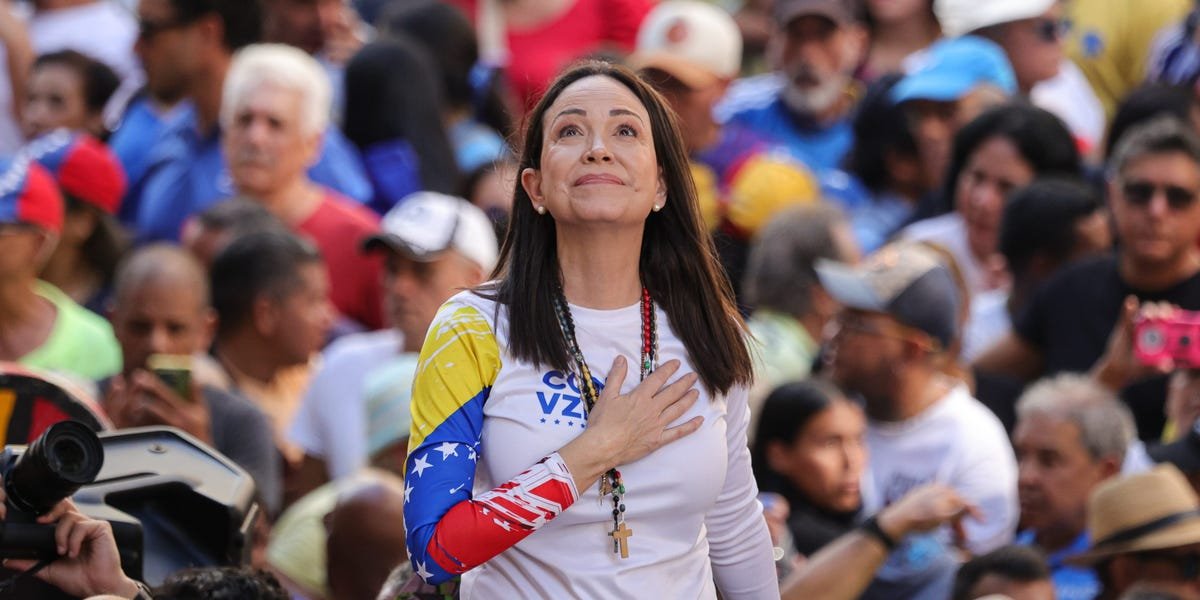
    2025: María Corina Machado


    María Corina Machado

    María Corina Machado.


    Jesus Vargas/Getty Images

    This year’s Nobel Peace Prize winner is Machado, a Venezuelan politician who is vocally opposed to the current leader of Venezuela, Nicolás Maduro.

    She earned the honor for “her tireless work promoting democratic rights for the people of Venezuela and for her struggle to achieve a just and peaceful transition from dictatorship to democracy.”

    Share. Facebook Twitter Pinterest LinkedIn Tumblr Email
    Press Room

    Related Posts

    Why ‘AI Is Amazing’ and ‘AI Is Our Doom’ Sound Like the Same Thing

    February 24, 2026

    Bryan Johnson Says He Wants an AI Agent to Read, Filter His Social Media Feed

    February 24, 2026

    ‘a Knight of the Seven Kingdoms’ Season 1: Easter Eggs, Book Details You Missed

    February 24, 2026
    Leave A Reply Cancel Reply

    LATEST NEWS

    Why ‘AI Is Amazing’ and ‘AI Is Our Doom’ Sound Like the Same Thing

    February 24, 2026

    ZachXBT Insider Trading Report Targets Major Crypto Firm in 2 Days

    February 24, 2026

    Bryan Johnson Says He Wants an AI Agent to Read, Filter His Social Media Feed

    February 24, 2026

    Arizona Named XRP in State Crypto Reserve

    February 24, 2026
    POPULAR
    Business

    The Business of Formula One

    May 27, 2023
    Business

    Weddings and divorce: the scourge of investment returns

    May 27, 2023
    Business

    How F1 found a secret fuel to accelerate media rights growth

    May 27, 2023
    Advertisement
    Load WordPress Sites in as fast as 37ms!

    Archives

    • February 2026
    • January 2026
    • December 2025
    • November 2025
    • October 2025
    • September 2025
    • August 2025
    • July 2025
    • June 2025
    • May 2025
    • April 2025
    • March 2025
    • February 2025
    • January 2025
    • December 2024
    • November 2024
    • April 2024
    • March 2024
    • February 2024
    • January 2024
    • December 2023
    • November 2023
    • October 2023
    • September 2023
    • May 2023

    Categories

    • Business
    • Crypto
    • Economy
    • Forex
    • Futures & Commodities
    • Investing
    • Market Data
    • Money
    • News
    • Personal Finance
    • Politics
    • Stocks
    • Technology

    Your source for the serious news. This demo is crafted specifically to exhibit the use of the theme as a news site. Visit our main page for more demos.

    We're social. Connect with us:

    Facebook X (Twitter) Instagram Pinterest YouTube

    Subscribe to Updates

    Get the latest creative news from FooBar about art, design and business.

    Facebook X (Twitter) Instagram Pinterest
    • Home
    • Buy Now
    © 2026 ThemeSphere. Designed by ThemeSphere.

    Type above and press Enter to search. Press Esc to cancel.