
From June 1 through June 13, I was in Park City, Utah participating in the Law Institute for Economics Professors run by the Law & Economics Center at Scalia Law School. It was a two-week crash course in American law and I will be sharing some insights over future posts (as an aside, if you are an economics professor, I highly recommend this program).
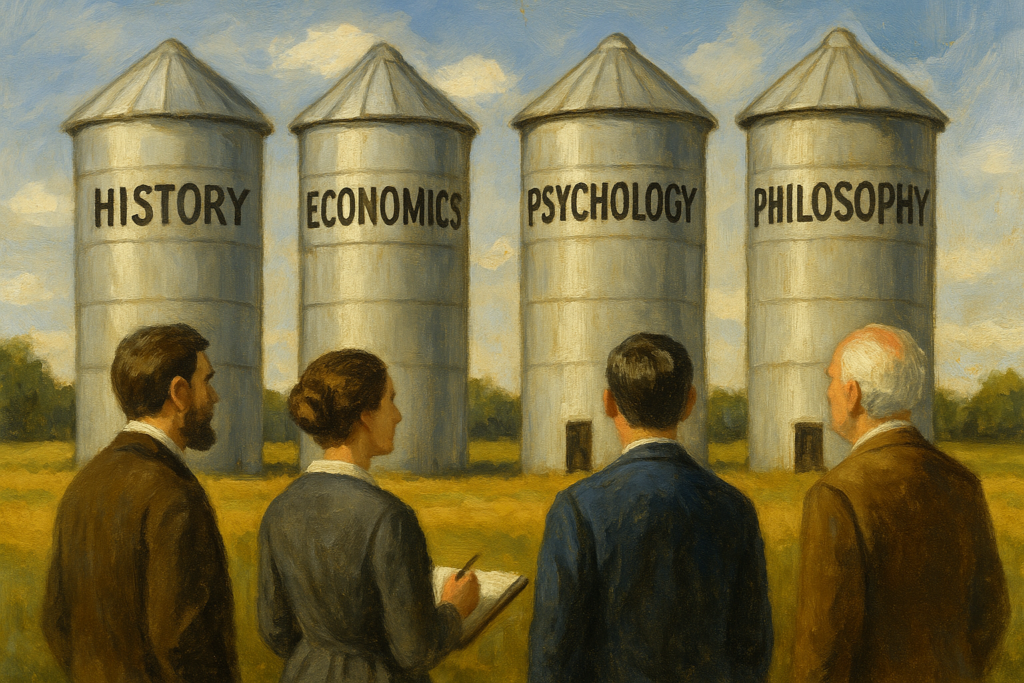
One of the big takeaways I had related to my research is how important it is to break down disciplinary barriers. There is a developing trend in American public discourse to separate things into distinct disciplines: X is a political issue, or Y is a public health issue. Thus, one should just “listen to the experts” in that field and ignore what everyone else says. I have seen this twice in the past 5 years. First, during the Covid pandemic, as governments were doing seemingly random policy, whenever economists would give an opinion, we would be told to “stay in your lane.” But, of course, economics permeates every aspect of our lives: it is the study of how people make choices given constraints. If you change the constraints, if you change the incentives, economics has a lot to say on that matter. Indeed, if the public health officials listened to economists (and other disciplines) more, they could have avoided the cascading failures that characterized the American response to Covid. More recently, economists are being told that our criticisms of Trump’s trade policy are irrelevant because it’s a “political” issue.
But attempting to separate issues into distinct silos leads to poor thinking. Economics (and other disciplines) have insights into real world problems beyond what some person claims is the nature of the problem. Yes, economics had things to say about pandemic spread because we knew that price controls lead to shortages, which in turn cause people to search more for the goods they need. Consequently, in a pandemic spread by close contact with each other, people have more contact points, creating more disease vectors, leading to increased spread. Economics also had insights on how to produce more needed goods, another thing which was ignored.
To bring this back to law and economics, one of the things that struck me during the conference is how much law and economics have to say to one another. I do not mean in the sense of Richard Posner, who argued that economics should shape law into being more efficient. Rather, I mean that both law and economics study social orders. We just come at it from different angles. To be clear, by “law” I do not mean simply statutes or government-created rules (although they are part of a social order). Rather, I refer to “law” as the broader set of rules, both government-created and emergent, that govern our daily lives. Economics has a lot to say about the emergence and the persistence of these emergent rules. Economics has a lot to say about the incentives that various legal actors face (judges, juries, expert witnesses, etc). And, likewise, the law has lots of things to say about how people bargain and exchange.
Adam Smith famously discusses how the division of labor can increase our productive capabilities and lead to more discoveries. But he also warns against extending this logic too far. If one becomes too specialized, it can lead to a “torpor of his mind,” rendering him “as stupid and ignorant as it is possible for a human creature to become” (Wealth of Nations pp. 781–782). Siloing is exactly that. Yes, we should specialize. But we must not become so ignorant of the world around us as to reject insights from other disciplines. To that end, I will be sharing some insights from the law over the next few posts.
