
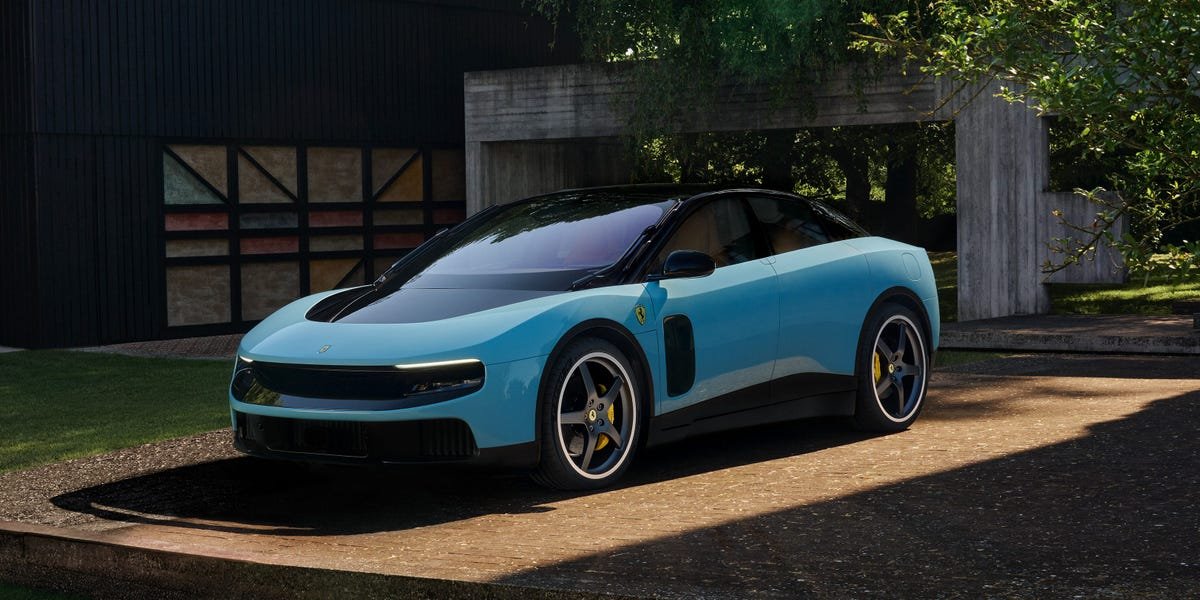
I love the Ferrari Luce. Not because I’m a Ferrari fan or want to buy one, but because it’s made me richer.
Since the Luce was unveiled earlier this week, a storm has raged across the internet. It’s clear there’s no brand in the world that’s as much a religion, and no product that’s worshipped as passionately, as a Ferrari. Even, and especially, by people who’ll never be able to afford one.
Why does that make me richer? Because classic Ferraris have become even more attractive and valuable. Classic Ferraris have always been my passion. Now they’re becoming my retirement fund.
A love for the classics
Ulf Poschardt
I’ve been driving Ferraris for 25 years. As a child from a modest background, I bought my first Ferrari with my first severance pay. It was a fiery red Ferrari 328 GTB, and although the car was pretty mediocre, the whole thing seemed like an incredible adventure to me — the kid from a rough neighborhood — in a car with that prancing horse on the steering wheel.
Twenty-five years later, there are four black Ferraris in my garage, and there is hardly anything in my life — aside from my sons — that brings me such joy as these useless but magnificent sports cars. In their restless irrationality, they shake every cell of my otherwise rational and rigorous life.
Enzo Ferrari once said that with Ferrari, you’re really just buying the engine — and getting the rest of the car for free. That has always been the brand’s Archimedean point. And perhaps that is precisely what explains the confusion surrounding the new electric Ferrari Luce.
A dislike of the new
Ferrari/Reuters
An electric car has, at first glance, nothing to do with the heroism of the old Lampredi or Colombo engines. It no longer possesses fascinating mechanics, no vibrating heart of metal. It rather resembles a digital device on wheels. The moral significance of modern mobility simply looks like the Luce. The heroization of mobility, on the other hand, looks like a Challenge Stradale, an F40, or a 250 GTO.
How much Ferrari is a brand close to people’s hearts is evident in the fierce reactions of those who may never own one yet still feel a deep emotional connection to it. For them, it is not reality that is crumbling, but a myth. There are few brands worldwide that evoke such quasi-religious reactions.
Ferrari’s concept has always been to translate the brutal and the raw into the most elegant and sophisticated aesthetics imaginable and bring them into the present. The Luce, on the other hand, employs a form of mimicry that borders on the childish.
In places, the car is reminiscent of a Flintstones car or those Playmobil vehicles with which children embark on their first imaginary highway rides through the sandbox. Of course, both CEO Benedetto Vigna and Chairman of the Supervisory Board John Elkann were likely aware of the potential for sacrilege inherent in such a design.
With Marc Newson and Jony Ive, Ferrari brought in two designers from the digital world. They didn’t want to hide the electric innards behind nostalgic forms. On the contrary, they built, in a sense, an anti-Ferrari. The logo is no longer proudly displayed, but almost demonstratively embossed. A clever, almost philosophical punchline.
The Luce seems almost deliberately alien in places, almost like an object without geographical origin, without cultural memory. While older Ferraris looked as if they belonged on country roads around Lake Como or among the curves of southern French coastal roads, the Luce seems to come from the abstract space of the digital present — from a world that is everywhere and nowhere at the same time.
That “everywhere and nowhere” nature of digital space is coolly acknowledged and consistently implemented in this car. While the old entrepreneurs were still heroes of an analog industrial age — men who, even after work, would take breakneck drives in their Ferraris (and I still very much enjoy doing so) — today’s digital founders and multimillionaires often define their worldview precisely in contrast to this old-school entrepreneurship. It is a car for emotionally detached intellectuals with no need for compensatory status symbols.
The memes about the Luce ultimately show one thing above all: How emotionally charged this brand remains to this day. Everyone loves Ferrari. The Luce seems to violate the realm of dreams and desires.
The value of the classics
Ulf Poschardt
Perhaps the Luce will go down in Ferrari history as its boldest gamble. Or perhaps as a spectacular dead end. The only certainty is this: Ferrari has decided to attempt this transformation not cautiously, but radically. And in that alone lies a remnant of that old Ferrari megalomania that has always made this brand so fascinating.
The Luce is, at the same time, a car of radical anti-distinction. Precisely because it looks like a Nissan, it makes itself small, almost inconspicuous — even though highly valuable technology is hidden beneath its exterior: a powertrain concept with over 1,000 horsepower, designed to accelerate the Luce to up to 310 km/h on the highway.
Who cares, though? Somebody recently called and offered me a lot of money for my black Testarossa. He saw the video of my triumphant ride the day after the Luce presentation.
“I don’t sell,” I replied. I never will. I’m the guardian angel of Enzo Ferrari’s spirit.
Ulf Poschardt is the publisher of WELT, POLITICO Germany, and Business Insider Germany.
This story is courtesy of the Axel Springer Global Reporters Network, which harnesses the resources of the company’s newsrooms to publish ambitious scoops, investigations, interviews, opinion pieces, and analysis. It allows journalists — including those from POLITICO, Business Insider, WELT, BILD, Onet and Fakt — to collaborate on major stories for an international audience of hundreds of millions across platforms.
