
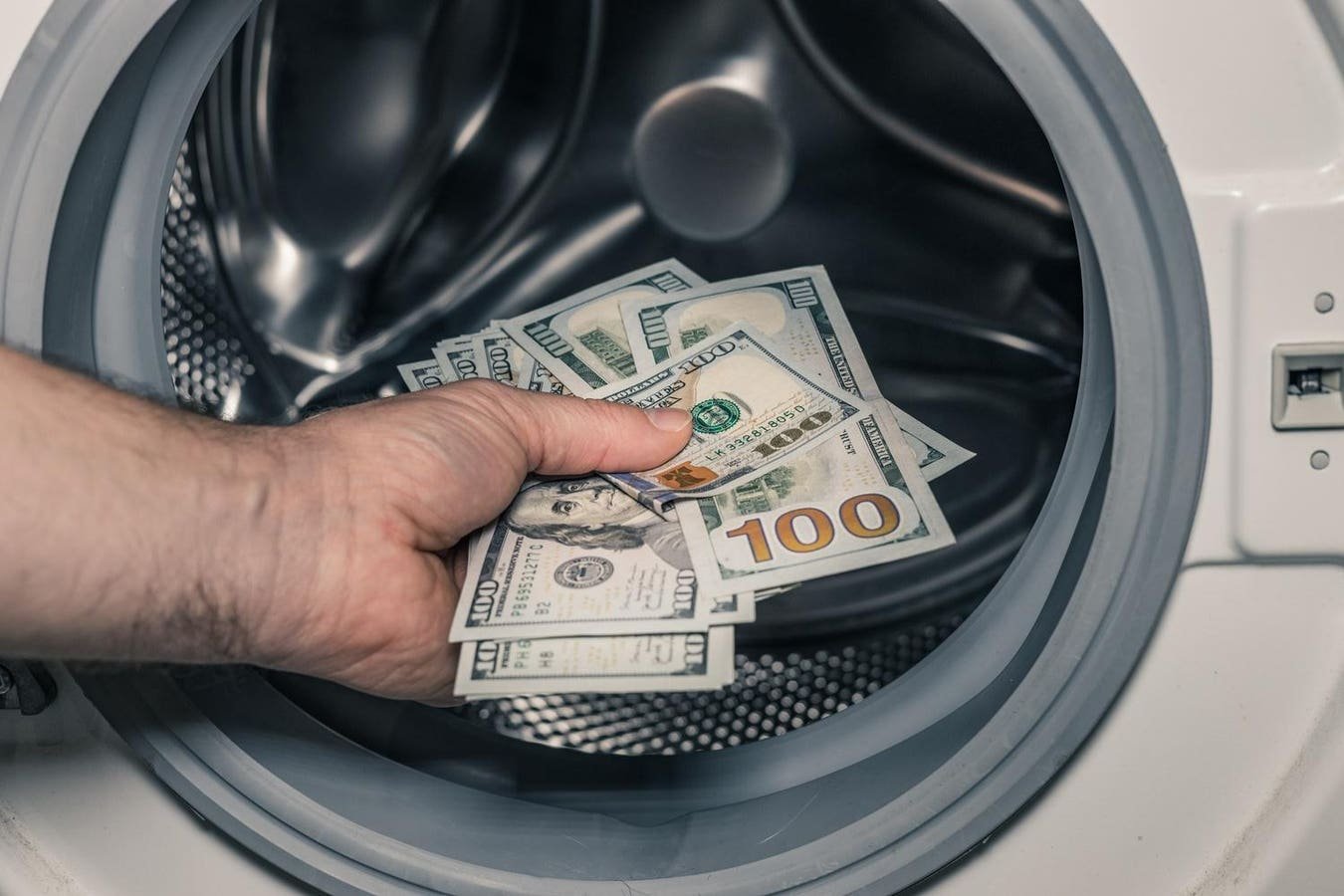
American dollars being put into the washing machine, Concept, Money laundering, Illegal business … [+]
The “Center for Art Law Report on Anti-Money Laundering and Art” [1]is an enlightening and comprehensive guide that explores the practices of Anti-Money Laundering (AML) in the art sector across EU member states and the UK, following the enforcement of the EU’s 5th AML Directive in 2018. This Directive brought the art world under closer scrutiny by EU’s AML regulations, particularly due to the increasing association of art financing with terrorist activities.
What sets this report apart is its pioneering effort in compiling a guide of this nature. It features survey responses from leading Art Law experts across 14 jurisdictions, offering valuable insights. The report delves into the specific AML laws that apply in each country, their approach to Non-Fungible Tokens (NFTs), and the array of sanctions in place. Not only does this approach provide a comprehensive understanding of the diverse legal landscapes, but it also raises awareness about the implications for participants in the art market throughout Europe and beyond.
In Austria, the approach to AML is comprehensive and encompasses various laws, such as the Financial Markets Anti-Money Laundering Act, the Beneficial Owner Registry Act, and the Trade Act. These regulations prioritize due diligence, identification of beneficial owners, and ongoing monitoring of business relationships. Special attention is given to Politically Exposed Persons (PEPs) and transactions involving high-risk countries, requiring enhanced due diligence. Failure to comply with these regulations can result in significant sanctions.
In Belgium, a law was enacted in response to the EU AML 5th Directive, which came into effect on January 1, 2022. This law applies to art transactions and covers art galleries, dealers, auction houses, and freeports, but excludes artists and public museums. It defines ‘works of visual art’ and clarifies that NFTs are generally not included in this category. The AML regime in Belgium mandates the registration of art market participants and applies to those engaging in regular trading activities involving artworks.
These insights into Austria and Belgium exemplify the EU’s approach to AML regulations in the art sector. They demonstrate the meticulous regulatory frameworks and specific compliance requirements imposed on art market participants. However, it is unfortunate that the document did not provide direct comparisons with the US approach, which would have offered a more comprehensive understanding of the differences between the two regions in combating money laundering in the art world.
The perspective on Anti-Money Laundering (AML) in the art market differs significantly in the United States. In the U.S., the main legislation governing AML is the Bank Secrecy Act (BSA), which was established in 1982 and later amended by the Anti-Money Laundering Act of 2020, a part of the National Defense Authorization Act (NDAA) of 2020. The latter specifically addresses the regulation of “antiquities.”
Here are key aspects of the U.S. Art AML Regulations:
1. Scope of Regulation: The AML Act of 2020 includes provisions for individuals “engaged in the trade of antiquities.” This encompasses advisors, consultants, and anyone involved in the business of selling antiquities. However, the exact definition of institutions or individuals to be included under these regulations is still being finalized.
2. Rulemaking and Implementation: The responsibility for determining the scope of rulemaking lies with the U.S. Treasury, in conjunction with the FBI, Attorney General, and Homeland Security. Factors such as business size, type, and location will be considered when deciding which individuals or businesses should be regulated.
3. Concerns by FinCEN: FinCEN, a part of the U.S. Treasury, has expressed concerns regarding money laundering and terrorist financing in the trade of art and antiquities.
4. Proposed Rulemaking: In 2021, FinCEN published an Advanced Notice of Proposed Rulemaking, seeking feedback on various aspects related to the application of the BSA to the trade of antiquities. However, as of July 2023, no regulations pursuant to the AML Act have been drafted or proposed, and FinCEN has surpassed the deadline set by Congress for taking this action.
5. High Risks/Red Flags: The specific high risks or red flags associated with money laundering in the art market are yet to be clarified in the implementing regulations. However, there is a focus on high-value trades in antiquities and the identification of actual purchasers, as well as agents or intermediaries involved in transactions.
6. Record-Keeping and Reporting Requirements: Current regulations for financial institutions include reporting cash transactions exceeding $10,000 and filing Suspicious Activity Reports (SARs). However, the specific requirements for antiquities dealers and a broader range of participants in the art market are still being finalized.
7. Reporting System: FinCEN provides an e-filing system for SARs, enabling regulated entities to report suspicions of money laundering.
The approach taken by the United States is still in the development stage. Key aspects, such as the scope of regulations, high-risk factors, and specific reporting and record-keeping requirements, are yet to be finalized. This stands in contrast to the more established and detailed frameworks in the European Union, where the 5th Directive has been implemented across various member states, accompanied by specific guidelines for art market participants.
While this report is innovative and comprehensive, it is important to note that it does not constitute legal advice. Rather, it serves as a valuable compilation that enhances our understanding of the intricacies of Art AML laws. The inclusion of the US approach for comparison purposes adds an extra layer of depth, making it a must-read for professionals and enthusiasts alike who are eager to navigate the complex intersection of art and AML regulations. Overall, this is an excellent read for anyone interested in either anti-money laundering laws or the global art market.
[1] Center for Art Law is a Brooklyn-based nonprofit that offers educational resources and programming for the advancement of a vibrant arts and law community. Center for Art Law – At the intersection of visual arts and the law (itsartlaw.org)
