
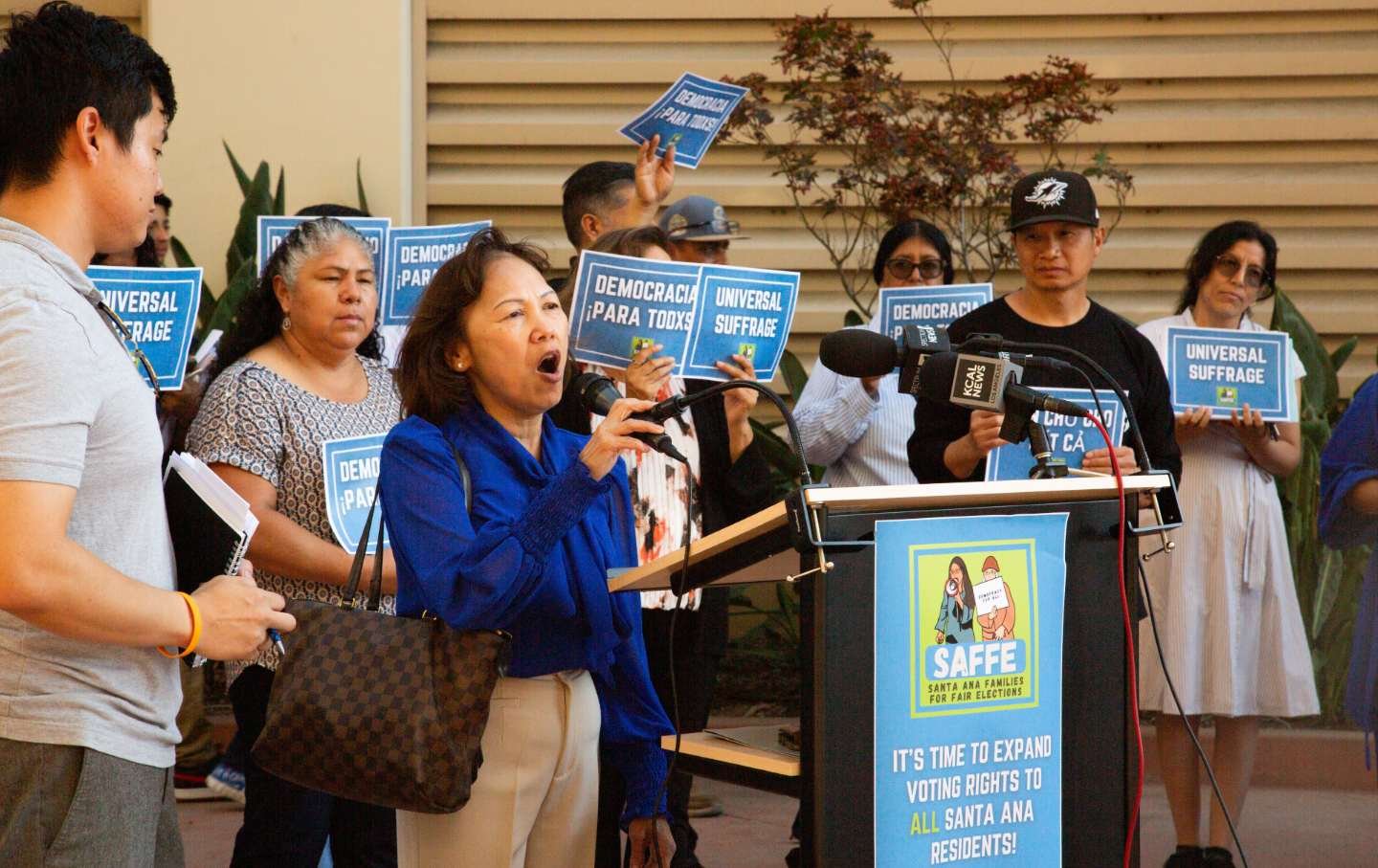
Measures to allow local noncitizen voting failed in the last election, but that hasn’t always been the case throughout American history.
Santa Ana Families for Fair Elections launching a campaign to expand local noncitizen voting in September 2023.
(Santa Ana Families for Fair Elections)
Carlos Perea remembers listening to his mother’s stories about dodging immigration raids in Orange County’s textile factories.
“There was this interesting dynamic in Orange County at the time, being heavily anti-immigrant but relying on immigrant labor,” said Perea. “It showed me how we’re treated as Mexicans, as undocumented people.”
Perea, a Deferred Action for Childhood Arrivals (DACA) recipient, came to the United States at 14, joining his mother who had immigrated a decade earlier. He arrived in Santa Ana, Orange County, just as the Bush administration launched sweeping workplace raids targeting undocumented workers across the nation. At the same time, Los Angeles erupted in historic protests, including “La Gran Marcha,” where more than half a million people marched for immigrant rights. A few years later, Perea would be involved in the Dreamer movement challenging Obama on mass deportations.
In 2012, after years of pressure, Obama enacted DACA through executive action. But the more protective pathways to citizenship for millions of undocumented people died in Congress, and have never been revived. “A lot of these fights started to sharpen our politics,” said Perea, now the executive director of the Harbor Institute for Immigrant and Economic Justice. “Are we going to continue to have our immigrant communities be this chess piece for the Democratic Party or Republican special interest? Are we going to constantly be tossed around and gain no meaningful outcome?”
For thousands of progressives in Santa Ana, the way forward was clear: Power needed to come from the bottom up. Recognizing a “crisis of democracy” at the local level, Perea and others in the Latino and Vietnamese communities of Santa Ana began campaigning for the right to vote as noncitizens.
In November of 2024, these efforts culminated in a measure on the Santa Ana ballot. Measure DD proposed expanding the right to vote to noncitizens in general municipal elections by 2028. The measure, the first of its kind to be proposed in Southern California, failed by a margin of 59 percent to 41 percent—fewer than 15,000 votes. “This was something people thought was impossible to even get on the ballot,” Perea said. “I think it speaks volumes that there were a large number of people in Santa Ana ready for noncitizen voting on our first try.”
Current Issue

Twenty-two localities already allow noncitizen voting of some sort, including San Francisco and Oakland. Each of these municipalities has distinct laws governing noncitizen voting. Some only allow lawful permanent residents to vote, and most limit it to parents in school board elections. Currently, 16 towns in Maryland, two cities in California, three towns in Vermont, and the District of Columbia allow noncitizens to vote in local elections. Four municipalities in Massachusetts have also passed local voting laws, but, without approval from the state, they can’t implement them.
Measure DD was one of the boldest and most inclusive proposals to date, with its definition of “noncitizen” encompassing permanent residents, refugees, undocumented immigrants, DACA recipients, and those on school or work permits.
“We established a narrative—now people know what noncitizen voting is,” Perea said. “It’s going to be our job now to make the case of presenting this as the North Star of the [immigrant] movement. It’s going to be a tough battle, but we have nothing to lose.”
From the country’s founding until 1926, 40 states at various points allowed noncitizen immigrants to vote in local, state, or federal elections, according to Ron Hayduk, a professor of political science at San Francisco State University. “History flies in the face of this idea that immigrants never could or never should be voting. That it’s improper, that it’s unconstitutional, that it’s illegal. In fact, history shows that it’s the opposite,” said Hayduk. “I like to say that it’s as American as apple pie and older than our national pastime: baseball.”
Noncitizen voting, then called “alien suffrage,” was seen as a pathway to foster citizenship and immigrant integration. Millions of immigrants from Western and Northern Europe voted, often advancing anti-slavery and pro-worker causes. But these alien suffrage laws began to change as more immigrants came to the US from Southern and Eastern Europe—Italians, Slovaks, and Jews—who were not seen as white and were often associated with socialist and anarchist ideologies.
Between 1840 and 1900, voter turnout in presidential elections was between 70 and 80 percent of the eligible population. However, by 1924, voter turnout had plummeted to 49 percent, coinciding with broader efforts to curtail voting rights and immigration. The Chinese Exclusion Act of 1882 marked the beginning of these restrictive policies, followed by limits on immigration that reduced annual admissions from as many as 800,000 to 150,000 people. These changes compounded with other restrictive election reforms—such as state poll taxes, literacy tests, and felon disenfranchisement laws—limited democratic and progressive possibilities for decades. Arkansas was the last state to eliminate alien suffrage in 1926.
Immigrant voting was restored in New York City in a limited way during the civil rights era, led by African American and Latino activists as part of a larger movement for community control in school board elections. In the 1980s and ’90s, the sanctuary movements further inspired the restoration of noncitizen voting in Maryland.
In 1993, Representative Jamie Raskin wrote a seminal law journal article that put immigrant voting back on the map and helped Takoma Park, Maryland, enact noncitizen voting laws. “He said at the time, ‘Immigrant rights are like the civil rights of the day.’ And by that logic, noncitizen voting is the suffrage movement of our time,” Hayduk said.
In early 2020, driven by Santa Ana’s growing immigrant population from Vietnam and Latin America—according to county data, 29.5 percent of the residents are noncitizens—the campaign to restore noncitizen voting in the city found its footing.
Inspired by the passage of San Francisco’s Proposition N in 2016—following failed attempts in 2004 and 2010—advocates saw a path forward for Santa Ana. A coalition, called the Santa Ana Families for Fair Elections, spearheaded the campaign for noncitizen voting with support from the ACLU of Southern California.
Mayor Valerie Amezcua strongly opposed Measure DD, citing concerns about the expenses of a new voting system and costly litigation similar to what occurred in San Francisco. Additionally, two council members backed by the police union and department association opposed the measure, and some members of the progressive wing concerned about reelection called it too radical of a step. “That to me was a clear example of us as advocates deciding to move forward,” Perea said. “What is the point of building a progressive movement if we do not deliver?”
The coalition seized on the centuries-old American slogan, “No taxation without representation,” framing noncitizen voting as both a democratic and economic issue. Immigrants in Santa Ana contribute more than $117 million in state and local taxes yet have no political say over how those funds are spent. According to city council member Johnathan Hernandez, 70,000 noncitizen residents of voting age—many of whom are business owners and parents—remain excluded from decision-making. “For many it came down to the principle,” Perea said. “I care about the economy. I care about my people. I care about how, locally, my tax dollars are spent.”
“Robust and inclusive political participation leads to more diverse representative bodies, making representatives more responsive to all constituents and fostering more effective public policy,” Hayduk said. A report on the impact of immigrant voting in San Francisco showed that noncitizen voting programs can increase broader civic engagement. “These programs encourage greater parental involvement, which in turn, contributed to improved student achievement, reduced drop-out rates, and better school attendance.”
Studies on immigrant voting programs in the United States, as well as global studies on noncitizen voting in Sweden, Norway, and Latin America, have found positive outcomes in promoting naturalization and immigrant integration. Over 40 countries on nearly every continent allow for some form of noncitizen voting in local, regional, and even national elections.
The opposition against Measure DD raised over $1 million, while the grassroots campaign operated on a much smaller budget of just $10,000. Perea said that this level of expenditure on council races or ballot initiatives was “unprecedented” in Santa Ana. “[It] speaks volumes as to who feels threatened by immigrants and refugees having a seat at the table,” Hernandez said. “Who is it that we’re afraid of? What is going to happen if noncitizens vote? I think Santa Ana becomes a safer and vibrant community. That’s what residents should be afforded.”
As Measure DD in Santa Ana failed, voters in eight states—Idaho, Iowa, Kentucky, Missouri, North Carolina, Oklahoma, South Carolina, and Wisconsin—passed constitutional amendments explicitly banning noncitizen voting. Proponents of these measures, like Republican state Representative Michael Meredith of Kentucky, argued that they were a proactive way to “get ahead of” potential local charter changes that might enfranchise noncitizens in the future and safeguard elections for eligible voters.
A surge in election skepticism and anti-immigrant rhetoric accompanied the amendments, in part driven by President-elect Donald Trump and Speaker of the House Mike Johnson. Both perpetuated false claims about noncitizens voting in federal elections. In September, Johnson threatened to shut down Congress if the Safeguard American Voter Eligibility Act—a measure requiring proof of citizenship to vote in federal elections—was not passed.
Popular
“swipe left below to view more authors”Swipe →
“This othering criminalization of immigrants and keeping these myths alive justify draconian immigration restrictions to keep minority rule,” said Hayduk. “It was an attack on the legitimate place of immigrants in our polity, and plays on these ‘Great Replacement’ fears.”
Measures like those passed in November provide a pretext to impose voter suppression tactics, according to Hayduk, such as requiring proof of citizenship and strict voter ID laws. A national survey showed that one in 10 adult citizens—around 21.3 million eligible voters—said they would not be able to easily produce their citizenship paperwork in preparation for next-day voting. Other tactics include voter purges and reducing the time frame for mail-in voting. States that misuse DMV records to cross-reference citizenship can flag previous permanent residents who haven’t updated their driver’s licenses to reflect their citizenship status. “The challengers will challenge folks with Latino surnames, Latino in appearance, and those challenges could deter some voters from participating,” said Thomas A. Saenz, president of the Mexican American Legal Defense and Educational Fund. Moreover, with Trump promising mass deportations, some fear that their pathway to citizenship may be jeopardized if they participate in local noncitizen voting.
Elsewhere in California, the California Local Voting Coalition, a group working to expand voting rights, continues to push for local noncitizen initiatives statewide. Emerging campaigns are underway in Richmond, San Jose, Long Beach, and Pasadena. Across the nation, similar efforts are gaining traction in Maine, Ohio, and Connecticut. Meanwhile, the legal challenge to New York City’s noncitizen voting law is set to reach a final ruling in the coming months.
“I think [Trump] is going to radicalize a lot of our community,” Perea said. “Many folks are going to become active. If the extreme right is saying the most outrageous things about immigrants, we are going to have to push for the most radical idea. To present clear divergent views.”
Hayduk said the constant scrutiny on whether noncitizens are voting illegally stifles genuine discussions about the merits of local noncitizen voting and humane immigration law. “It’s a missed opportunity for Democrats and progressives more broadly.” Hayduk said. “Debate about immigration and voting rights cuts right to the heart of issues embroiling the nation. Big questions about who is an American and what is the nature of America. Are we a multiracial egalitarian society? Or are we an Anglo-Christian white republic? This is a time to invite the public to think about who ‘we the people’ constitute.”
More from The Nation
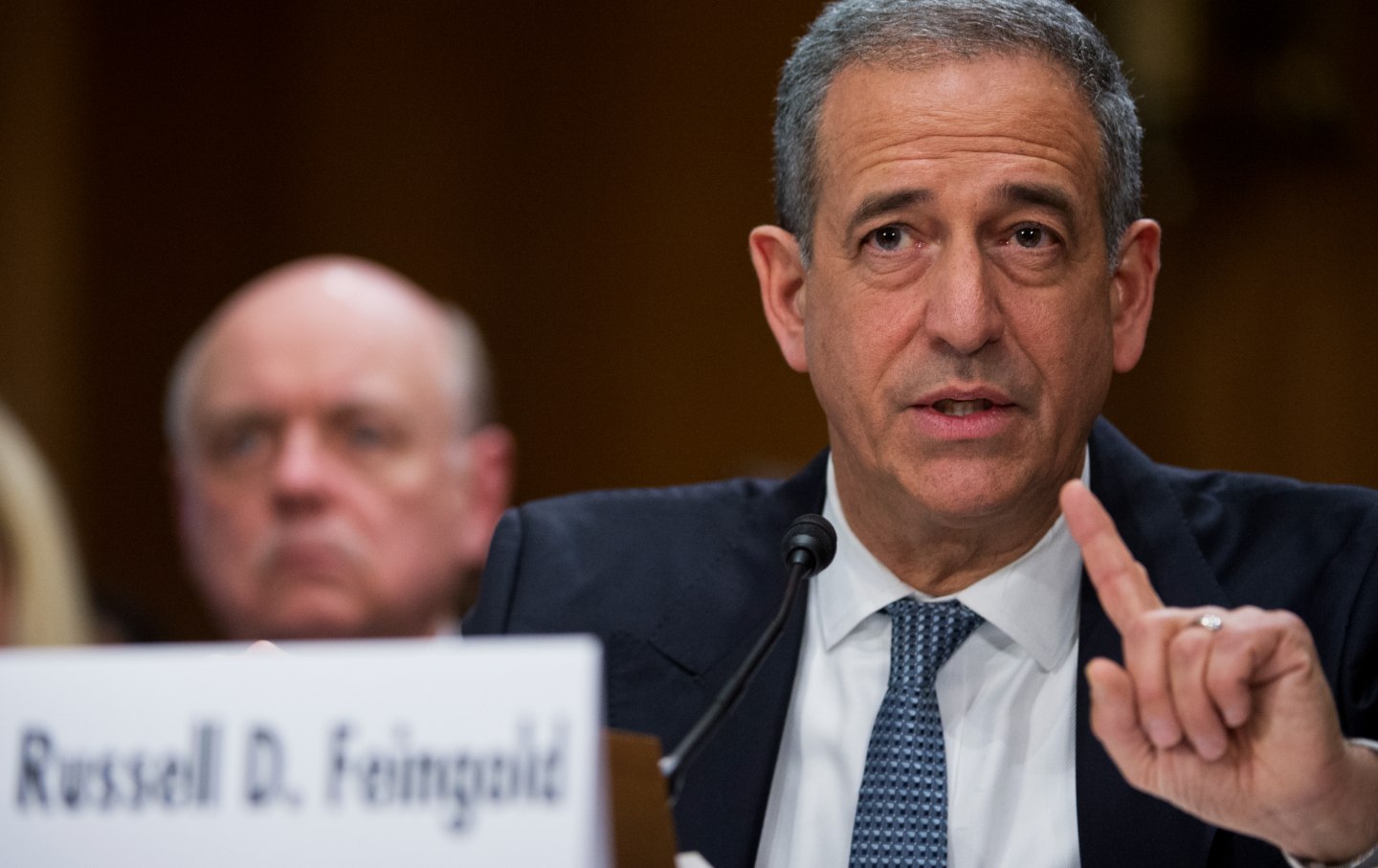
The head of the American Constitution Society says President Biden is right: The ratification standard has been met.
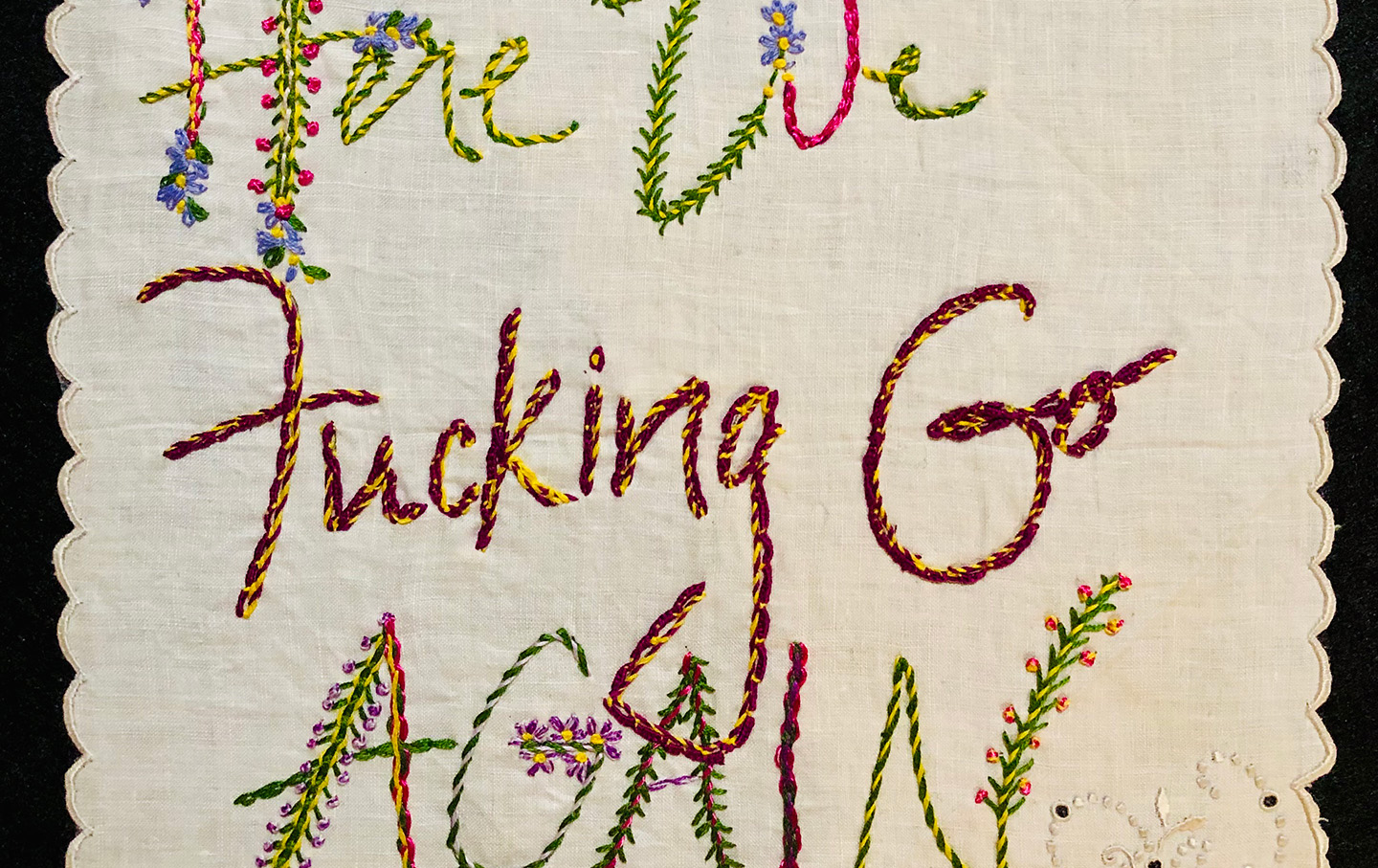
Trump’s second term will bring enormous challenges for the nation and for the world.

In front of Trump stood a handful of CEOs whose combined wealth topped $1.2 trillion. They and the crypto scammers are the true beneficiaries of Trump’s second term.
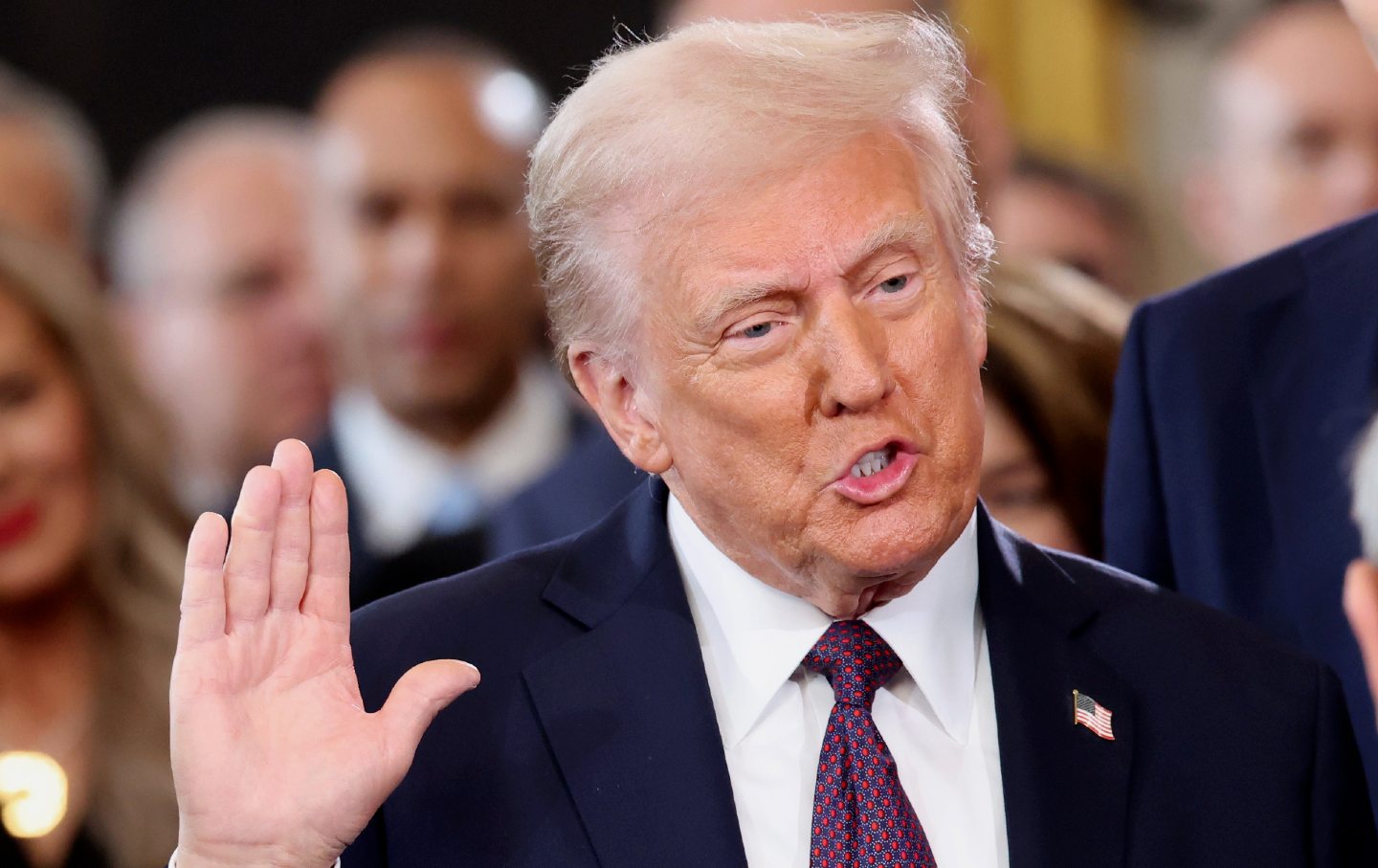

In 2020, after losing his bid for reelection to Joe Biden, Donald Trump summoned a mob to the Capitol. Today, as we mark the peaceful transfer of power, we offer this reminder.
