
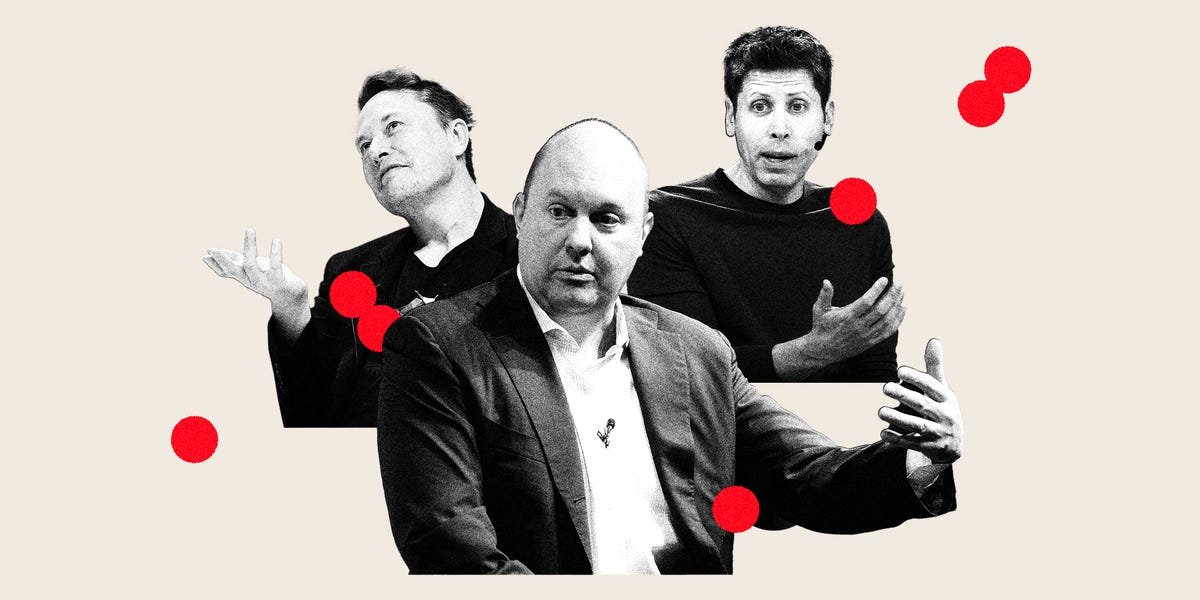
Since a turtlenecked Steve Jobs strode the global stage, tech executives and venture capitalists have doubled as company hypemen, churning out aspirational koans and fantastical assurances about how their products will change the world. As full-time salesmen — especially in the age of virality and world-historic funding rounds — they’re incentivized to offer outlandish predictions, promising to settle other planets, reconfigure human consciousness, conquer sleep or death, and financialize every breath of human life. Or just to say some bizarre things about how humanity works.
A recent example of this kind of talk came last month from OpenAI CEO Sam Altman, who was defending his company from criticism that training AI models takes huge amounts of energy. Responding to an interviewer from The Indian Express, Altman said:
“One of the things that is always unfair in this comparison is that people talk about how much energy it takes to train an AI model relative to how much it costs a human to do one inference query. But it also takes a lot of energy to train a human. It takes like 20 years of life, and all of the food you eat during that time, before you get smart.”
Altman was scorched on social media for distilling human beings as little more than long-gestating productivity machines. “This is how industrial agriculture talks about livestock,” wrote the historian Sam Haselby.
More often than not, this kind of off-the-cuff sensationalism is rewarded by the media, investors, and markets, who have a heavy appetite for bombastic chief executives. Over the weekend, web browser pioneer-turned-venture capitalist Marc Andreessen told an interviewer that he essentially has no inner life. And he’s proud of it.
“If you go back 400 years, it would never have occurred to anybody to be introspective,” said Andreessen, apparently disregarding thousands of years of literary and philosophical history, from Marcus Aurelius to Augustine to Rene Descartes. Introspection gets in the way of doing great things, he explained. “Move forward. Go.” Later, Andreessen doubled down. “Introspection = neuroticism x narcissism x thumbsucking,” he posted on X. And he challenged his doubters: “Ratio me, navelgazers.”
Beyond getting ratioed by navelgazers, there is little downside for making these kinds of all-encompassing, grandiose statements about human life. The same goes for being unbelievably bullish about your company’s prospects and eventually being wrong, as Elon Musk has proven many times in his evolving predictions about Tesla’s autopilot capabilities and his solar-system exploration. In an environment that rewards virality above all, the market cap for insanity is infinity.
There is little downside for making these kinds of all-encompassing, grandiose statements about human life.
Tech ambition used to be represented by aspiring toward 1 billion users — a mile marker reached by a handful of now-dominant companies, like Meta, Alphabet, and Microsoft. Lately, CEOs talk about their startups devouring the world. Last December, Tarek Mansour, the 29-year-old cofounder of prediction market Kalshi, was asked to elaborate on his own promise that prediction markets would eventually be bigger than traditional stock markets. Mansour decided to one-up himself, telling the interviewer that he wanted it all: “‘Kalshi’ is ‘everything’ in Arabic. The long-term vision is to financialize everything and create a tradeable asset out of any difference in opinion.”
The “financialization of everything” was once a warning about how markets were taking over areas of life that had once been considered walled-off from pecuniary concerns. Now it’s the ultimate business strategy.
There’s a lineage here, a public record of a world-eating worldview coming into its own. A canonical example came during a 2017 Netflix earnings call, when CEO Reed Hastings told investors and analysts that his company’s only competitor wasn’t Amazon Prime or Hulu; it was sleep. “When you watch a show from Netflix, and you get addicted to it, you stay up late at night,” Hastings said. “We’re competing with sleep, on the margin. And so, it’s a very large pool of time.” The idea that the corporation was up against the time limitations of biology practically became company policy. “Sleep is my enemy,” read a contemporaneous post from Netflix’s official Twitter account.
Backed by unprecedented amounts of cash — OpenAI is reportedly raising a $100 billion investment round — tech elites seem to have an ever-rising mandate to put forth incredible claims. When they’re getting bankrolled to build data centers that take up entire zip codes, they are, in essence, eating the world, divvying it up among themselves. Now competing on social media with influencers, pop stars, and presidents, they often seem more intent on recruiting converts than customers. They offer dark prophesies about humanity succumbing to the apocalyptic potential of runaway AI or to the machinations of climate-change campaigner Greta Thunberg, who venture capitalist Peter Thiel has repeatedly said might be the antichrist.
The growing bloat of popular tech rhetoric could serve as evidence for how the tech industry, having conquered so much of daily life, work, and entertainment, has begun to exhaust its imaginative capacities. Industry leaders promised that the mammoth capital for AI outlay would lead to the creation of a smarter-than-human intelligence that would serve as a universal solvent, fixing climate change, poverty, and even the problem of death itself. But that horizon — which we are supposed to reach by pumping out more fossil-fuel emissions and destabilizing labor and education — remains impossibly far away.
Tech elites speak to the public as if revolutionary change is always around the corner.
“My prediction is that work will be optional,” said Elon Musk, citing advancements in AI and robotics, at a US-Saudi investment summit in January. “It’ll be like playing sports or a video game or something like that.”
His rival Sam Altman has offered a comparably rosy, almost post-capitalist vision. According to the OpenAI CEO, AI will eventually lead to the creation of “universal extreme wealth.”
Using similar language, Musk has promised that AI will create “universal high income.” The world’s richest person was long known for saying that he needed to accumulate $1 trillion to build a human colony on Mars. Lately, as his paper wealth has surpassed $700 billion, he’s downscaled his ambitions, saying that the moon is a better candidate for settlement.
Tech billionaires are rarely asked to explain themselves in a substantive way. The interviewers questioning Altman and Mansour onstage offered little more than respectful murmurs in response to the CEOs’ Olympian pronouncements. Andreessen’s subsequent posts on X have mostly been trollish challenges to his critics, not a considered explanation of his belief system.
One exchange offered a vivid example of the paper-thin foundation behind one of tech’s most extravagant fantasies. Last year, Musk told an interviewer that the automatic language translation feature on X could help create a “collective consciousness” comprising “the thoughts of people in every language group.”
It was a heady possibility, recalling Musk’s promise to “extend the light of consciousness” throughout the solar system. Perhaps he could elaborate.
“And why is that important, Elon?” asked the interviewer, the billionaire investor Nikhil Kamath. “Collective consciousness, to have one platform.”
Musk struggled to muster a reply, first restating the question, then going quiet, before talking abstractly about the trillions of synapses in a human mind. Finally, he settled on a familiar answer: “The why, I guess, is to increase our understanding of the universe.”
He might have said that allowing people of varying linguistic backgrounds to communicate in real time with one another is a powerful tool to bring humanity together. But such talk might have also sounded dangerously close to an embrace of the woke multiculturalism that Musk so routinely denounces. Instead, Musk was, at least for a moment, out of ideas.
Jacob Silverman is a contributing writer for Business Insider. He is the author, most recently, of “Gilded Rage: Elon Musk and the Radicalization of Silicon Valley.”
Business Insider’s Discourse stories provide perspectives on the day’s most pressing issues, informed by analysis, reporting, and expertise.
