
In a recent case, the Tax Court again considered whether the 90-day time period to file a deficiency petition in the Tax Court is jurisdictional in nature. This is not the first time that the Tax Court has been called to answer this question in the wake of Supreme Court cases that have sought to clarify when deadlines are jurisdictional. For example, in Hallmark Research Collective, the Tax Court held that being a single day late in filing the petition deprived it of jurisdiction (read my prior coverage of the Hallmark case here).
Section 6213 provides that once the IRS issues a notice of deficiency to a taxpayer, the taxpayer has 90 days (or 150 days if the taxpayer is outside the United States) to file a petition with the Tax Court for a redetermination of that deficiency. An issue that unfortunately arises is what happens when the taxpayer files the petition late. If the deadline is jurisdictional in nature, that means the Tax Court cannot consider the petition (as it does not have jurisdiction at that point).
The Tax Court has long held that the deadline in § 6213 is jurisdictional in nature; thus, it cannot review a late petition. However, as explained more below, at least one circuit court of appeals (the Third Circuit) has disagreed with the Tax Court’s interpretation of § 6213. In the case below, the Tax Court expressly considered whether it would agree with the Third Circuit’s interpretation or stick with its own interpretation of § 6213.
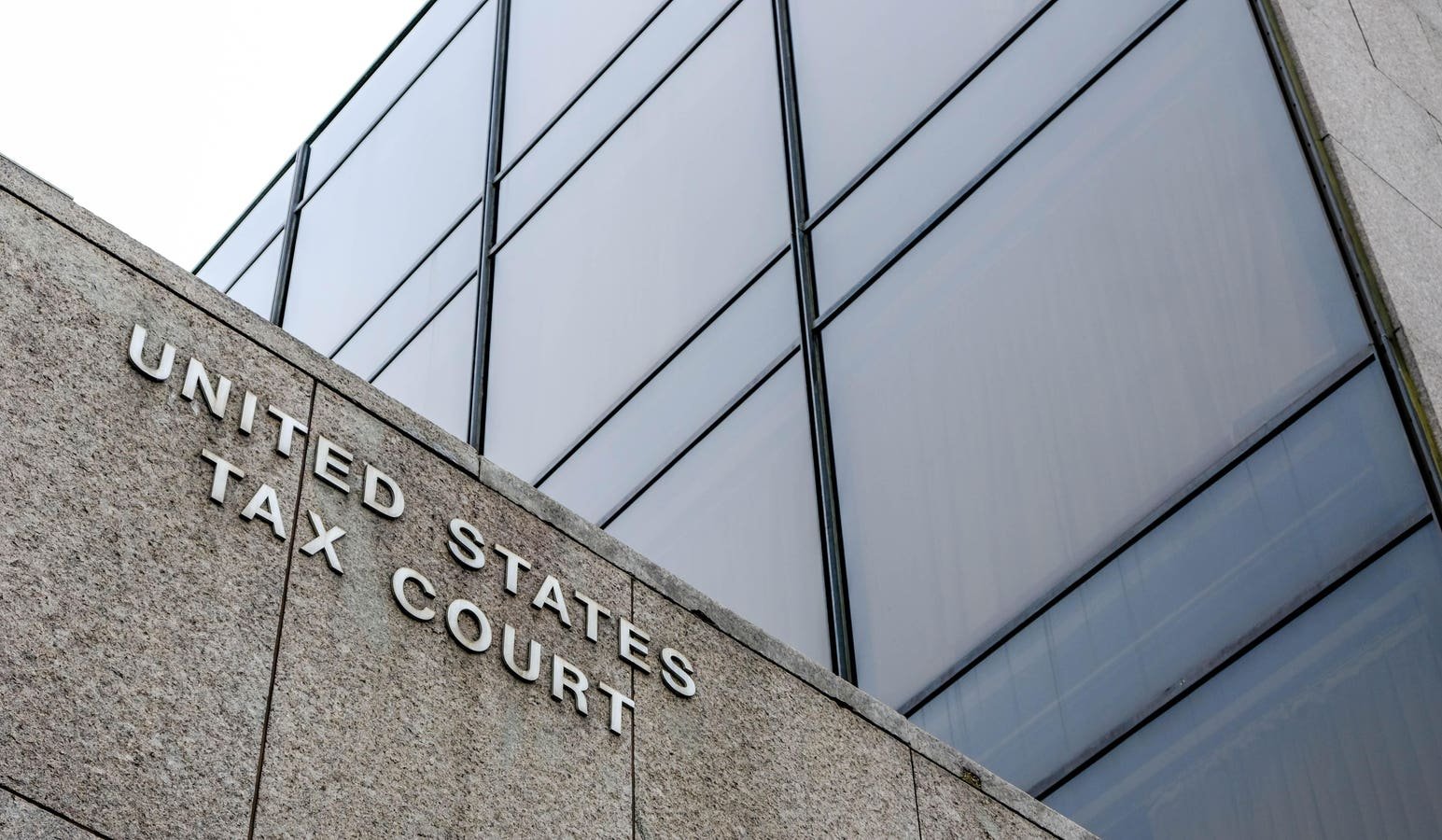
United States Tax Court building in Washington DC
The salient facts of the case are as follows. In 2022, the IRS issued a notice of deficiency against the taxpayer for tax year 2018. The petitioner filed a petition in the Tax Court, but it was postmarked two days after the expiration of the 90-days permitted under § 6213. Accordingly, the Commissioner moved to dismiss the petition for a lack of jurisdiction, arguing that the petition was not timely filed.
The Tax Court analyzed whether the 90-day deadline is jurisdictional for deficiency cases. Importantly, the taxpayer lived in Maryland, meaning that the case would be appealable to the U.S. Court of Appeals for the Fourth Circuit, which has not yet addressed this issue in a precedential opinion.
The Tax Court started with the major premise that it is a court of limited jurisdiction, and it can exercise jurisdiction only to the extent allowed by Congress. It then turned to history, noting that its predecessor—the Board of Tax Appeals—had characterized its then-60-day deadline as jurisdictional in nature.
Tracing the statutory lineage, the Tax Court noted that, although Congress has amended § 6213—for example, by changing the 60-day deadline to 90 days—it has not amended the text “so as to expressly disturb the courts’ settled interpretation of the 90-day deadline as a jurisdictional requirement.”
The court also noted recent Supreme Court cases that it described as trying ‘“to bring some discipline’ to the judicial treatment of procedural requirements as ‘jurisdictional.’” (MOAC Mall Holdings LLC v. Transform Holdco LLC, 598 U.S. 288, 298 (2023) (quoting Henderson ex rel. Henderson v. Shinseki, 562 U.S. 428, 435 (2022)). The Tax Court synthesized this effort as a “clear statement substantive canon of construction,” meaning that statutory requirements should be considered as jurisdictional only if Congress clearly states as much by considering the text, context, and history of the statute.
The Tax Court then noted that in Boechler, P.C. v. Comm’r, 142 S. Ct. 1493 (2022), the Supreme Court held that the 30-day requirement under § 6330(d)(1) was a non-jurisdictional rule. There, the Supreme Court reasoned that the section lacked any clear textual or contextual statement that it was jurisdictional in nature. In Hallmark Research Collective v. Commissioner, 159 T.C. No. 6 (2022), the Tax Court examined § 6213(a)’s 90-day deadline considering Boechler. In Hallmark, the Tax Court held that, based on the text, context, and history of the section, the 90-day deadline was jurisdictional.
The Third Circuit came to the opposite conclusion, however, in Culp v. Commissioner, 75 F.4th 196, 205 (3d Cir. 2023). In Culp, the Third Circuit held the 90-day deadline was non-jurisdictional. According to the Third Circuit, there was not a “clear tie” between the deadline and the jurisdictional grant.
Reviewing the Third Circuit’s decision, the Tax Court noted that because it was not bound by the precedent of the Third Circuit—given that this taxpayer resided in the Fourth Circuit—it would follow stare decisis and apply its own precedent. Additionally, the Tax Court explained that its earlier reasoning in Hallmark was not just based on stare decisis (i.e., relying on past cases of the Tax Court), but rather also the prior-construction canon. The prior-construction canon holds that once a line of judicial interpretation has settled on the meaning of a statutory provision, repeated use of that language in a statute incorporates those prior judicial interpretations. Pointing back to Hallmark, the Tax Court explained that, for over 70 years, Congress directly or indirectly affected § 6213, knowing that the Tax Court and others have interpreted it as jurisdictional in nature. The Tax Court therefore reasoned that “[t]he repeated congressional actions that were predicated on section 6213(a) providing a jurisdictional time limit for filing a petition counsel in favor of construing section 6213(a) to provide a jurisdictional deadline.”
The Tax Court again emphasized that the case would presumptively be appealed to the Fourth Circuit, so the Culp precedent did not bind it under the Golsen rule (under which the Tax Court applies the circuit precedent of which the case would be appealed). The Tax Court expressly decided to reaffirm its reasoning in Hallmark to treat the 90-day deficiency deadline as jurisdictional in nature (for cases outside of the Third Circuit).
Judge Buch filed a concurring opinion, which was joined by several judges. Judge Buch’s concurrence addressed in more detail the jurisdictional nature of the deadline given the text, context, and historical treatment of § 6213. For example, he emphasized the prior-construction canon, which he argued was not addressed in Culp (nor in the dissent, discussed below).
Judge Foley, however, filed a dissent (joined by Judge Weiler). He argued that § 6213 is not jurisdictional because, like § 6330 in Boechler, § 6213 is subject to multiple interpretations, and the statute is not clearly jurisdictional in nature. He emphasized that the only jurisdictional language in § 6213 appears several sentences away from the 90-day requirement of the first sentence. Given this lack of statutory clarity, he advanced that the majority and concurring opinions must rely heavily on the prior-construction canon and § 6213’s historical interpretation. He concluded that the majority and concurring opinions “jump through a series of analytical and interpretive hoops,” and thus the clear-statement rule has not been satisfied.
The case is Sanders v. Comm’r, 161 T.C. No. 8 (Nov. 2, 2023).
This is only a summary of the case and some portions—including facts, issues, citations, or analysis—may have been omitted or edited; if you need advice in this area, please review the case in its entirety and consult an attorney.
