
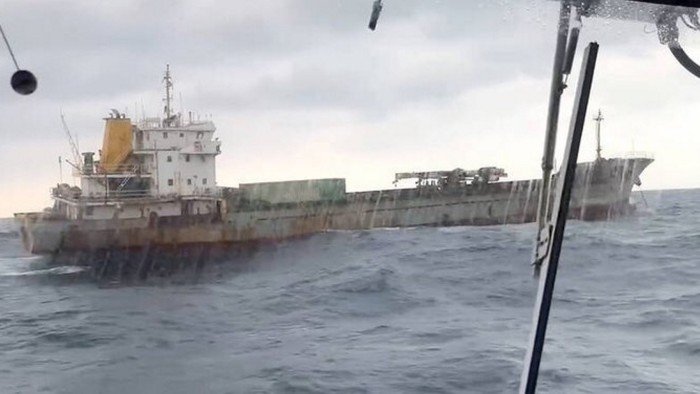
Taiwan has drawn up a blacklist of 52 Chinese-owned ships that use flags of convenience, which it will track and proactively inspect in an effort to regulate part of a rapidly growing “shadow fleet” that is causing global security concerns.
The move comes amid explosive growth in the number of ageing vessels that evade oversight and hide their identity with deceptive signalling.
While international attention has focused on Russia’s use of this shadow fleet to export oil in circumvention of sanctions over its war on Ukraine, the ranks of such ships have swelled beyond tankers and pose increasing maritime and national security risks to coastal states.
Taipei launched its crackdown after a dilapidated Chinese-owned freighter was suspected of cutting one of its subsea cables this month, following similar incidents involving Chinese and Russian-owned ships in the Baltic Sea.
The tighter inspection regime targets cargo ships sailing under the flags of Cameroon, Tanzania, Mongolia, Togo and Sierra Leone whose owner companies are registered in mainland China, Hong Kong or Macau, according to the blacklist seen by the Financial Times.
“The cable-cutting incident reminded us of the risks posed by substandard vessels. It is a risk to all coastal states, and we must fulfil our responsibility as a port state,” said a Taiwan coastguard official. “Moreover, we face an additional risk from China.”
Beijing claims Taiwan as part of its territory and threatens to annex it by force if Taipei resists unification indefinitely. Since China often includes commercial ships in military exercises and uses fishing vessels as militia to assert disputed maritime claims, Taiwanese officials fear that Chinese-owned ships could be used as part of “greyzone” operations that fall below the threshold of outright war.
Cameroon, Tanzania, Mongolia, Togo and Sierra Leone are among dozens of states that allow ship owners to register their ships without being domiciled in the country. Ship owners often choose such flags of convenience to avoid higher costs, stricter safety standards and more stringent oversight in their own nations.
Taipei is focusing on those five countries because vessels from their flag register top the ranking of vessels found to have faulty documentation, by violating maritime safety or labour regulations or circumventing sanctions, according to the Tokyo MOU, a multilateral grouping for port state control in the Asia-Pacific region.

Due to opposition from Beijing, Taiwan is not a member of the Tokyo MOU but received the organisation’s list of problematic ships “through channels”, one official said. It then “whittled down” that list by selecting those with owners of a China background.
The Taiwanese government has marked 15 of the 52 ships as posing a threat to the country because they lingered in its territorial waters for 15 days or more over the past year. Among those, the vessel suspected of cutting the cable was defined as posing a “high threat”, four others a “medium threat” and 10 more “some threat”, according to the blacklist.
On Thursday, the coastguard boarded and inspected the Bao Shun, a 20-year-old Mongolia-flagged freighter owned by a Hong Kong-registered company, in what was the first use of the new regulatory approach.
The ship had been idling close to Taiwan for two months and is one of those identified as a medium threat. A person close to the Maritime and Port Bureau said that in the past the port regulator would only carry out spot checks of vessels coming into port.

The inspection did not turn up invalid documents, contraband cargo or cable-cutting equipment on board. But the coastguard instructed it to leave Taiwanese waters. As of Sunday, it was drifting 27 nautical miles outside Kaohsiung, the country’s largest port. The owner of the Bao Shun could not be reached for comment.
On January 3, a subsea communications cable owned by a global telecoms consortium was severed just off the north coast of Taiwan. Taiwan’s government identified the Cameroon-flagged freighter Shunxing39, which had been criss-crossing the area where several regional and transpacific cables land for at least a month, as the likely suspect.
According to an FT analysis of tracking data from three different providers, the vessel’s real name is Xing Shun 39 and it is registered in Tanzania, but it has used several different identities over the past year.

In the weeks before the incident, it alternated between two different maritime mobile service identities, or MMSI numbers, broadcast from its automatic identification system (AIS). Over the past year, it has appeared under three different names, for one of which it used three different spellings, and four different MMSIs. It also briefly assumed the identity of a separate ship.
“In the normal, above-board shipping world, such deceptive practices would be unheard of, but it would be a common tactic to manipulate the AIS if you are doing something that you don’t want to be seen,” said Bridget Diakun, a maritime risk analyst at Lloyd’s List, the London-based shipping information provider.
The owner of the Xing Shun 39 could not be reached for comment.
Taiwanese national security officials said the number of ships meeting the criteria for “shadow vessels” that were operating in regional waters had ballooned over the past two years.
According to Taiwan coastguard and port officials, the vessels mostly transport frozen food and miscellaneous small cargo, often relying on smaller shuttles that transfer the cargo at sea. “Their business model is to use the lowest cost possible by avoiding regular repairs and rarely going into port,” one of the port officials said.
Analysts said those observations reflected a steep increase in shadow vessels globally.
“Since Russia started using the shadow fleet to ship oil in violation of sanctions, the barrier of respectability has been broken,” said Elizabeth Braw, a maritime security expert at the Atlantic Council.
“Russia has shown that you can operate vessels in violation of international regulations without consequences,” Braw said. “Ordinarily when your vessel reaches retirement age, you pay to have it scrapped. But instead of doing that, ship owners now get paid by sending it into the shadow fleet.”
