
- China’s economy is struggling, with a 30-year low GDP, low birth rates, and rising unemployment.
- Even so, sectors like green industries and travel are thriving.
- The healthy sectors aren’t enough to outweigh the drag of the ailing ones.

China’s economy looks very bad right now.
The country’s GDP growth has hit 30-year lows, its birth rate continues to plummet, and youth unemployment is at concerning levels. Meanwhile, its financial markets are bleeding, the property market has gone up in smoke, local government debt appears alarming, and foreign investors are exiting in droves.
Despite these challenges, the world’s second-largest economy isn’t imploding entirely. Some sectors continue to thrive in the world’s second-largest economy.
“There’s decent spending on tourism catering and other services, but caution around bigger purchases, especially real estate,” Rory Green, the chief China economist at GlobalData.TS Lombard, told Business Insider.
“Consistent bad news from the property sector has overshadowed more resilient parts of the economy,” analysts at asset management firm AllianceBernstein wrote in January.
However, “since the economy has expanded at nearly 5% despite the housing sector’s woes, other industries are obviously growing at a much faster clip,” they added.
“What we’re seeing in the Chinese economy really is that it’s a two-speed economy,” John Lin, China Equities chief investment officer at AllianceBernstein, told Bloomberg TV in January.
Real estate — which was a huge part of China’s economy — has been hit badly, he said.
But, “outside of property, whether it’s in parts of the consumption sector or particularly in industrial manufacturing, some companies actually are doing quite well,” Lin added.
Green and niche industries are thriving
Even before COVID-19 hit, Beijing knew China’s economy needed to transition from its position solely as the world’s cheap factory floor — because companies were already starting to leave.
The reasons for the exits are manifold, ranging from former US President Donald Trump’s trade war to rising wages and an increasing desire by companies to diversify their supply chains.
To move up the value chain, Bejing is now targeting higher-value manufacturing. Industries focusing on sustainability are the key focus areas for Beijing.
In particular, China is championing what it calls the “new three” industries of electric vehicles, lithium-ion batteries, and solar cells to drive its economy.
These new growth industries are set to replace the “old three” pillars of furniture, garments, and home appliances in China’s economy, Louise Loo, the lead economist at Oxford Economics, wrote in a note on February 1.
They are already doing well.
Thanks to government subsidies, China is already the world‘s largest market and producer of electric vehicles. China-made EVs are now being exported to Europe and beyond. They also are poised to enter the US market, Business Insider reported in May.
China is also a lead producer of the lithium, iron, and phosphate batteries that power many electric cars. This has enabled China’s top two battery firms — BYD and CATL — to control about half the global market.
As for solar panels, China’s push in its energy transition plans has spurred intense investment. Wood Mackenzie, a commodity research and consultancy firm, expects China to dominate 80% of global solar manufacturing capacity until 2026.
Other niche industries are also performing, said AllianceBerstein’s Lin, citing bus and forklift exports in the heavy manufacturing sectors as examples.
In December, China witnessed a 17% surge in industrial profits from a year ago. Notably, profits in the railway, shipping, and aerospace industries jumped 20%, according to official data.
Travel has picked up after years of pandemic lockdown
Services is another pillar of China’s economy that Beijing has been trying to build up.
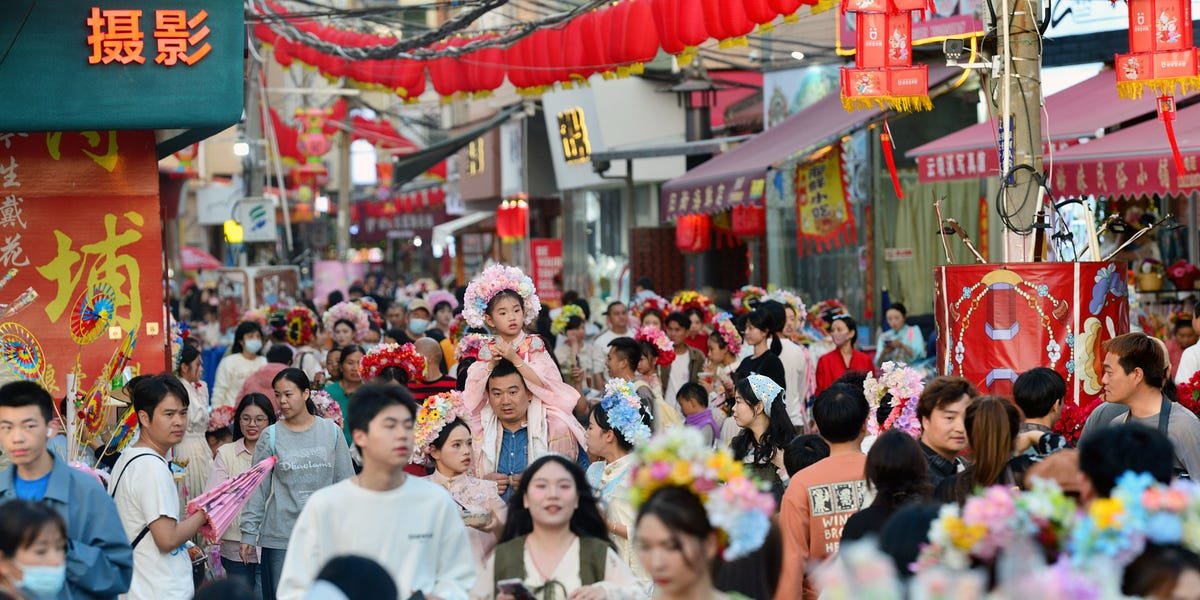
Economic uncertainty has hit consumer wallets. Even so, there has been a surge in travel, particularly within China, after years of on-off pandemic lockdowns.
This year, Chinese travelers made 474 million domestic trips over the weeklong new year holiday in February while splashing out 633 billion Chinese yuan, or $88 billion, on everything from hotels to sightseeing and food — surpassing pre-pandemic levels.
While authorities did not break down the data on a per-trip basis, Reuters calculations showed average spending per trip fell nearly 10% this year from 2019.
Still, Nomura economists said the spending this holiday season was encouraging.
“The question is whether this data is enough to stem the rout in stock markets and whether China will need to come out with stronger measures to support the market,” the Nomura economists wrote in a note on February 19.
China will still need time to drive new industries to replace real estate
China’s immediate economic outlook isn’t great.
“We continue to see consumption decelerating in 2024 as income, confidence, and negative wealth effects weigh on households, while base effects and pent-up demand prove less supportive,” said Green from GlobalData.TS Lombard. He predicts retail sales will slip 4% to 5% this year from a year ago.
This is in part because new growth industries are not able to take the place of real estate — yet.
Because the property market accounts for one-quarter of China’s GDP and more than two-thirds of household wealth, its overall drag on China’s economy is much greater than whatever is doing well right now.
For comparison, the “new three” sectors and their associated upstream sectors contributed 11% to China’s GDP in 2023.
So, “the positive impact from the rapid growth in the new industries is unlikely to make up the difference, at least over the next two years,” Oxford Economics’ Loo wrote in her February 1 report, comparing China’s new growth engines to the property sector.
“We view this as really a transition — a transition from historical, leverage-dependent growth model to one that is more like the rest of the East Asian economies today,” said AllianceBerstein’s Lin, citing Taiwan and South Korea, both of which had similar “painful” transitions of their own from lower to higher-end manufacturing economies.
