
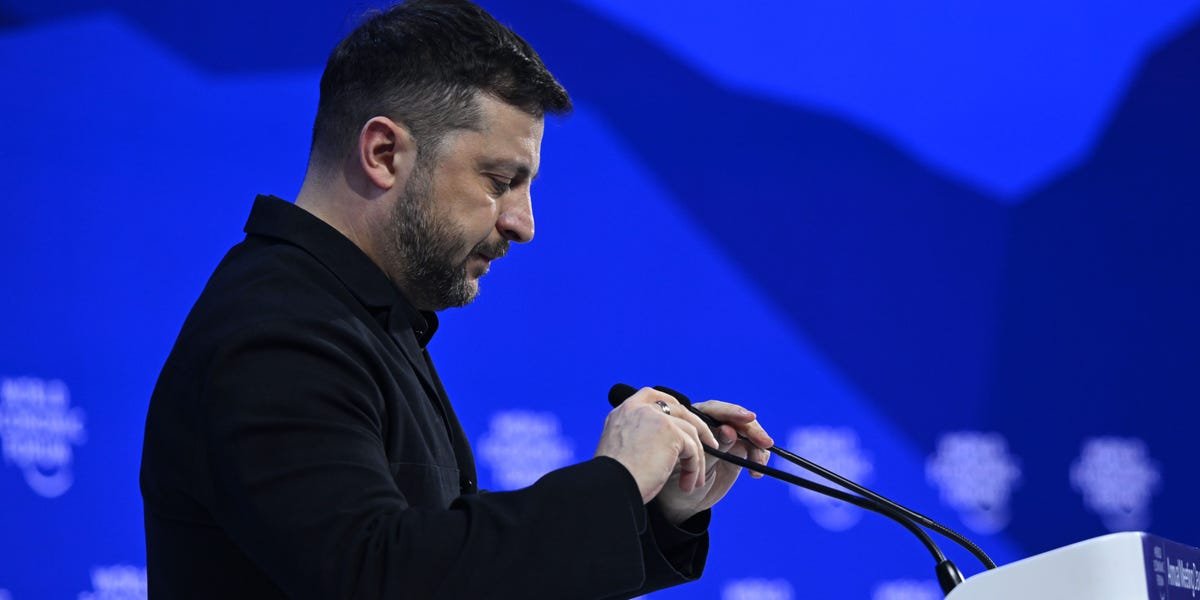
Ukrainian President Volodymyr Zelenskyy said on Thursday that Russia is building roughly 500 Iranian-designed drones a day.
His comments at the World Economic Forum in Davos, Switzerland, are a rare public assessment from Ukrainian leaders about Russia’s drone-making capacity and provide some insight into how Kyiv sees the balance of power in its long-range drone fight.
Zelenskyy has said repeatedly that Ukraine is building 1,000 interceptor drones — small quadcopters designed to counter other flying drones — every day.
“We produce them at about 1,000 a day. We really produce them, but it’s not enough. It’s still not enough,” he told his audience in Davos. “Russia has 500, about 500 drones, Iranian drones, each day, and dozens of missiles, ballistic missiles.”
Iranian drones refer to Russia’s Geran family of loitering munitions, which are mostly based on the Iranian Shahed, a delta-wing drone designed to carry explosive warheads at long range. Because their designs are so closely related, Ukrainians often use their names interchangeably.
These drones have been a major pain point for Ukraine, which is frequently bombarded by hundreds of Gerans and decoy drones at a time from across Russia’s border.
Last week, Ukraine’s commander in chief, Oleksandr Syrskyi, said that Russia is likely aiming to scale up its drone-making capacity to 1,000 Gerans per day.
He added that Russia is already building 404 Shaheds of “various types” per day.
Zelenskyy’s latest comment also provides clues about the battlefield conditions for Ukraine’s new type of air defense with interceptor drones.
The Ukrainian president’s figures imply that his country is fielding twice as many interceptors as Russia’s Shaheds, but that a 2:1 ratio isn’t sufficient to protect his country’s skies.
For now, interceptor drones in Ukraine are mostly controlled by human pilots, who have the difficult task of maneuvering lightweight quadcopters — sometimes in strong winds or poor weather — to chase down a flying target at speeds of over 100 mph in the vast sky.
Earlier this week, Zelenskyy said that Ukraine also risks running short of interceptor drone pilots and told his government to prioritize recruiting and training more of them.
The Kremlin has been increasingly developing versions of Gerans with new features, such as jet engines to replace propellers or additional cameras to help the drone avoid interceptors.
More recently, Ukraine said Russia has deployed a new type of turbojet Geran that mirrors Iran’s Karrar attack drone. Unlike the Shahed, it features a more conventional aircraft design,
