
Stay informed with free updates
Simply sign up to the Automobiles myFT Digest — delivered directly to your inbox.
Renault will aim to cut its sales reliance on Europe with a new push in India and other emerging markets as analysts warn of the French carmaker’s high exposure to competition from far bigger Chinese rivals.
Under its new chief executive François Provost, the company will look to boost annual sales to more than 2mn vehicles, up from 1.6mn last year, and generate half of its sales outside Europe by 2030. Last year, it generated 62 per cent of sales in Europe where BYD, Chery and other Chinese brands have rapidly expanded their market share with affordable electric vehicles and hybrids.
“We will show that we are here for the long term and we will become the benchmark for the European automotive industry on the global stage,” Provost said.
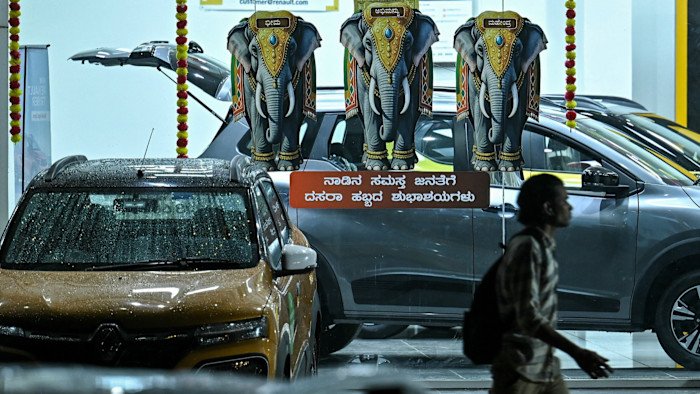
To expand its international footprint, Renault plans to launch 36 new models between now and the end of the decade, including 14 outside Europe with a focus on Morocco, Turkey, Latin America, South Korea and India.

Renault will also build a sport utility vehicle in India to be sold locally and for other markets with a fast development cycle that it claims would be comparable to Chinese speed and cost. Electric vehicles and hybrids will account for all Europe sales by 2030 and 50 per cent outside the region, according to its plans.
“They have to prove there is an independent future for Renault,” said Philippe Houchois, an analyst at Jefferies. That would partly be a “play on productivity”, while also trying to show it was the “biggest learner of Chinese methods to duplicate the Chinese success in Europe”, he said.
After being pushed close to the brink by events including the 2018 arrest of former boss Carlos Ghosn in Japan and the 2022 retreat from Russia, the French carmaker is trying to re-establish itself as a small but agile manufacturer.
Former chief executive Luca de Meo restored some of Renault’s shine with a financial turnaround and a series of hit cars like the electric version of its 1970s-era R5. But his abrupt departure last June to join luxury group Kering, followed by a profit warning, has heaped pressure back on the carmaker.
Analysts warn that Renault is the most exposed to the rapid rise of Chinese rivals not just in Europe but also in emerging markets such as India. But with no major presence in the US or China, the group is forced to seek alternative geographies.

In Europe the French group faces the added pressure of the EU’s regulatory push to accelerate the industry’s shift to electric vehicles.
“This is a company that has the highest European exposure and they are not a global [carmaker] . . . so Renault just has the biggest exposure to that structural threat,” UBS analyst Patrick Hummel said, pointing also to the overlap with Chinese rivals not just in geographical footprint but also in the mass affordable segment.
In the medium term Renault is eyeing operating margins of between 5 and 7 per cent of sales, compared with a record high of 7.6 per cent in 2024.
To make up for its lack of scale, Renault has built on its existing alliance with Nissan and Mitsubishi Motors to partner with other companies including Ford and truckmaker Volvo in Europe and China’s Geely in South Korea and Brazil.
