
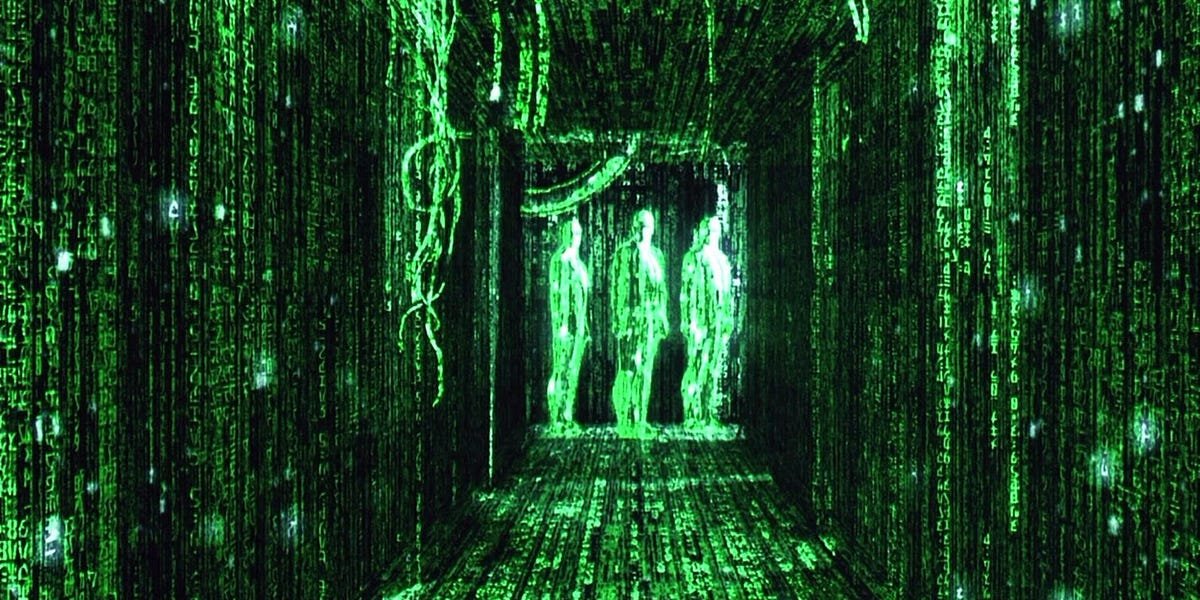

- It’s not a stretch to imagine we all live in a giant simulation, says Physicist Melvin M. Vopson.
- The clues are there. It’s just a matter of knowing what to look for and how to measure it.
- To that end, Melvin and colleagues started a crowdfunding site to fund their experiment to find out.

Physicists have long struggled to explain why the universe started out with conditions suitable for life to evolve. Why do the physical laws and constants take the very specific values that allow stars, planets and ultimately life to develop? The expansive force of the universe, dark energy, for example, is much weaker than theory suggests it should be – allowing matter to clump together rather than being ripped apart.
A common answer is that we live in an infinite multiverse of universes, so we shouldn’t be surprised that at least one universe has turned out as ours. But another is that our universe is a computer simulation, with someone (perhaps an advanced alien species) fine-tuning the conditions.
The latter option is supported by a branch of science called information physics, which suggests that space-time and matter are not fundamental phenomena. Instead, the physical reality is fundamentally made up of bits of information, from which our experience of space-time emerges. By comparison, temperature “emerges” from the collective movement of atoms. No single atom fundamentally has temperature.
John A. Paice
This leads to the extraordinary possibility that our entire universe might in fact be a computer simulation. The idea is not that new. In 1989, the legendary physicist, John Archibald Wheeler, suggested that the universe is fundamentally mathematical and it can be seen as emerging from information. He coined the famous aphorism “it from bit”.
In 2003, philosopher Nick Bostrom from Oxford University in the UK formulated his simulation hypothesis. This argues that it is actually highly probable that we live in a simulation. That’s because an advanced civilization should reach a point where their technology is so sophisticated that simulations would be indistinguishable from reality, and the participants would not be aware that they were in a simulation.
Physicist Seth Lloyd from the Massachusetts Institute of Technology in the US took the simulation hypothesis to the next level by suggesting that the entire universe could be a giant quantum computer.
And in 2016, business magnate Elon Musk concluded “We’re most likely in a simulation.”
Empirical evidence
YouTube/Stargazer
There is some evidence suggesting that our physical reality could be a simulated virtual reality rather than an objective world that exists independently of the observer.
Any virtual reality world will be based on information processing. That means everything is ultimately digitized or pixelated down to a minimum size that cannot be subdivided further: bits. This appears to mimic our reality according to the theory of quantum mechanics, which rules the world of atoms and particles.
It states there is a smallest, discrete unit of energy, length and time. Similarly, elementary particles, which make up all the visible matter in the universe, are the smallest units of matter. To put it simply, our world is pixelated.
The laws of physics that govern everything in the universe also resemble computer code lines that a simulation would follow in the execution of the program. Moreover, mathematical equations, numbers and geometric patterns are present everywhere – the world appears to be entirely mathematical.
Hulton Archive / Stringer / Getty Images
Another curiosity in physics supporting the simulation hypothesis is the maximum speed limit in our universe, which is the speed of light. In a virtual reality, this limit would correspond to the speed limit of the processor, or the processing power limit. We know that an overloaded processor slows down computer processing in a simulation. Similarly, Albert Einstein’s theory of general relativity shows that time slows in the vicinity of a black hole.
Perhaps the most supportive evidence of the simulation hypothesis comes from quantum mechanics. This suggest nature isn’t “real”: particles in determined states, such as specific locations, don’t seem to exist unless you actually observe or measure them. Instead, they are in a mix of different states simultaneously. Similarly, virtual reality needs an observer or programmer for things to happen.
Paramount Pictures
Quantum “entanglement” also allows two particles to be spookily connected so that if you manipulate one, you automatically and immediately also manipulate the other, no matter how far apart they are – with the effect being seemingly faster than the speed of light, which should be impossible.
This could, however, also be explained by the fact that within a virtual reality code, all “locations” (points) should be roughly equally far from a central processor. So while we may think two particles are millions of light years apart, they wouldn’t be if they were created in a simulation.
Possible experiments
All About Space Magazine / Contributor / Getty Images
Assuming that the universe is indeed a simulation, then what sort of experiments could we deploy from within the simulation to prove this?
It is reasonable to assume that a simulated universe would contain a lot of information bits everywhere around us. These information bits represent the code itself. Hence, detecting these information bits will prove the simulation hypothesis.
The recently proposed mass-energy-information (M/E/I) equivalence principle – suggesting mass can be expressed as energy or information, or vice versa – states that information bits must have a small mass. This gives us something to search for.
I have postulated that information is in fact a fifth form of matter in the universe. I’ve even calculated the expected information content per elementary particle. These studies led to the publication, in 2022, of an experimental protocol to test these predictions.
The experiment involves erasing the information contained inside elementary particles by letting them and their antiparticles (all particles have “anti” versions of themselves which are identical but have opposite charge) annihilate in a flash of energy – emitting “photons”, or light particles.
Argonne National Laboratory
I have predicted the exact range of expected frequencies of the resulting photons based on information physics. The experiment is highly achievable with our existing tools, and we have launched a crowdfunding site to achieve it.
There are other approaches too. The late physicist John Barrow has argued that a simulation would build up minor computational errors which the programmer would need to fix in order to keep it going. He suggested we might experience such fixing as contradictory experimental results appearing suddenly, such as the constants of nature changing. So monitoring the values of these constants is another option.
The nature of our reality is one of the greatest mysteries out there. The more we take the simulation hypothesis seriously, the greater the chances we may one day prove or disprove it.
Melvin M. Vopson is a senior lecturer in physics at University of Portsmouth.
This article is republished from The Conversation under a Creative Commons license. Read the original article.
