
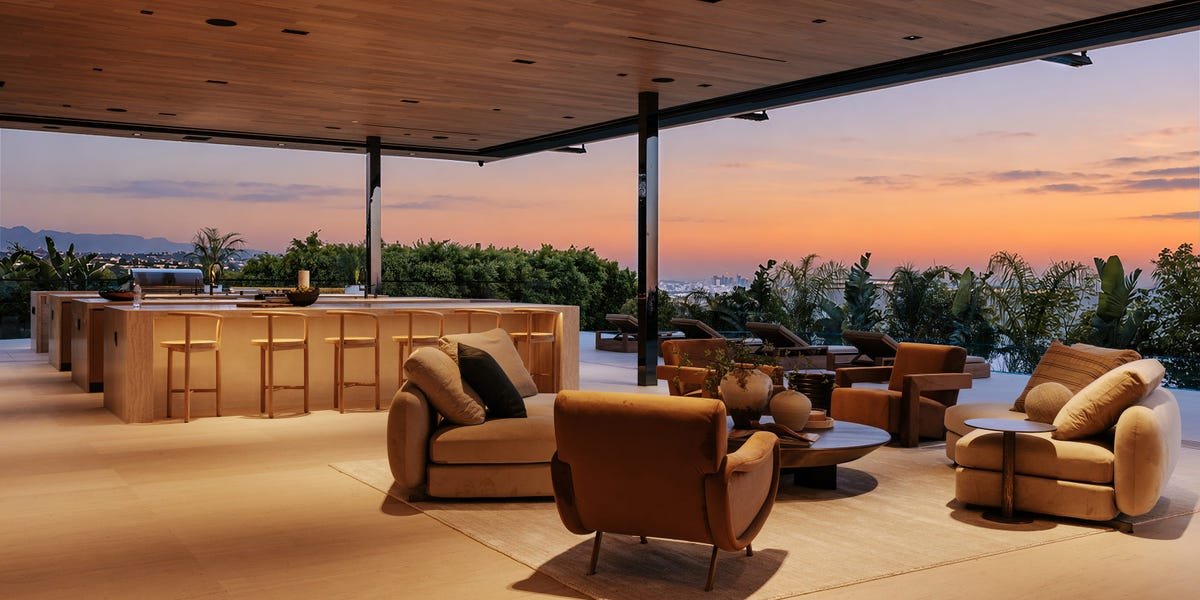
This as-told-to essay is based on a conversation with Phillip Braunstein, president of Colossal Properties and owner of the home at 1210 Chickory Lane in the Brentwood neighborhood of Los Angeles. The property is listed for $29,995,000 and accepts shares from OpenAI and Anthropic as payment. The conversation has been edited for length and clarity.
I’ve been in construction and real estate development for almost 15 years, and I’ve also become increasingly involved in tech investing.
I started building this house in Brentwood in 2021. It’s an architectural modern residence with almost four stories, including a basement and a rooftop deck with views of the Pacific Ocean, downtown Los Angeles, and the Getty Museum.
I’ve put a lot into the property. But when I put it on the market, I also started thinking about what else I might accept as payment.
I’m a big believer in AI, and I thought: If somebody has a significant amount of equity in OpenAI or Anthropic, why not consider trading the house for that?
Why I’m open to AI shares
Courtesy of Carolwood Estates
I started using AI heavily in 2023, initially for personal applications. Then I got deeper into it and started building an actual stock-trading algorithm with a friend and neighbor who was formerly the director of Applied AI at Google.
At the same time, my friends and I were talking about getting investment stakes in AI companies.
Meanwhile, the Los Angeles real estate market was very soft. The mansion tax had been introduced, and there was also uncertainty around a proposed billionaire tax in California. There were a lot of questions about whether people with the net worth to buy a property at this price point would want to remain in Los Angeles.
So I thought, you know what? If someone has a lot of equity in OpenAI or Anthropic, I’d be happy to take it.
As someone who uses AI heavily, I really believe in the technology. I wanted to let the marketplace know that if someone wanted the house and had a surplus of equity, I’d consider trading them the property.
The house with a view
Courtesy of Carolwood Estates
The views are probably my favorite thing. The property sits on a cul-de-sac on a bluff, with views of the Pacific and downtown Los Angeles. We designed the house to really capitalize on that setting.
When you walk through the front door onto the main floor, there’s a 110-foot wall of motorized glass. You press a button, and the entire wall opens up. It creates this indoor-outdoor experience with 270-degree views.
What’s also special is that even though the architecture is very modern, with all the glass and concrete, the house feels warm. There’s a lot of plasterwork, travertine, and limestone. You feel tucked in when you’re inside.
I also really love the basement. When I spend time there with my son, he likes to go downstairs and play with his toys or watch something in the theater. The adults can be upstairs enjoying the views.
It’s a really well-laid-out house. The architecture and the views are inspiring, and I think that’s what makes it special.
I understand the risks
Courtesy of Carolwood Estates
For me, the business behind the demand for intelligence may hit some road bumps, but overall, I think it’s going to be up and to the right.
I don’t know how many winners there will be in this space, but I’d be comfortable accepting equity in either Anthropic or OpenAI.
I see how much productivity these applications can create when they’re properly integrated into businesses. The models have gotten so good, even over the past 12 months, and the AI agents that have come out this year are particularly impressive.
I use Meta Muse for virtually all my bill paying. I don’t pay a single bill myself. Whether it’s a mortgage payment, a utility bill, or an invoice that comes in by email, text, or even physically. I take a picture or send it over, and Muse handles it.
It’s my default payment processor for everything.
I understand there’s a risk in taking private-company equity instead of cash. The shares could lose value, and the AI market could go through a correction. But even if the equity became worth less than the agreed-upon dollar value of the house in the short term, I believe that over a long enough period, it could be worth multiples of that amount.
