

Author
Ahmed Barakat

Author

Share


The House passed a stopgap funding bill 220-205 on July 21, moving its proposed government-funding deadline from September 30 to December 4 and placing it after the midterms. This has led to the odds of a Government shutdown happening across all predition markets.
But that is no longer the full picture: on August 8, the Senate passed its own version 90-6, extending funding through December 11 instead. The two versions still need to be reconciled, meaning Congress has moved closer to avoiding an October shutdown without yet completing the process.
For Bitcoin traders, that distinction matters. The immediate September 30 cliff looks less threatening, but the underlying funding fight has largely been pushed deeper into the year rather than eliminated.
Discover: Everyone’s Got a Take. Join Kalshi and Get a Free $25 to Actually Trade Yours
Odds of a Government Shutdown: A Rescheduled Fight, Not a Settled One
The disputes behind the funding deadline were not settled by the July House vote. The House measure simply extended current funding largely at existing levels through December 4, while the Senate’s subsequent version would run through December 11 and contains provisions absent from the House bill.
The Senate bill also restricts the administration’s ability to redirect certain funds and temporarily blocks a White House rule requiring political review of federal grants. Those differences mean the legislation must return to the House before it can reach President Trump’s desk.
Meanwhile, House Republicans have separately advanced a $95 billion budget plan covering Iran-related defense and intelligence spending, farm assistance and parts of President Trump’s election-law agenda. The baseline appropriations fight has therefore been postponed rather than permanently settled.
Discover: Your Market Calls Are Worth Something. Start With Free $25 on Kalshi
What the Prediction Markets Are Saying
Kalshi and Polymarket run event contracts that pay according to whether defined outcomes occur under each market’s resolution rules. The October 1 shutdown market therefore measures whether a shutdown occurs around that specific deadline, not whether another funding confrontation emerges in December.
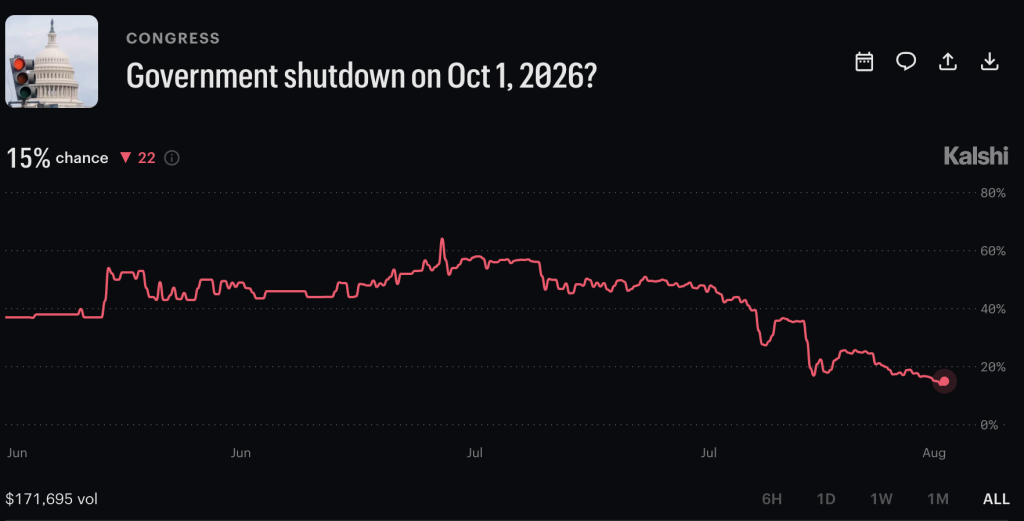
That distinction has become even more important since the Senate vote. With both chambers now backing temporary funding beyond the midterms, the probability of an October shutdown should not be treated as a proxy for the broader probability of another fiscal confrontation later in 2026.
Prediction markets have also proved highly sensitive to congressional developments during previous funding fights. The Department of Homeland Security shutdown that began February 14, for example, generated large swings in contracts tracking when funding would return as negotiations evolved.
Why Bitcoin Traders Are Watching December Aside from the Odds of a Government Shutdown
Shutdown risk can matter for crypto because fiscal uncertainty, liquidity expectations and broader risk sentiment can all influence Bitcoin. But the relationship is not mechanical, and a shutdown by itself does not guarantee either a Bitcoin rally or decline.

Arthur Hayes has separately argued that potential Federal Reserve intervention to support the Japanese yen could expand dollar liquidity and ultimately benefit Bitcoin. His broader liquidity thesis makes the policy response surrounding fiscal or monetary stress potentially more important for Bitcoin than the political event itself.
A December funding standoff would also arrive after the midterm elections and during year-end market positioning. For traders considering a liquidity-driven framework, the key issue is therefore not only whether a shutdown occurs, but what fiscal and monetary conditions develop around it.
Bitcoin’s Other Near-Term Catalysts
On August 12, Bitcoin remained below $65,000 after briefly reaching about $65,200 earlier in the week. The congressional funding timeline is only one of several macro variables influencing the market.
July CPI is due on August 12, leaving the Federal Reserve’s September decision sensitive to another inflation surprise. Market expectations remain divided over whether policymakers could raise rates again, meaning a hotter-than-expected inflation print could reset the rate outlook independently of developments in Congress.
The Strait of Hormuz relief trade has also unraveled after President Trump demanded decades of compensation from Iran, pushing oil prices higher. Bitcoin has struggled to establish a sustained move above $65,000 amid the renewed geopolitical uncertainty.
That leaves Bitcoin exposed to several simultaneous catalysts: inflation, Federal Reserve expectations, oil prices, Iran-related developments and the evolving U.S. funding negotiations. Any attempt to attribute its next move solely to shutdown odds would therefore oversimplify the macro picture.
Don’t Miss Out on Our $1,000 USDT Airdrop on ByBit
