Close Menu
    What's Hot

    CLARITY Act Faces House Calendar Bottleneck

    September 4, 2026

    The Netherlands Shifted Billions in Gold Out of the US and Canada

    September 4, 2026

    Solana launches Payment Channels for AI agents, Alibaba Cloud integrates APIs (SOL-USD:Cryptocurrency)

    September 4, 2026
    Facebook X (Twitter) Instagram
    Hot Paths
    • Home
    • News
    • Politics
    • Money
    • Personal Finance
    • Business
    • Economy
    • Investing
    • Markets
      • Stocks
      • Futures & Commodities
      • Crypto
      • Forex
    • Technology
    Facebook X (Twitter) Instagram
    Hot Paths
    Home»Business»Neurotechnology study delivers ‘another level’ of touch to bionic hands
    Business

    Neurotechnology study delivers ‘another level’ of touch to bionic hands

    Press RoomBy Press RoomJanuary 16, 2025No Comments3 Mins Read
    Facebook Twitter Pinterest LinkedIn Tumblr Email
    Share
    Facebook Twitter LinkedIn Pinterest Email

    Unlock the Editor’s Digest for free

    Roula Khalaf, Editor of the FT, selects her favourite stories in this weekly newsletter.

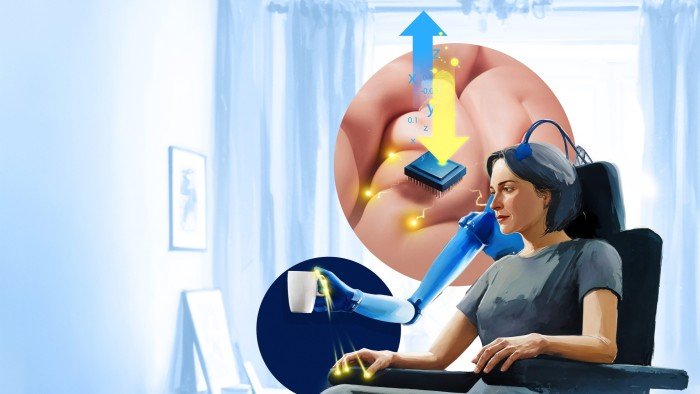
    Scientists have for the first time given a realistic sense of touch to people operating a robotic hand via signals sent from their brain, marking the latest advance in neurotechnology research to help overcome disabilities.

    The University of Chicago study, published in Science on Thursday, worked over several years with volunteers paralysed by spinal cord injuries. They had tiny electrodes implanted in the brain’s sensory and motor regions that control sensations and movements in the arm and hand.

    The subjects learned not only to grasp objects by driving a bionic limb with their thoughts — a feat achieved in previous research — but also to feel edges, shapes and movements. Such rich two-way communication between the robotic hand and brain raises hopes that intuitive systems could improve the lives of millions of disabled people.

    “The research went beyond anything that has been done before in the field of brain-computer interfaces,” said Giacomo Valle, who led the Chicago study and recently moved to Chalmers University of Technology in Sweden.

    “We are at another level of artificial touch now. We think this richness is crucial for achieving the dexterity, manipulation and tactile experience typical of the human hand.”

    The researchers mapped the brain areas that respond to touch in specific parts of the hand and fingers, using implants made by Blackrock Neurotech, the longest established US manufacturer of BCIs.

    “Electrodes next to each other in the brain don’t create sensations that ‘tile’ the hand in neat little patches with one-to-one correspondence,” said Chicago’s Charles Greenspon, a senior author of the study. “Instead the sensory locations overlap.”

    The researchers developed programs that used the overlapping of touch zones to enable participants to experience the sensation of something moving smoothly over their bionic fingers, such as a steering wheel in a driving simulator. They could also identify letters of the alphabet traced on their fingers.

    Greenspon said more progress in restoring a lifelike sense of touch to people living with amputation or paralysis depended more on increasing the sensitivity of synthetic skin on prosthetic hands than developing better brain implants.

    Scientists also needed to improve subjects’ “proprioception” — the sense of knowing where bionic limbs are positioned.

    The research was funded by the US National Institutes of Health through the Cortical Bionics Research Group, a university consortium. Valle said his move to Chalmers had extended its activities to Europe, where there has been less investment in neurotechnology than in the US.

    A similar approach could help people with other types of sensory loss, the scientists said. For example, they are working with surgeons and obstetricians at Chicago university on a Bionic Breast Project, which aims to produce an implantable device to restore the sense of touch that is missing after mastectomy.

    Commenting on the findings, Paul Marasco, a neuroscientist at Cleveland Clinic in Ohio who was not involved in the research, said: “The beauty of the study . . . is that they are discovering how brain circuits are processing tactile information at a very local level.

    “They are at the first stage of learning to speak the brain’s language, which no one really understands.”

    Share. Facebook Twitter Pinterest LinkedIn Tumblr Email
    Press Room

    Related Posts

    Rheinmetall investors to get bumper dividend from booming arms sales

    March 11, 2026

    How to fight deepfakes

    March 11, 2026

    Best Employers: UK

    March 11, 2026
    Leave A Reply Cancel Reply

    LATEST NEWS

    CLARITY Act Faces House Calendar Bottleneck

    September 4, 2026

    The Netherlands Shifted Billions in Gold Out of the US and Canada

    September 4, 2026

    Solana launches Payment Channels for AI agents, Alibaba Cloud integrates APIs (SOL-USD:Cryptocurrency)

    September 4, 2026

    Paul Graham Says a Startup Is the ‘Least Efficient’ Way to Look Cool

    September 4, 2026
    POPULAR
    Business

    The Business of Formula One

    May 27, 2023
    Business

    Weddings and divorce: the scourge of investment returns

    May 27, 2023
    Business

    How F1 found a secret fuel to accelerate media rights growth

    May 27, 2023
    Advertisement
    Load WordPress Sites in as fast as 37ms!

    Archives

    • September 2026
    • August 2026
    • July 2026
    • June 2026
    • May 2026
    • April 2026
    • March 2026
    • February 2026
    • January 2026
    • December 2025
    • November 2025
    • October 2025
    • September 2025
    • August 2025
    • July 2025
    • June 2025
    • May 2025
    • April 2025
    • March 2025
    • February 2025
    • January 2025
    • December 2024
    • November 2024
    • April 2024
    • March 2024
    • February 2024
    • January 2024
    • December 2023
    • November 2023
    • October 2023
    • September 2023
    • May 2023

    Categories

    • Business
    • Crypto
    • Economy
    • Forex
    • Futures & Commodities
    • Investing
    • Market Data
    • Money
    • News
    • Personal Finance
    • Politics
    • Stocks
    • Technology

    Your source for the serious news. This demo is crafted specifically to exhibit the use of the theme as a news site. Visit our main page for more demos.

    We're social. Connect with us:

    Facebook X (Twitter) Instagram Pinterest YouTube

    Subscribe to Updates

    Get the latest creative news from FooBar about art, design and business.

    Facebook X (Twitter) Instagram Pinterest
    • Home
    • Buy Now
    © 2026 ThemeSphere. Designed by ThemeSphere.

    Type above and press Enter to search. Press Esc to cancel.