
At a time when congressional Democrats and Republicans seem unable to agree on almost anything, they may soon pass an expanded child tax credit, which gives money to parents.
The credit, part of a $78 billion tax package that the House may vote on this week, is the rare family policy that has bipartisan support. It is not guaranteed to become law, but the new deal between Democrats and Republicans is part of a tax package with broad appeal across the ideological spectrum.
The biggest benefits of the child tax credit would be for the poorest families, analysts said: The payments could bring nearly half a million children out of poverty and decrease poverty for five million more, by some estimates. Research has shown that families spend those extra dollars on food, child care and other basic needs.
Still, it would reduce child poverty by only about 5 percent by 2025, compared with a temporary reduction of 35 percent achieved by a larger child tax credit expansion passed during the pandemic, according to the Columbia University Center on Poverty and Social Policy.
“It is a fairly modest tweak in the scheme of things,” said Patrick T. Brown, a fellow at the Ethics and Public Policy Center, a conservative think tank. “But at the same time, it could pave the way toward a broader conversation about what the purpose of the child tax credit is and how we can make it more possible for parents across the spectrum to raise a kid.”
Here’s how the proposal would work — and why politicians like it.
How does the child tax credit work now?
Under current law, families are eligible for up to a $2,000 tax credit for each of their children. But not every family gets the full amount: Those who do not work for pay (or who have very high incomes) do not qualify, and others get a partial credit.
In order to qualify for any credit, families must earn at least $2,500 a year, and the size of the payment increases with household income. A single parent of one child must earn about $24,800 before becoming eligible for the full credit; a married couple with two children must earn about $35,700. That structure is intended to encourage poor parents to work, and has been a key requirement for many Republican lawmakers.
What would the new child tax credit do?
The new proposal would keep that idea intact, but increase payments to poor families who meet that minimum income threshold. It would also increase the $2,000-per-child maximum credit to keep up with inflation. And it would let families choose between their current year’s income or the previous year’s when calculating the size of the credit.
The new credit, which its authors are hoping to pass in time for this year’s tax filing season, would be temporary, expiring at the end of 2025.
How would it help poor families?
In the first year, the new credit would reach an estimated 80 percent of families whose incomes are too low to receive the full amount now, including roughly 16 million children, according to the Center on Budget and Policy Priorities, a left-leaning research group.
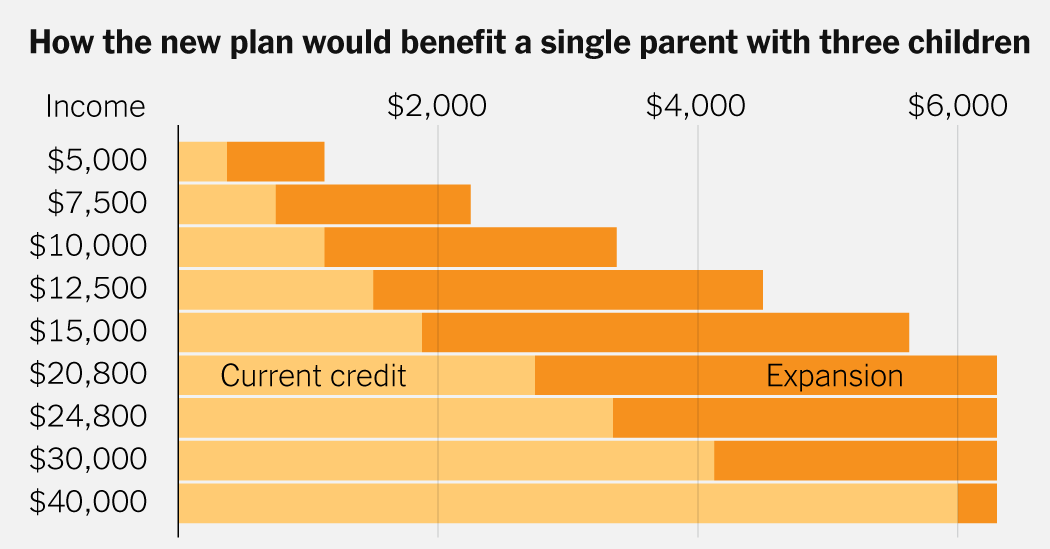
The legislation does that by increasing the amount that poor families can receive, particularly those with multiple children. For example, single parents with three children earning $15,000 would receive three times the payment in 2025 as they would under current law — $5,625 a year instead of $1,875.
During the pandemic, there was a much more generous one-year expansion of the child tax credit. The annual payment increased to as much as $3,600 per child, and the government sent it in the form of monthly checks. For the first time, it also went to families with no incomes. That expansion lifted 2.9 million children out of poverty in 2021, decreasing child poverty to the lowest rate on record. But it expired at the end of that year, contributing to a slide back below the poverty line for many families.
How did the idea achieve bipartisan support?
Spending on policies that help families has traditionally been a Democratic priority. But this bill — released by Representative Jason Smith of Missouri, the Republican chairman of the House Ways and Means Committee; and Senator Ron Wyden of Oregon, the Democratic chairman of the Senate Finance Committee — was written in a way that has made many Republicans embrace it.
It’s part of a broader tax package that also cuts several taxes on businesses, and won’t increase the deficit much because it gets rid of a pandemic-era business tax credit that has become a magnet for fraud.
In recent years, a contingent of the Republican Party has begun embracing government spending on certain family policies, driven by working-class voters’ movement to the G.O.P., and a concern among lawmakers about declining fertility rates. It appeals to values held by both parties, “both the anti-poverty left and the pro-family right,” Mr. Brown said.
Kristen Soltis Anderson, a founding partner of Echelon Insights, a Republican polling firm, said she had seen growing consensus among voters in both parties about the need for family policies: “You have many Republicans who are very anxious about young people saying, ‘I don’t think I want to have kids,’” she said. “There’s this culturally conservative anxiety around that.”
The sticking point for most Republicans had been an income requirement, so that payments wouldn’t go to parents who did not work. The new bill has removed that obstacle.
Perhaps surprisingly, the bill has garnered some Democratic opposition — the major complaint being that it is not generous enough. Last week, the bill passed out of the Ways and Means Committee by a vote of 40-3 — the three opposing it were all Democrats.
What do voters think about an expanded child tax credit?
The idea is popular with voters across the ideological spectrum, though it does not have the support of a large majority. A review of 31 surveys about the pandemic-era expansion found that on average, six in 10 likely voters supported it.
What happens next?
The House may vote on the measure as soon as this week. Speaker Mike Johnson said Monday the bill would get a vote, and he expects it to pass with a large bipartisan tally. If it passes there, it will head to the Senate, where prospects for passage also look strong. Senator Chuck Schumer of New York, the majority leader, hopes to bring it to the floor, and several moderate Republicans have indicated they will support it.
Even if the bill became law, the additional benefits would end after 2025 — and at that point, the child tax credit would become even smaller than the amount parents receive today, to a maximum benefit of $1,000 per child. That’s because another tax credit law is also set to expire in 2025.
Without a future bill, the child tax credit is at risk of shrinking considerably.
