
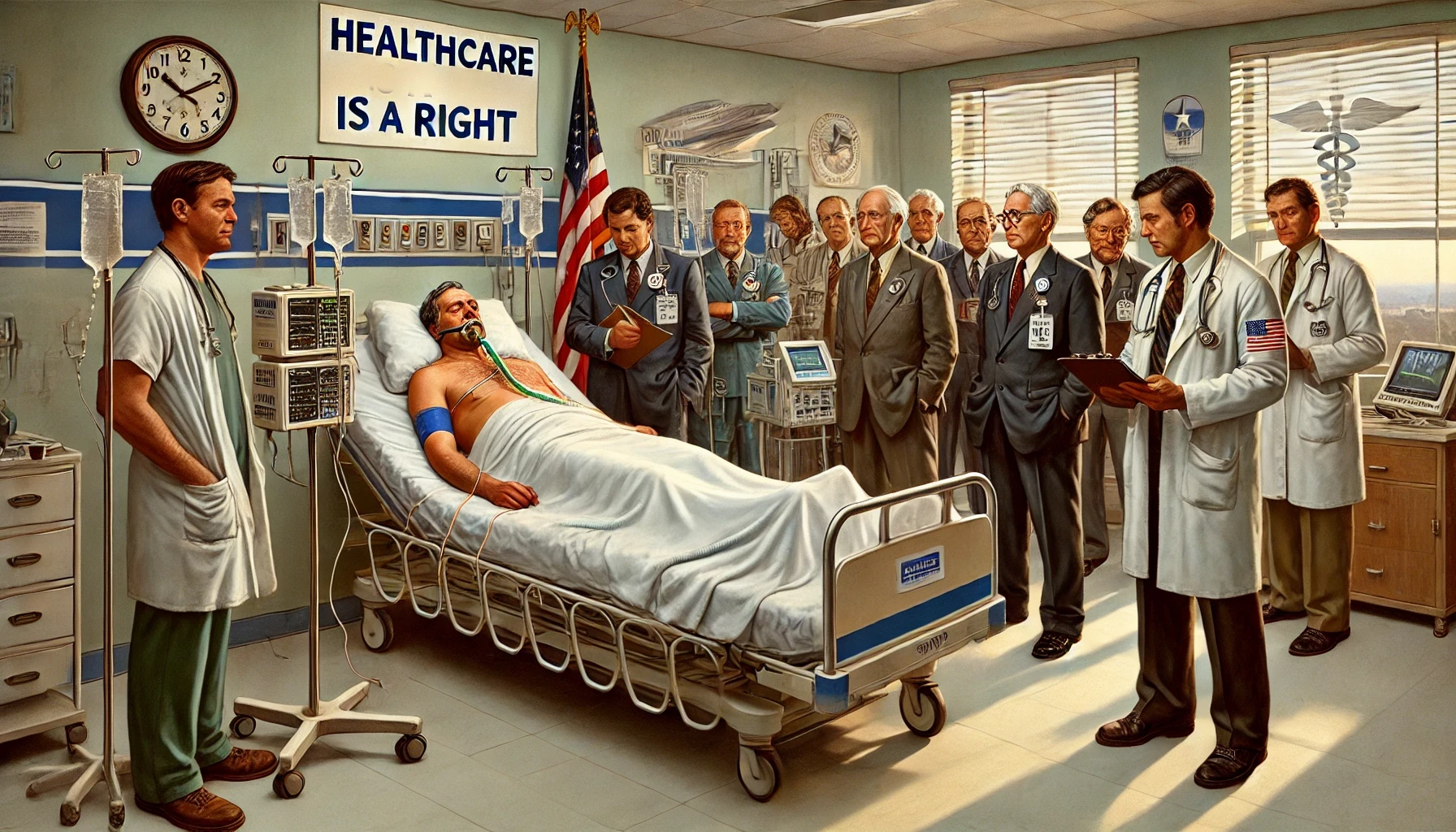
Much remains to be known about the murderer of UnitedHealthcare CEO Brian Thompson. I don’t know what “brain fog” is and whether Mangione, the young man charged with the murder, suffered from it as was reported. But there is certainly much mind fog in the support he received after his arrest and, more generally, in ideas about health insurance that lie around in the zeitgeist.
For many people, health care and health insurance are special goods because they deal more directly with life, death, and bodily integrity. Food, clothes, and housing would also be candidates. Moreover, individuals do make trade-offs between health and other goods or activities such as smoking, drinking, and mountaineering. The source of the problem lies in the unbridgeable gap between scarce resources and infinite human desires—the subject matter of economics. Wealth can only partially bridge the gap. For nearly 100% of mankind before the Industrial Revolution, the partial solution did not exist, as it still doesn’t for many inhabitants of the third world who are exploited by their own governments.
A sign held by one of Mangione’s supporters in a demonstration read:
Privatized healthcare is a crime against humanity
Privatized? How was it before it was privatized? And who privatized it? Perhaps the implicit mind-foggy model is that, 100,000 years ago, healthcare was made freely available by benevolent governments but, as “neoliberalism” started its assault on nirvana, they gradually privatized it, or accepted its privatization, until the crime reached its zenith today after millennia of combat between the individual and the collective.
Even in a rich society, healthcare is not a “right” except under at least one of three conditions. First, you obtain it through voluntary and private contracts. Second, you enslave somebody (some physicians, nurses, shareholders, or taxpayers) to provide it to you. There is a third possibility: that some public health insurance or healthcare is made publicly available at subsidized prices by the rules of a “social contract” à la Buchanan to which unanimous consent is arguably plausible, or perhaps by spontaneous-order rules à la Hayek. The justifications of this third possibility are more demanding than most people think and must be handled with great care.
In rich countries, everybody can get a minimum of healthcare through a varying mix of the three conditions or justifications above. In the United States, publicly financed healthcare accounts for about half of total health expenditures. But remember that these countries became rich because, in economic life generally, the first condition—private contracts—was privileged. In matters of healthcare, the United States may remain the country that diverges the least from the private contractual ideal.
Private health companies are not in the business of denying what their contracts obligate them to provide to their customers, who can go and shop elsewhere. But they do have to control their costs, lest they would be unable to offer their services to anybody because nobody would voluntarily invest in these companies. Economic analysis shows that competition between private insurers will bring the lowest prices for feasible insurance while providing a diversity typical of markets. The more you pay, the more likely it is that your insurance will cover a given claim, and mutatis mutandis if you choose a policy with less coverage. Note also that the more consumers in this market are directly or indirectly subsidized by the state, the more they bid up healthcare prices.
We should not forget that the health industry is one of the most regulated in America, and that regulation limits competition. Most Americans get their healthcare insurance from their employers, an unfortunate sequel of WWII wage controls. They have to change jobs to switch insurer. Moreover, employers rather than insurance companies are often the ones trying to control insurance costs. (See “How American Health Insurance Got So Infuriating,” Wall Street Journal, December 20, 2024.)
Partial or total nationalization of healthcare insurance or delivery cannot solve the problem of the unescapable allocation, by prices or other means, of what consumers want given the necessarily limited supply. Not all Americans can get the healthcare that, say, Elon Musk or Bill Gates must be getting. If the allocation by prices is abolished, waiting lines and bureaucratic decisions will be the new rationing mechanism. In Canada, where health insurance is a monopoly (at the provincial level), the median time between referral by a general practitioner and an appointment with a specialist is 15 weeks; another 15 weeks then elapse between the appointment and the start of treatment. These waiting times have tripled since 1993 despite recurrent and grandiose political attempts at internal reform of the system. (See Fraser Institute, Waiting Your Turn: Wait Times for Health Care in Canada, 2024 Report.) Not counted are the delays to see a general practitioner and the lack of amenities and privacy in hospitals, which are, formally or informally, all public. These problems are endemic in nationalized healthcare.
We should beware of the simplistic argument that the state’s takeover of health insurance and healthcare would solve all problems. It certainly did not in the Soviet Union. But even a much lighter implementation would likely increase discontent among Americans, who are accustomed to being treated as customers, not as public wards. It would probably not restrain mind-foggy wackos and perhaps excite them even more—now against public officials. But this last bit is not sure: once a society has reached that point, individuals may have become submissive and resigned.
******************************

A piece of art, especially from AI, can be interpreted in many ways
