
Evolving drone and missile threats, from Europe to the Middle East, are pushing the Marine Corps to move faster on critical air-defense programs, a top Marine general said last week.
The Marine Corps is investing in new air-defense systems, including the Marine Air Defense Integrated System, but Lt. Gen. Eric Austin, the Corps’ deputy commandant for combat development and integration and senior ground-acquisition official, said the pace of battlefield change means the service needs to move faster to keep up with emerging threats.
Austin shared his thoughts during a discussion on Marine Corps modernization efforts at the Center for Strategic and International Studies, a DC-based think tank.
“We’re on a path for our 2030 vision, but guess what, it’s not fast enough,” he said of the service’s efforts to reform its air defense systems as the entire military overhauls its capabilities after 20 years of the Global War on Terror. “We’ve got to field faster, and we have to get these out at scale.”
US Marine Corps photo by Lance Cpl. Nicholas Figueroa
The Corps’ budget request for the next fiscal year includes weapons like MADIS, but it’s not enough to simply purchase more systems, Austin said.
New air-defense systems need to be easy for each service to use and built with open architecture, meaning they can work with other systems and be upgraded quickly.
“For a Marine Corps system, and particularly for air defense, it’s absolutely critical that it be able to talk to all the other air agencies,” Mark Cancian, a senior adviser at the Center for Strategic and International Studies and retired Marine colonel, told Business Insider.
Interoperability helps ensure systems can work together to take down threats and also recognize friendly weapons and assets.
Though the Marine Corps is pursuing these capabilities, Austin said the current modernization timeline hasn’t kept up with emerging, fluid threats and warrants a much more urgent overhaul.
After the conclusion of the Cold War, the US air defense portfolio slipped due to a lack of modernization efforts and budget cuts.
“Our ground-based air defense portfolio got a little bit sleepy back in the 90s,” Austin said. “We were relying on a really point-defense, low altitude air defense mechanism, but that’s not good enough anymore.”
US Marine Corps photo by Lance Cpl. Allison White
His comments come as US troops have faced rising missile and drone threats in the Middle East, especially during the Iran war, and as lessons learned from the battlefields of Ukraine continue to influence the US military’s sweeping transformation efforts. In March, six US service members were killed in Kuwait after an Iranian Shahed drone penetrated American air defenses.
And in 2024, three US service members were killed with dozens more injured after a one-way attack drone hit Tower 22, a small logistics outpost in northeastern Jordan. An investigation found several failures and a lack of preparedness that led to the drone slipping past defenses.
The strike in Kuwait also highlighted certain vulnerabilities in American combat facilities, which were previously considered to be sufficiently protected with large, thick concrete barriers known as “t-walls,” or giant earth-filled HESCO barriers, and even sandbags.
But in a time of prolific drone warfare, in which cheap drones are significantly lowering the barrier to entry on surveillance and precision strike, such perimeter defenses are less effective, leaving troops vulnerable to aerial attacks. The shift has even prompted some US units to begin training for underground operations, echoing Ukrainian tactics.
“One of the things that’s come out of the war in Iran is the need to deal with drones,” Cancian said, pointing to Iranian-designed Shahed one-way attack drones, which have been fired at times in the hundreds.
US Marine Corps photo by Cpl. Iyer P. Ramakrishna
The Marine Corps wants an integrated, layered air-defense network capable of defending against threats ranging from missiles to small drones, including tools capable enough to defend bases abroad and safe enough for defense at home as well.
Cancian said that such a defensive setup would likely need to include both kinetic and non-kinetic solutions, as well as low-altitude, medium-altitude, and high-altitude interceptors. Having defenses that can operate across altitudes gives air defenders more options for intercepting a threat.
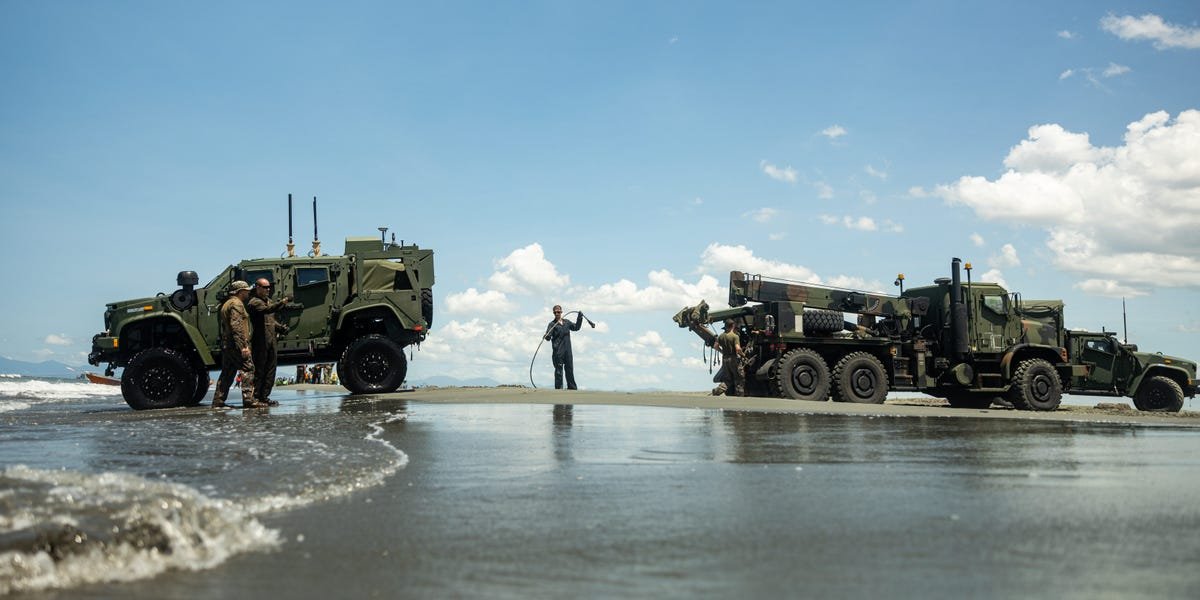
The Corps hopes to accelerate the air defense overhaul for the next fiscal year, Austin said. MADIS turns two Joint Light Tactical Vehicles into a single short-ranged ground-based air defense system.
In June, Marines in Okinawa received their first MADIS, along with their first Navy-Marine Expeditionary Ship Interdiction System (NMESIS). “These systems provide Okinawa-based, 3rd Marine Division Marines, with cutting-edge, land-based anti-ship and anti-sUAS [small-uncrewed aerial systems] capabilities tailored for the complex littoral environment,” per the press release.
But the more of these capabilities are needed in more places where the Marines are operating.
“We have to field faster, and we have to get these out at scale. It’d sure be nice to have these fielded at scale in CENTCOM today,” Austin said, referring to US Central Command, which oversees the US military activities in the Middle East. “We’ve got some fielded and some forward, but not enough.”
