
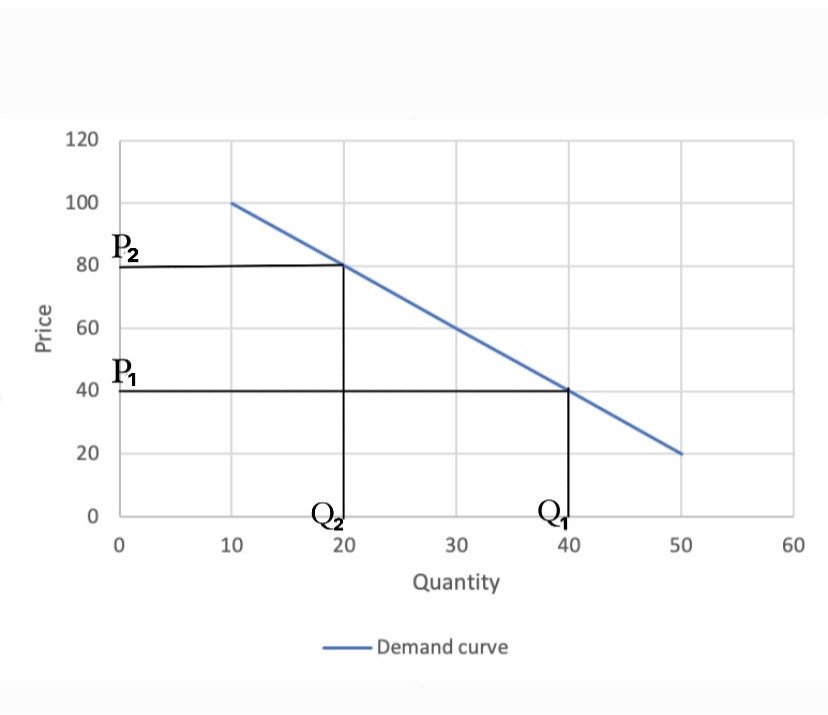
In a recent post, I imagined a hypothetical situation where cranberries turned out to be a surefire way to prevent cancer. I described how this would create a huge shift in demand, leading to an increase in prices, which in turn would lead to an increase in supply:
Suppose tomorrow, scientists announce that eating 100 grams of cranberries per day has been proven to make one immune from ever developing cancer. What would happen in the short run? There would be a huge increase in the demand for cranberries – the demand curve would shift sharply to the right. Cranberries, in turn, would become much more expensive, so even though demand will drastically increase, the quantity demanded will not rise by all that much, at least in the short run. What would happen on the production front? For any given cranberry farm, you’d expect there are some marginal adjustments they could make to increase output, but those changes hadn’t been worth the cost of making. But when the price rises, those adjustments become worth making. You’d expect current cranberry farmers to immediately try to maximize their yields and push as many cranberries out the door as they possibly could.
In the longer term, you’d expect them to increase their cranberry production capacity, and you’d also expect to see many other people shift away from growing blackberries or marionberries and start growing cranberries instead. This, in turn, shifts the supply curve to the right as well, bringing the market price for cranberries back down. The process of adjustment will take some time, but if your goal was to make sure lots of people can take advantage of cranberries and their cancer-preventing properties, implementing price controls on cranberries would be your worst enemy, because it would prevent these adjustments from occurring.
At least, the process I describe above is what would ideally happen if cranberries were found to have such amazing properties. Realistically, I suspect what would actually happen is that after the initial demand increase and subsequent price spike, the government would intervene with price controls and regulate the cranberry market into oblivion. And part of what would motivate those policies is a claim we often hear in favor of price controls for some good – that in the absence of price controls, “only the rich” will be able to afford such-and-such, so we need price controls to ensure the good in question is “affordable” for everyone. If the price of cranberries suddenly shot up to $1,000 per serving, there would doubtless be outrage that “only the rich” can now afford cranberries and their cancer-preventing properties. (This outrage often tricks people into thinking the case against price controls somehow overlooks the distinction between “willingness to pay” and “ability to pay” – an elementary yet common mistake, because outrage rarely sharpens one’s reasoning skills.)
The problem with this mode of thinking is that it (like Ferengi economic philosophy!) fails to think past step one. Yes, if such a thing were to happen, “only the rich” would be able to afford cranberries – at first. But the high price would incentivize huge numbers of people to get in on the cranberry market, pushing the supply curve out to the right and bringing the price back down. If you’re stuck in a static, one-stage frame of mind, pontificating about how “only the rich” can afford this or that may seem troubling. But if you can think beyond stage one, you realize how much that view misses.

Given that the way we frame issues has a significant impact on how people view that issue, here’s a framing I think would be helpful: high prices today enable the rich to subsidize access for the poor tomorrow. In the case of cranberries, in order for supply to rise, existing farms will need to be expanded and new farms will need to be created. This involves a great deal of expensive, up-front costs. Letting cranberries be sold for a high price to the rich today is what funds that very process of expansion, pushing out the supply curve and making cranberries abundant for everyone else. That is, allowing the rich to buy at high prices early on subsidizes the process of making goods available to the poor at low prices for the long haul.
This isn’t a fanciful process – this reflects what we can see throughout economic history. Whenever there is some new technology, product, or breakthrough, in the early stages it’s usually very expensive. But as time goes on, costs come down and it becomes more available and affordable. But in order to reach that stage, it needs to be able to go through the “very expensive” step first, to help offset all the costs that went into bringing the product to market, and the still-high marginal costs of production for this new product. Take, for example, electric cars.
A newcomer in the electric car space is Rivian. Their first two vehicles, the R1S and R1T, started at over $80,000 and could easily go for over $100,000 if you added a few basic options. But now Rivian is preparing to release newer, more mass-market vehicles at half the price of the initial generation. In order for Rivian to be able to produce less expensive electric cars more accessible to the average consumer, they first had to go through a process of selling expensive cars to wealthy consumers. Those high income people buying the initial rounds of $100,000 Rivians enabled the company to begin producing more affordable versions of their vehicles.
Almost everything you enjoy today was once an expensive luxury only affordable to the rich. With this in mind, look back and ask yourself what would have happened if any of these things were immediately hit with price controls when they first came to market to prevent “only the rich” from being able to afford them. If you can see why that would have been a bad idea in all those cases, you can understand the same thing in present times as well. The rich paying top dollar for things today is what will make them affordable for you tomorrow – so keep that framing in mind when feeling upset about the high price of something. And remember to always think past step one.
