
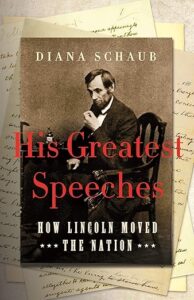
As The United States approaches its 250th anniversary in 2026, there is no better time to study the great men and women who built, protected, and improved the nation. Many historians regard Abraham Lincoln as America’s greatest President, for good reason. Lincoln mended the fractured United States, wrote the Emancipation Proclamation, and gave some of the most impactful speeches in American history. Through examining three of Lincoln’s speeches, EconTalk host Russ Roberts and Diana Schaub show how Lincoln’s commitment to the principles of the founding, and vision for a freer and more united future can assist Americans in resisting the current challenges to democratic governance, just as Lincoln did during the Civil War.
The three speeches Schaub pegs as Lincoln’s greatest are The Gettysburg Address, his Second Inaugural Address, and the lesser-known Lyceum Address. Schaub emphasizes Lincoln’s ability to blend America’s past, present, and future to address threats to freedom and democracy while affirming the framework the founders set in place.
This is most noticeable in Schaub and Roberts’ discussion of The Lyceum Address. Lincoln lauds the founders for providing a system of republican governance and individual freedom while describing how his generation might continue to protect that system. Lincoln’s journey through the speech covers the founding, potential separation, and permanent reconciliation, offering an early preview of the forces that would drive America to the Civil War:
It is very early. Lincoln is very young. But it is a comprehensive reflection on the nature, and especially the dangers and threats, to popular government–to democratic government. So, it really is a very comprehensive political reflection. He speaks about founding. He speaks about the possibility of destruction. And then he hints at the possibility of saving a republic or what would be necessary to save a republic… He is opposed to the Democrats, but he does not specifically attack Andrew Jackson or Stephen Douglas. But that’s kind of in the background. So, I think what he shows, instead of making it so explicitly partisan, he really digs deeper and shows these underlying threats to democracy, which might take partisan form, but are more profound.
What are the threats to freedom and democracy Lincoln discusses? Lincoln regarded the sharp increase in mob violence and fanaticism during the 1830’s as a signal of a burgeoning rejection of institutions in favor of vigilantism, populism, and demagoguery. Schaub argues that maintaining a republic is more difficult than founding one, and she pinpoints a consistent challenge for democracies in channeling individual ambition. Lincoln articulated how the passion for greatness which helped forge the United States was also leading to its separation, as autocrats sought destroy the principles of the founding and establish their own legacy.
Lincoln’s speeches warn against mob rule, not only because of the danger of vigilantism to individual freedom, but also because those not participating in mob violence lose faith in the ability of established democratic and legal institutions to promote justice and security. This opens the door for an autocrat:
So, he says that the lawless in spirit will become lawless in practice. And then, the more worrying effect is that: What about the good citizens? What effect does this have on them? And he says: When they see government breaking down in this way and not holding people to the law, they will become alienated from the government. He says: This alienation can go so far that they become alienated not just from a particular government or a particular administration, but they become alienated from the very form of government. In other words, they give up on popular government. What they want is safety and tranquility, security of person and property. And, when they see this happening around them, they are likely to turn to the strongman–the demagogue who promises that he can get things back in order.
In The Second Inaugural Lincoln showed his deep commitment to principle. Schaub and Roberts go over how Lincoln won election during wartime and issued the Emancipation Proclamation not out of his own abolitionism, but due to his belief that emancipation was necessary to save the union. In these examples, Lincoln’s adherence to institutions is clear, particularly democracy and the rule of law. Lincoln stressed using one’s rights, such as speech and assembly, to democratically change unjust laws and warned that breaking the law- even for a good purpose, diminishes reverence for the rule of law and undermines the legitimacy of democratic decisions.
Because all men are created equal, because there are no natural rulers, the only way we can rule is through the consent of the governed. We are bound by the determinations of the majority. As I say, that is not to say that the majority is always right. They are often wrong, but we have democratic mechanisms to change democratically arrived-at law. Lincoln says, ‘You’ve got to use speech.’ Free press, free speech, right of assembly, right of petition. So, we have all kinds of avenues to reach our fellow citizens and convince them that they are wrong and that things need to be changed. But Lincoln says that is the only allowable method. To go outside that is actually to deny majority rule and to deny the equality principle on which majority rule is based. So, he is emphatic about this: Civil disobedience is destructive of civil government.
The last key point in the podcast concerned the impact of rhetoric on the character of the nation. Roberts finds current political rhetoric in America to be far below the standard of Lincoln (Schaub agrees), but warns against the dangers of rhetoric. Rhetoric can be a powerful weapon in the hands of tyrants and demagogues. Schaub’s solution is referential of Lincoln’s: it is necessary to study the blueprint that the patriotic and democratic rhetoric of past American leaders. This blueprint is in the founding documents, and the very speeches Schaub and Roberts are discussing, which are key to fulfilling Lincoln’s project to build American pillars of self-governance, freedom, and equality which reaffirm and protect the themes of the founding
My only solution is we still have the annals of political rhetoric. It is what shaped a great writer like Lincoln, and it’s always possible for people to go back to that and steep themselves in it. There must be people out there capable of doing that, and then figuring out what would be the kind of rhetoric for our moment and our democratic audience.
Related EconTalk Episodes:
Injustice and the “Letter from Birmingham Jail” (with Dwayne Betts)
Bruce Bueno de Mesquita on Democracies and Dictatorships
Bruce Bueno de Mesquita on the Spoils of War
Jill Lepore on Nationalism, Populism, and the State of America
How the Constitution Can Bring Us Together (with Yuval Levin)
Related Liberty Fund Network Content:
Lincoln’s Lessons for Turbulent Times, by Carson Holloway, at Law and Liberty
Understanding Lincoln’s Cardinal Principles, by Tyler MacQueen, at Law and Liberty
Lawerence Reed on Best and Worst American Presidents, The Great Antidote Podcast, at Adam Smith Works
The Elusive Goal of Political Stability, by Arnold Kling, at Econlib
How Libertarian Was the Civil Rights Movement? by Bryan Caplan, at Econlib
