
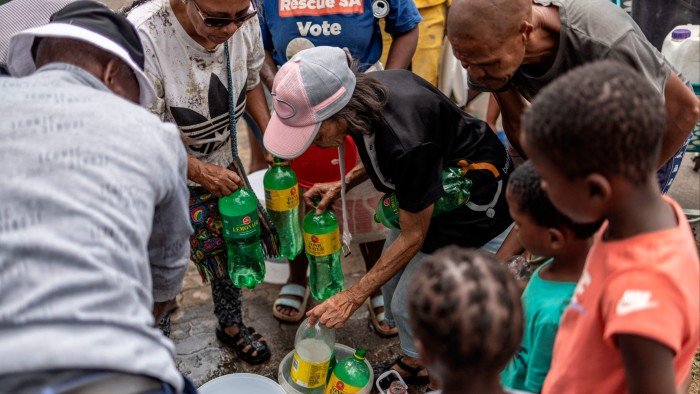
Residents and businesses in Johannesburg are reeling from a series of cuts to water supplies lasting up to 86 hours, highlighting the economic cost of South Africa’s struggle to deliver essential services.
Poor management of scarce resources, a failure to fix critical infrastructure and corruption had worsened the outages in South Africa’s biggest city and across the continent’s most developed country, experts said.
The potential damage from further cuts threatened to dwarf that caused by years of blackouts by power utility Eskom, which helped to condemn the country to a decade of annual growth rates under 1 per cent, they added.
“This water crisis we’re seeing now is an existential threat to the economy,” said Anthony Turton, board member of the South African Water Council and former vice-president of the International Water Resources Association. “The power cuts were much easier to fix than this will be.”
The disruptions in Johannesburg this month were intended to fix leaking pipes and ageing infrastructure. But for residents they were merely the latest supply cuts in a fraying city that has had 10 mayors in the past six years.
In September, taps ran dry for days at one of Johannesburg’s largest hospitals. Emergency care was prioritised while doctors were asked to bring their own drinking water to work. Last month, unreliable supplies halted proceedings at the Constitutional Court of South Africa, which is based in the city.
An MP for the Democratic Alliance, a coalition partner of the African National Congress, described the shutdown of the country’s highest court as a “national embarrassment”.
Ferrial Adam, executive manager of the non-profit organisation Water Community Action Network, said 25 per cent of state schools and 46 per cent of clinics did not have running water.
“There are many places where you can’t drink the tap water because of municipal failure. Those municipalities are not fixing the infrastructure because they don’t have the money,” she added.

Turton said the crisis risked “deindustrialising” the country, home to foreign investors such as carmakers Toyota and VW.
“The lack of water security means [car production] could shut down entirely. You cannot produce a single thing — be it a tin of beetroot or a vehicle — without water,” he said.
The automotive sector earned R203bn ($11bn) in export revenue last year. With 112,000 people employed in carmaking and related trades, the sector is a vital concern in a country with 32.1 per cent unemployment.
Pemmy Majodina, the water and sanitation minister, has been criticised by opposition parties for saying South Africans should “change their behaviour” to avoid water cuts.
“For the minister to pretend there is no crisis is a huge slap in the face for thousands of South Africans who don’t have water,” said Malebo Kobe, an MP for DA splinter party, ActionSA. “Our government lacks the ability to manage water properly to ensure it reaches the people.”
Kobe said the problem started at local government level. “Municipalities have no capacity to think about infrastructure investment since their officials were appointed because of political patronage, not because they could do the job properly,” she said.
This is evident in Johannesburg, where 46 per cent of the supply is not paid for by anyone, including residents, equating to a loss in 2022-23 of R3.4bn for the city. State-owned water boards distribute supplies to municipalities, which are supposed to fix leaking pipes, but Johannesburg said “budget constraints” had hit maintenance work.
Corruption exacerbates the problem. In Makana in the Eastern Cape, where residents are rationed to 50 litres of water daily, the municipality’s chief financial officer Nomfundo Ntsangani is alleged to have diverted a water tanker to her house to fill her swimming pool. She did not respond to questions from the Financial Times.
But Majodina said “it is not correct” to say the government had no grasp on the problem.
Municipalities, she said, were “not maintaining their infrastructure and are not adhering to standard operating processes for drinking water treatment and wastewater treatment”. Their billing systems were weak, while officials did not prioritise sanitation infrastructure or hire staff with appropriate qualifications, such as technicians and scientists, she said.
“The main underlying cause of the decline in water services is the poor performance of municipalities,” Majodina said.
Turton said it was almost too late for South Africa to avoid “day zero”, referring to research published two decades ago that said its largest cities would run out of water by 2028.
“If all the leaking pipes are fixed, and if the recovery plan goes precisely to plan, this can be avoided. But given how little has been done until now, the likelihood of failure is exceptionally high,” he said.
Political and business leaders did not appreciate the precariousness of the situation, Turton added, arguing that no factory in Johannesburg would be able to sustain production without a guaranteed water supply.
“From there, the knock-on for job losses and tax revenues is catastrophic. And if government is then forced to lay off 40 per cent of its workers, you can imagine what risk that poses to social stability.”
The DA’s Stephen Moore told other MPs that a failure to solve the crisis would compromise the country’s food security, and hospitals and schools would be forced to close.
“While we have emerged battered from 15 years of power cuts, we may not survive water shedding,” he said.
