
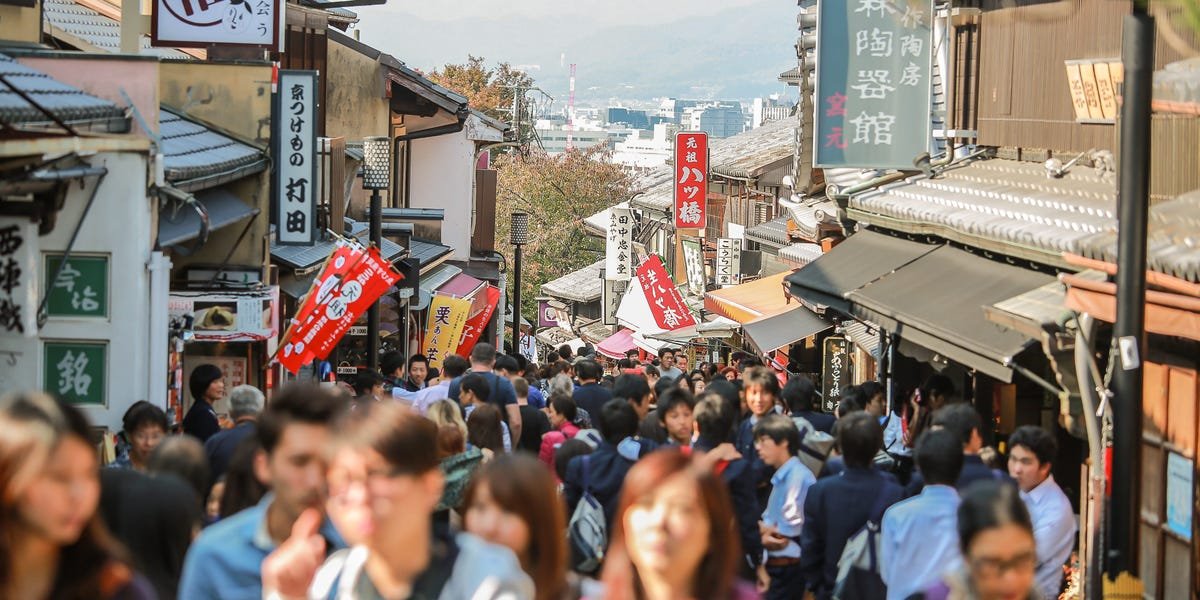
- Japan’s tourism has exploded in recent years, with a record 36.8 million visitors in 2024.
- The weak yen has drawn visitors to Japan, which is already experiencing overtourism impacts.
- Experts say Japan should learn from other travel hot spots and be proactive about managing tourism.
If it feels like everyone you know is going to Japan right now — sort of how it felt like everyone was going to Iceland back in the 2010s — that’s because they are.
The iconic images of Iceland’s Blue Lagoon and black sand beaches that dominated social media feeds have given way to pastel-colored images of Mount Fuji and adorable videos of snow monkeys soaking in hot springs in Japan’s Jigokudani Monkey Park.
“It’s become ‘the destination,’ especially with younger clients,” Katherine Flynn, a travel planner for the New York-based travel agency Fora, told Business Insider of Japan. “This is one of the few destinations I’ll have clients include TikTok links when they submit their ‘must-do activities’ in my inquiry form.”
In 2024, the number of visitors to Japan reached a record high of nearly 37 million, a 47% increase from 2023 and a 15% increase from 2019, before the pandemic. The number of Americans alone who visited Japan in December grew more than 30% year-over-year, according to preliminary data compiled by the Japanese government.
The travel boom has been driven in part by Japan’s weak currency, making a destination previously considered expensive to visit much more affordable. Lauren Joory, another Fora advisor, said the US dollar’s strong position against the yen as well as Japan’s closed borders for a couple years after the pandemic have fueled Americans’ interest in the country.
Similarly, Iceland’s tourism boom came in the wake of an economic crisis — and also helped pull the island nation out of it. But while tourists can be a welcome sight to a struggling economy, they can also bring with them a host of problems associated with overtourism, as some destinations in Japan are already experiencing.
Though the two countries are different in some key ways, sustainable tourism advocates say there are lessons for Japan to learn from Iceland, as well as other destinations that have undergone rapid tourism growth in a relatively short amount of time.
Tomohiro Ohsumi/Getty Images
Tourism can be a lifeline for struggling economies
After the financial crisis of 2008, the value of the Icelandic krona tanked, along with the Iceland Stock Exchange. Thousands lost their homes and unemployment skyrocketed. Two years later, the eruption of the Eyjafjallajökull volcano disrupted air travel to Europe and caused more problems for the already struggling country — but it also drew international awareness to Iceland.
Travelers from around the world — drawn in by the weak krona and creative marketing by budget airlines promoting Iceland as a desirable stopover between Europe and the Americas — started rolling in. Iceland’s annual visitor numbers grew by 328% between 2010 and 2019.
“Tourism was extremely important to get us back on our feet after the crash, and it grew into our biggest export industry,” Sigríður Dögg Guðmundsdóttir, then the head of Visit Iceland, told ADP in 2022.
Now Japan is facing economic challenges of its own, including a weak currency, high inflation, and shrinking GDP. Japan is also dealing with an aging population, low birth rate, and a labor shortage.
“Tourism’s a quick win for many of these places,” said Alan Fyall, the Visit Orlando endowed chair of tourism marketing at the University of Central Florida’s Rosen College of Hospitality Management who studies sustainable tourism, said of countries with struggling economies.
“Tourism can be a very, very powerful economic and social force for good. There’s no question. However, it’s like everything — it’s how you do it,” he said.
When overtourism becomes a problem
As the travel industry news site Skift put it in 2019, Iceland became “the poster child for the positive and negative effects of the overtourism phenomenon” as tourism evolved into the country’s biggest industry in a relatively short number of years. The impacts of the tourism boom included crowding at hot spots, disrespectful tourist behavior, stress on infrastructure and natural areas, and higher prices for locals and visitors, as well as a potential over-reliance on tourism as an industry.
Richard A. Brooks/AFP/Getty Images
Japan is much larger than Iceland — in size, population, and GDP — but the country is already facing some of the same overtourism problems.
Masaru Takayama, chairperson at the Japan Alliance of Responsible Travel Agencies and an expert in sustainable travel, said Kyoto, where he is based, has become “a capital of overtourism.” The central part of the city has been inundated with tourists who are consuming public resources and making it difficult for local residents to go about their daily lives.
“We have a lot of elders here who can ride buses and subway for free, but there’s no seats available for them,” he said.
Takayama said local businesses have also changed to accommodate the tourists. He said his favorite restaurants are within walking distance but that it’s difficult to actually go because tourists make reservations months in advance. The restaurants have also raised prices and switched up their menus to cater more to foreigners.
“We can literally see these places, but you cannot go,” he said, adding, “So we are really losing the authenticity of what it was, what was nice about Kyoto.”
A rise in rental properties has also led to higher prices and taxes for locals, many of whom don’t work in tourism-related industries and therefore are experiencing the downsides of tourism without much of the benefits, he said.
Japan has already taken some measures to address issues with tourism. Last year officials in Kyoto banned tourists from certain alleyways in Gion, the popular geisha district, after complaints from locals about visitors’ behavior.
Fujikawaguchiko, a small town near Mount Fuji, said last year it was building a mesh barrier to block a popular photo spot for tourists after residents complained about disrespectful behavior. Japan also announced last year new regulations and a tourist tax for climbing Mount Fuji, a UNESCO World Heritage site, due to overcrowding.
Still, the experts who spoke to BI said Japan should focus on a proactive approach to managing tourism that prioritizes the needs of the locals alongside the benefits of tourism.
Proactive measures against overtourism
Fyall said Japan is relatively new to the tourism game, only emerging as a common destination for travelers in the past 10 to 15 years. He also said the country has been relatively cautious about promoting tourism and not quite as aggressive as other destinations. But now that the yen is weak, he said it’s “bonanza time” for travelers from China and the West.
Stanislav Kogiku/SOPA Images/LightRocket/Getty Images
Anna Abelson, an adjunct professor at New York University’s Jonathan M. Tisch Center of Hospitality, said Iceland was not initially prepared for its tourism boom, but that the pandemic, while challenging for the tourism industry, allowed the country to shift its focus on fostering a sustainable travel industry.
Iceland has adopted several measures to address overtourism, including a tourism tax, which is applied to hotel rooms, cruises, and campsites and is used to support sustainability efforts and mitigate the environmental impact of tourism. The country has also invested millions in improving infrastructure at popular tourist spots, building much-needed parking lots, restrooms, and designated trails, and encouraging visitors to travel to less-explored areas.
Abelson said Japan should be proactive — rather than reactive — at addressing the problems with overtourism or risk getting to a point where locals take out their frustration on tourists. In Barcelona last summer, for instance, protesters sprayed visitors dining at restaurants in the city center with water guns during a demonstration against overtourism.
Abelson said one thing Japan could do is appeal to tourists directly to encourage better behavior, like the Palau Pledge, in which visitors to the island nation are required to sign a pledge “to act in an ecologically and culturally responsible way.” She said Japan could also focus on spreading tourists out, as Thailand has done by promoting lesser-known regions like Chang Mai and other islands, instead of the areas that are already experiencing overcrowding.
Takayama said he thinks the Japanese government is still focusing on tourism quantity rather than quality, the latter of which he says is necessary for sustainable tourism. While there are sustainable tourism guidelines — set by the Global Sustainable Tourism Council, which Takayama is part of — he said implementation and action is another question.
He agreed that Japan could encourage tourists to visit lesser-known places, but that the government would also have to ensure those destinations are prepared and could accommodate tourists in a sustainable way. He also said the government could do more to try and attract the right kinds of tourists who are interested in traveling responsibly.
“Japan is still a very good place to visit, and there are a lot of sanctuaries that people are not aware of, which they should explore,” he said. “We will love to have you as long as you obey the local rules.”
Have a news tip or a story to share? Contact this reporter at kvlamis@businessinsider.com or via the encrypted-messaging app Signal @kelseyv.21.
