
Stay informed with free updates
Simply sign up to the Technology sector myFT Digest — delivered directly to your inbox.
Precision Neuroscience, a company developing a device for controlling smartphones and computers through thought, has raised $102mn as it races rivals such as Elon Musk to build the novel technology.
The New York-based company’s latest investment round, which gives it a post-money valuation of about $500mn, tops the $75mn raised by Synchron, another so-called brain-computer interface (BCI) company.
The field is still dominated by Elon Musk’s Neuralink, which has raised more than $600mn, but the latest funding points to widening investor interest as a number of companies press ahead with their first human trials.
BCI devices use a variety of methods to collect signals from the brain, which are then interpreted using artificial intelligence and used to control computers. Neuralink, whose electrodes have been implanted in two people, says its devices have been used to play video games and manipulate computer-aided design software.
The first brain implants in humans date back two decades, but recent advances in the electronics used to collect and transmit brain signals, as well as the machine learning needed to analyse and make sense of the data, have raised hopes that the devices could soon be medically useful.
“We now have capability with the AI systems to actually interpret [data from the brain], model it, and do it in real time,” said Howard Morgan, chair of B Capital, a Precision backer. “We’ve gotten to the point where it’s no longer too early [to invest], we’re now poised to be able to do really effective things clinically.”
The device made by Precision, which was founded in 2021, has been used on 27 patients, though so far it has only been implanted temporarily in people while they undergo neurosurgery. However, chief executive Michael Mager claimed Precision had already amassed more brain data than any other company working in the field, giving it a head start in learning how to interpret the signals.
Morgan Stanley recently estimated that more than 9mn people in the US suffer from various forms of upper limb impairment and other disabilities that would make them candidates for an implant, representing a total market worth $400bn. However, it predicted that annual revenues would not reach $1bn a year until 2041.
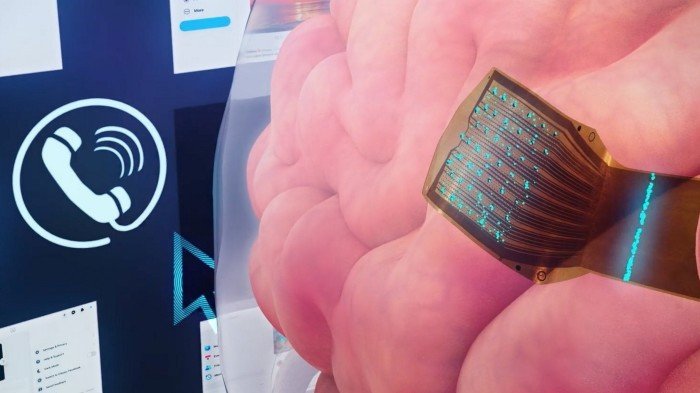
Precision, whose founders include neurosurgeon Ben Rappaport, a co-founder of Neuralink, makes a wafer-thin microelectrode array that is inserted through a narrow slit in the skull and sits on the surface of the brain. It hopes that the relatively non-invasive procedure will eventually be offered to outpatients.
According to Morgan Stanley, take-up of brain-computer interfaces could be slowed by a shortage of neurosurgeons capable of handling implants, hesitation among patients to have a device inserted in their brains and reluctance on the part of governments and health insurers to offer reimbursement for the devices.
Mager said that being able to control a computer with thought could give many severely disabled people the chance to rejoin the workforce. That would make a significant difference to their lives and more than justify the medical reimbursements, he said. Morgan Stanley estimated that the devices alone will eventually cost $25,000-$60,000 each, not including the costs of implanting them or the ongoing costs of collecting and analysing the signals.
Musk has said he started Neuralink to create a way for humans to one day compete with advanced artificial intelligence. Linking the brain to a computer could be used to augment human memory and processing power and match the performance of AI, he believes.
