
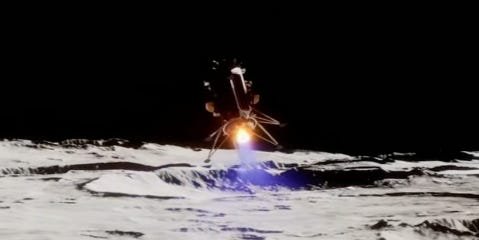
An American moon lander touched down on the lunar surface for the first time in over 50 years on Thursday.
The uncrewed Odysseus lander, made by the Houston-based company Intuitive Machines in collaboration with NASA, claimed a major victory not just for the US, but for the space industry at large: It is the first commercial spacecraft to ever land on the moon without crashing.
The last five years have racked up a series of failed moon landings — by Russia, India, Japan, an Israeli nonprofit, a Japanese company, and, just last month, NASA collaborator Astrobotic. Everyone is scrambling to get their feet on the moon in a new race to claim lunar territory and resources.
The success of Odysseus brings NASA and its commercial partners, finally, to the front of the 21st century’s mad moon dash.
There were some complications in the landing. The spacecraft is on the moon and sending basic signals back to Earth, but it is not in communication with mission control.
“We’re not dead yet,” mission director Tim Crain said on NASA’s livestream of the landing. “It’s faint, but it’s there.”
The Odysseus lander’s Odyssey so far
Odysseus launched atop a SpaceX rocket on February 14, carrying 12 payloads — six of them belonging to private companies and six of them science experiments for NASA.
The spacecraft traveled 620,000 miles to aim for its destination: a crater in the moon’s south pole.
On Thursday, however, the landing was delayed about 45 minutes after the lander’s navigation system failed.
Intuitive Machines mission controllers scrambled to upload software patches that instructed the lander to instead use a system of navigation lasers that NASA had loaded on board. The NASA laser system was meant to be a demo to see if the technology even worked — not to guide the landing on its own.
As Odysseus plummeted to the lunar surface and tilted itself to point the lasers toward the lunar surface to map it out, everything seemed to be going well. But the lander fell out of communication in the final moments of its descent to the lunar surface.
Intuitive Machines mission control reported that it was receiving pings from the lander, which means it touched down at about 6:24 p.m. ET, intact and alive.
It’s unclear if the touchdown issues were related to the navigation system failure.
A race to the moon’s south pole
The IM-1 mission was designed to get NASA and Intuitive Machines closer to the moon’s south pole than anyone has ever been before.
The US — along with its commercial and international allies — is racing against China and Russia to establish a permanent base in this lunar region.
The moon’s south pole is so coveted because it contains water frozen in its permanently shadowed craters. In theory, NASA (and anyone else who claims a crater) could use that water to produce fresh rocket fuel from their lunar base.
With that fuel, astronauts could launch toward Mars from the surface of the moon.
Adding a lunar pitstop to a mission to Mars would mean that the spacecraft doesn’t have to leave Earth with all the fuel required to make it to the red planet.
Until today, only India had solidly landed in the moon’s south pole region.
Landing on the moon is tricky, and expensive
Landing on the moon is no easy feat. The US isn’t the only nation to have tried and failed in previous attempts.
India only found success several years after crashing during its first attempt. Russia’s lunar lander was destroyed in a crash in August, and Japan’s landed upside down in January.
“Spaceflight is hard. A million things have to go right, and if one thing goes wrong, you can still have a failure,” said Vice President of Intuitive Machines’s space systems, Trent Martin, during a NASA press briefing last month.
In fact, only about 50% of lunar landing missions succeed. While technology has advanced a lot since Apollo, the moon’s treacherous terrain and distance from Earth make failure pretty likely.
Space exploration goes commercial
The IM-1 mission is part of NASA’s new deep-space strategy.
Through its Commercial Lunar Payload Services (CLPS) program, the government space agency can outsource spacecraft design to private companies, like Intuitive Machines.
The idea is that companies build the hardware and NASA hitches a ride, saving taxpayer money and giving the agency more options.
IM-1 wasn’t the first time NASA has done this. For its last lunar landing attempt in January, NASA partnered with the Pittsburgh-based company Astrobotic Technology to send its Peregrine spacecraft to the moon. But the mission did not succeed.
NASA has several CLPS missions scheduled over the next two years, including two more with Intuitive Machines.
In Intuitive Machines’ next mission, its spacecraft is scheduled to launch toward the moon’s south pole again in 2024, this time to deliver a drill designed to dig down into a ridge near the Shackleton crater to look for ice.
Even later this year, a different Intuitive Machines spacecraft is scheduled to head to the western edge of the moon’s near side. In that mission, it’s targeting a specific geographic feature called a “lunar swirl” that has a localized magnetic field.
So NASA and Intuitive Machines have officially put the new commercial lunar era in swing, and they’re just getting started.
