

Under what conditions does technology improve prosperity? Mass unemployment and deepening inequality are not new concerns, but the emergence of artificial intelligence has prompted great thinkers like Daron Acemoglu to suggest norms of engagement to optimize and equalize the benefits from technological change. On the other hand, Russ Roberts questions whether these conditions are necessary for innovation to result in prosperity, instead urging emphasis on competition, power of labor markets to protect individuals, and the ability of technological progress to spread benefits outside of its immediate industry.
Daron Acemoglu is an Institute Professor of Economics at MIT, the author or co-author of six books including Why Nations Fail, The Narrow Corridor, and Power and Progress. Acemoglu was awarded the Nobel Prize in Economic Sciences in 2024 alongside Simon Johnson and James A. Robinson for their work on how institutions affect differences in prosperity across nations.
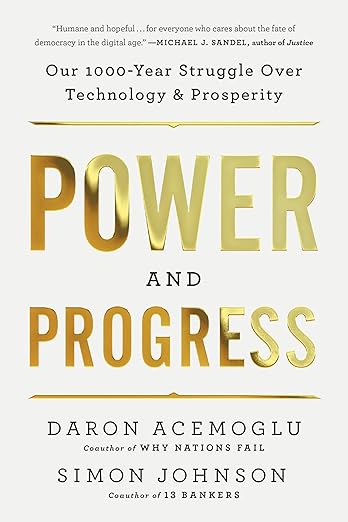
This spirited conversation between Acemoglu and Roberts revolves primarily around Acemoglu’s more cautious stance on technology’s ability to improve living standards and wages. He acknowledges that technology has made life better off. Since the Industrial Revolution, people have been healthier, are more educated, and the world is far more prosperous, but there is nothing automatic about this process. Acemoglu finds that humanity only benefits from technology given the optimal institutional structure. Roberts argues Acemoglu’s take is half-right. Humanity is better off due to technology, but it is not because of Acemoglu’s conditions. Roberts believes the power of innovation is maximized without shepherding.
Acemoglu cites three ingredients he sees as necessary for technology to have a positive effect. One is competition, with which Roberts agrees; however they differ on the other two. He challenges Acemoglu to prove that technology has been shepherded as opposed to being allowed to flourish through competition and innovation.
The second is coercion in labor markets. Acemoglu agrees that technology can increase the marginal productivity of labor, but if there’s coercion that might not result in higher wages, as the benefits from innovation would largely be distributed towards employers. He argues that the improvements in labor conditions and the redistribution of benefits to workers from the Industrial Revolution were not automatic,; they had to be advocated for. He points out the proliferation of trade unions as far more in line with improvements in working conditions than the Industrial Revolution itself.
And one important factor there is, you know, worker voice. Trade union activity was very harshly suppressed in Britain. Any kind of democratic movement was super-strongly discouraged…So, that is what I mean that there was nothing automatic about that process. And when Trade Unions start, you know, organizing after the Master and Servant Acts–which completely disempowered workers against their bosses, and Trade Unions were legalized–that is when you see conditions in factories improved quite a bit.
Roberts doubts that unionization contributes much at all to a rise in the standard of living. He argues unions raise wages by reducing employment. They do not equalize income; they just rearrange it. Even large corporations still have to compete for labor, and they do that by raising wages, therefore big companies, by virtue of their size do not necessarily have more bargaining power.
Acemoglu’s third condition is how automation affects workers’ earnings. He asserts automation may increase capital’s productivity, but not necessarily labor’s, because it reduces labor’s contribution to output.
And if you want to think about it that way–we discuss this as an illustration in the book as well– the factory of the future will have two employees, a man, and a dog. The dog is there to make sure that the man does not touch the equipment, and the man is there to feed the dog… But the reason why this is such a good example is that it clearly highlights why that man–or many people who may be working in these companies–don’t really contribute to average productivity in that huge way. You can eliminate this person and the dog, and the factory would still work fine. When that is the case, the labor market–the competitive process–shouldn’t pay this person a high wage. That is automation.
Roberts says Acemoglu is missing how automation increases real wages by circulating benefits throughout the population, with a chicken farm as an example. He argues automation reduces prices, a claim which Acemoglu agrees with, and that opportunities are created for other industries through those reduced prices, hence creating a higher standard of living.
The money mainly goes to the people who bought the machines, installed them, the people who made the machines and created them. However, the net result is an enormous drop in the price of eggs. And that means that the workers who work elsewhere have a much higher standard of living, including the ones that work in that plant. And that is happening all over the economy. And so, what is happening is–here’s the irony–as the innovation is stripping out labor from many different manufacturing processes, that’s creating opportunities for new employers to find things that those low-skill workers could do, and they have. Historically, there is not mass unemployment in the face of innovation. And the whole 20th century in the United States, is that story, to me.
Finally, Roberts asks Acemoglu for his solutions to minimize the destructive impact of creative destruction. He mentions shifting the balance in taxation on labor/capital to incentivize investment in labor rather than in capital, along with optimizing the rent-shifting ability of automation in order to ensure workers remain necessary and will be entitled to sharing quasi-rents. Acemoglu’s over-arching idea is to encourage rapid technological advancement in ways that are compatible with labor productivity and broader human well-being.
…we should have more sort of government competitions and programs to encourage human-complementary uses of AI and digital technology. The government, as I said, should not be at the driving seat, but the U.S. government through the Department of Defense, NIH [National Institutes of Health], NSF [National Science Foundation] in the past has had a very positive role in encouraging exploration of new areas. And I think this is something that we should consider. Definitely not automation taxes, definitely not slow down automation. We do not want to slow down automation. We want automation to be rapid, but at the same time find other things that we can do for workers, so that worker productivity is also central.
Related EconTalk Episodes:
Daron Acemoglu on Shared Prosperity and Good Jobs
Daron Acemoglu on Inequality, Institutions, and Piketty
Elizabeth Anderson on Worker Rights and Private Government
Tyler Cowen on the Risks and Impact of Artificial Intelligence
Living with Exponential Change (with Azeem Azhar)
Related LF Network Content:
Innovation in a Regulatory Labyrinth, by Shoshana Weissmann, at Law and Liberty
Is Technology Bad? By David P. Goldman, at Law and Liberty
Technological Unemployment and Work, by Bryan Caplan, at Econlib
Adam Thierer on Permissionless Innovation, The Great Antidote Podcast
