
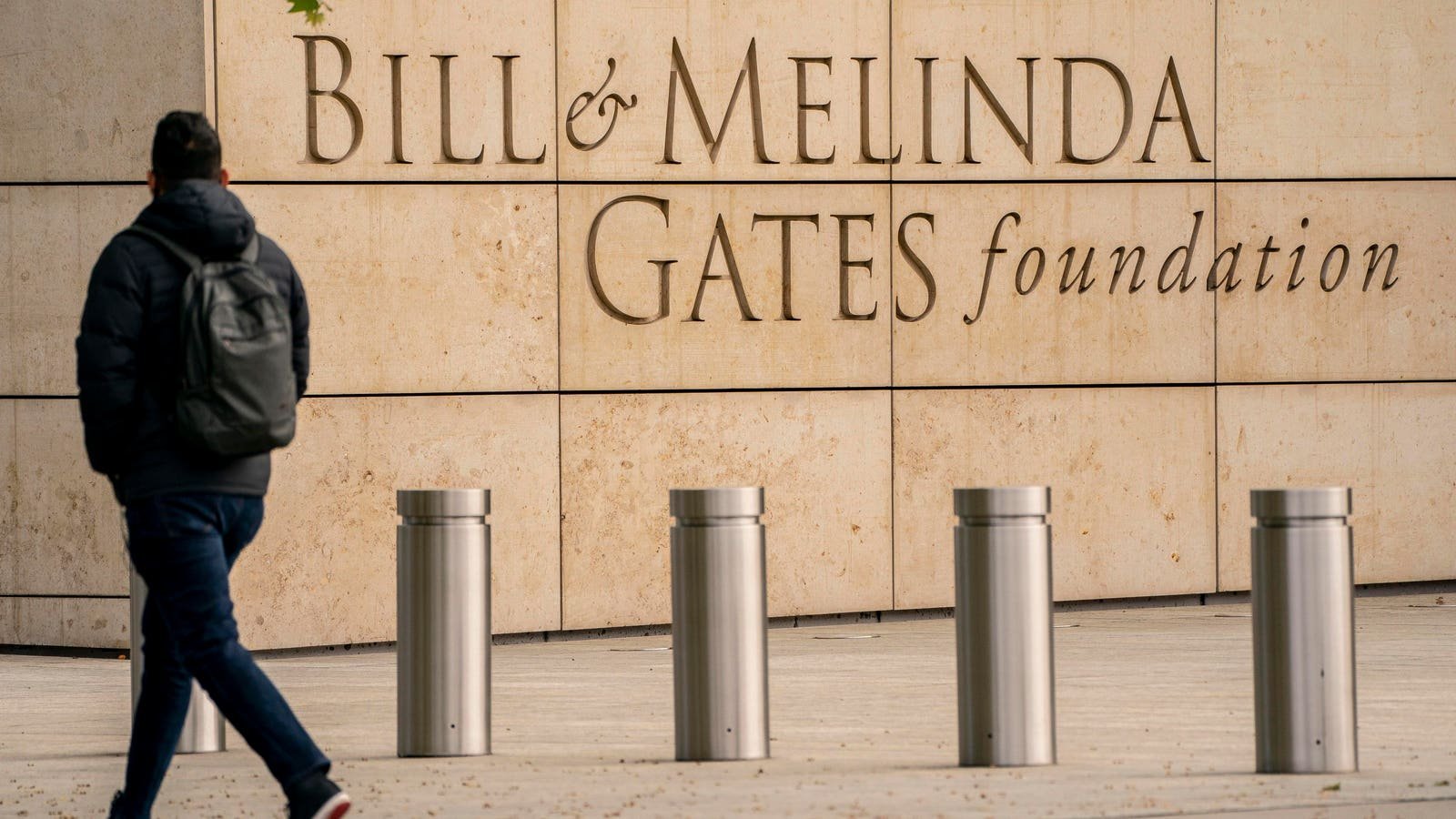
SEATTLE, WA – MAY 04: A pedestrian walks by the Bill and Melinda Gates Foundation on May 4, 2021. … [+]
The Bill and Melinda Gates Foundation talk about the need for what they call a “digital public infrastructure” (DPI). The Foundation says that a strong DPI has three foundational systems—identity, payments, and data exchange—that together can make life easier in important ways. It highlights such an infrstructure as a way to reduce poverty in emerging economices, but the truth is that developed economies need a digital public infrastructure too, including the United States.
Where’s Our Stack?
The International Monetary Fund (IMF) similarly talk about the need for digital public infrastructure built up from digital identity, the payments system and a data exchange layer. They agree that a DPI has the potential to support the transformation of the economy and support inclusive growth. The IMF highlights the particular example of India’s foundational DPI, the so-called “India Stack” , and show how it has been harnessed to foster innovation and competition, boost financial inclusion and improve government revenue collection. India’s DPI contains powerful lessons for other countries embarking on digital transformation, in particular a design approach that focuses on shared building blocks and supporting innovation across the ecosystem through APIs.
India fascinates me, because I find the whole topic of invention and innovation so interesting. Trying to understand how inventions come about, trying to learn from global examples of how inventions turn into sustainable innovations (and why some of them don’t), trying to see which inventions might form a nexus of innovation for the next generation of financial services. When it comes to payments, for example, many companies have built highly-competitive businesses around the Unified Payments Interface (UPI), which Mastercard
MA
Here is a particularly interesting example. The “soundbox”. Paytm is India’s largest digital payments company and its soundbox processes UPI transactions at no cost to merchants, but charges them a monthly fee (or a one-time payment of $12 for using the device). But here is the genuis part: it makes a sound when a transaction has been completed and so are increasingly common in markets to help reassure both parties (who may be illiterate) that payment is received. Only four million shops across South Asia currently support card transactions compared to more than double that number who have a soundbox from Paytm or a competitor. As one merchant says “I can now focus on other customers while the payment is being made. I have installed two sound boxes … one from Paytm and the other one from PhonePe”. That is a super example of a sustainable innovation that solves local problems.
The sound of money.
So where are we in the U.S.A. (or the U.K.) with our digital public infrastructure? We don’t have digital identity, we do have a payments system (and even America has instant payments now) and we don’t yet have a data exchange layer. What would it take for us to reach Indian levels of innovation? Well, looking at this infrastructure from the perspective of fintech opportunity, I think we can identify the infrastructure that we need in quite simple terms.
- Digital Identity. We need interoperable digital identity (not digitised identity) based on international standards and we need to be able to use it online as well as offline. The banks have failed to do this, and neither the U.S. nor the U.K. has anything like Aadhar, so we must prioritise this component of the infrastructure.
- Electronic Payments. Some combination of instant payments and central bank digital currency will eventually bring almost zero cost retail payments.
- Data Exchange. This is where the transition from open banking to (ultimately) open finance comes in. The management consultants McKinsey say that open financial data can create economic value by benefiting financial institutions, individuals, and small and midsize enterprise customers. Here, the U.S. is about to move to open banking and start on the path to open data.
If these pillars come into place, DPI will change lives. That sounds like a bold statement, but it is important to understand that DPI is not all about financial services. As the Foundation highlights, during a crisis such as COVID, countries with DPI were able to provide timley support to their citizens by delivering emergency payments to those who need them most. For example, within weeks of the initial pandemic lockdown, India digitally transferred emergency payments to 300 million people, including 200 million low-income women.
Compare that to the U.K., where the £21bn identified by the National Audit Office (NAO) to have been lost by the government, more than £7bn was linked to schemes introduced during the pandemic, with little chance of the majority being reclaimed. Similarly, between March 2020 and April 2022, American rapscallions made off with (latest estimate) $46 billion in fraudulent unemployment insurance claims by filing claims in more than one state (in one case, 29 states paid unemployment benefits to the same person), using the Social Security numbers of dead people, claiming on behalf of prison inmates and so on.
Business Case
Testifying before Congress last year, a Labor Department expert said that there could have been “at least” $163 billion in wrongly paid unemployment benefits as well as “significant” benefits obtained by malicious actors. A watchdog found that $58 billion the Economic Injury Disaster Loan program had been paid to companies that shared the same addresses, phone numbers, bank accounts or other data as other applicants, which ought to have been a red flag, to say the least. The losses are eye-watering and are an order of magnitude higher than what would have been the cost of putting in place a national DPI! Why wait until the next disaster! Let’s start work on the infrastructure needed for the new economy right now.
