
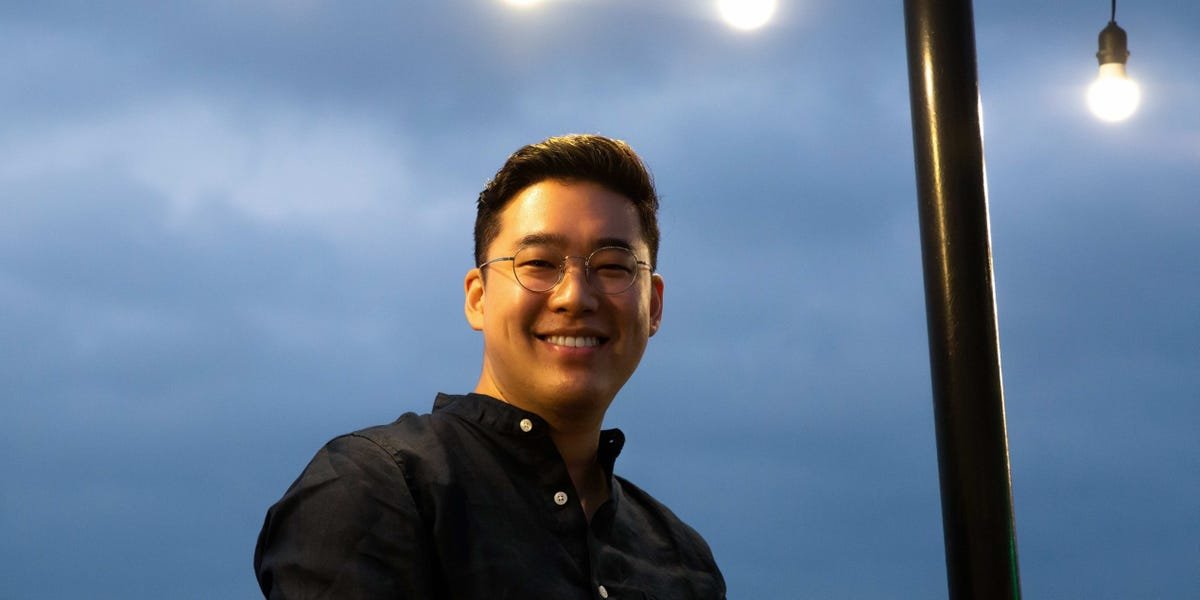
This as-told-to essay is based on a conversation with Jeff Niu, 31, a Columbia University graduate and American-born Chinese living in Beijing. His words have been edited for length and clarity.
I’m an ABC (American-born Chinese), and I’m most definitely both Chinese and American.
I feel more Chinese in the US and more American in China. I have to code-switch between two personalities. It can be disorienting, but it also helps me see the strengths and flaws of both cultures.
My parents met at medical school in Beijing. Our family immigrated to the US in the early ’90s, when my dad got a job as a biomedical researcher.
I was born in Flushing, Queens, five years after my sister, who was born in Beijing.
Growing up in Flushing, with many Asian communities — Cantonese-speaking Chinese, Putonghua-speaking Chinese, Taiwanese, Koreans — it was easier to distinguish between different Asian identities. It’s one of the few places in the US where the Asian diaspora feels truly granular.
In Flushing’s Chinatown, I’d hear Chinese on the streets and eat bao buns next to people who sounded like my parents.
In New York, I felt distinctly Chinese-American.
Joslyn Ma
From Flushing to suburbia
That changed when we moved to California during my teens. In a city with fewer Asians, I became more aware of being “Asian American.”
Whenever I met new Asian friends, there was this unspoken understanding: You’re not Chinese, and I’m not Filipino, Vietnamese, Korean, or Japanese — but we like the same things. We bond over boba, K-pop, and math.
One of my earliest memories is watching “My Fair Princess” with my grandparents in Beijing, where I spent every summer until middle school.
Related stories

Business Insider tells the innovative stories you want to know
Business Insider tells the innovative stories you want to know
I watched the city change year by year. Construction sites were everywhere, and people seemed hopeful about the future.
While Beijing was undergoing a generational metamorphosis, my hometown of Moorpark — a suburb in Southern California — was losing its only movie theater, a GameStop, and the few nice restaurants we had.
I was in high school during the 2008 financial crisis. California was hit hard: a million jobs were lost, public budgets collapsed, school programs were cut, teachers were laid off, and development stalled.
It was a stark contrast to what was happening in China.
Provided by Jeff Niu
Going back to Beijing
I was 14 when I went to Beijing for the Olympics. Fireworks lit up the sky, smoke hung in the air, but what struck me most was the energy. It was electric, unforgettable. That moment stayed with me, and from then on, I began following news about China more closely.
I studied at Sciences Po in France before pursuing East Asian Studies at Columbia University.
At Columbia, I was surprised to find that many professors hadn’t been to China in decades. Their frameworks felt ideological, disconnected from the country’s lived reality.
In 2013, I returned to Beijing for an internship and to visit my grandmother. I thought she was still alive, but when I arrived, I learned she had died. My parents hadn’t told me — they didn’t want to distract me during finals. That summer, I stayed with my grandfather and worked at an education consultancy.
After graduation, I had job offers in the US and China in strategy consulting and experiential education. Instead, I moved to Beijing to pursue a master’s degree in China Studies — economics and management, through the Yenching Scholarship at Peking University.
Nine years later, I’m still in China.
Differences in the working world
The longer I stay in China, the more I feel both Chinese and American.
I eat a mix of Chinese and American food, always craving whatever I’m missing at the moment. Beijing has great burgers, but I still miss New York delis — the eggplant parm, the turkey melts. I love a good sandwich.
Another thing I miss is less tangible: the organizational culture.
After graduating from Peking University, I joined a design consultancy, then moved to a healthcare company a year later.
Provided by Jeff Niu
I was the only US-born employee, and most people didn’t realize I was American. I wanted to know what it was like to be treated as a Chinese employee. It was hard.
There’s a dumbed-down argument that people in China lack creativity, but not everybody has the privilege to channel that energy. In the US, there’s more of an effort to empower employees.
In China, companies are founder-led, with everyone executing their vision.
I once broke my ankle and led a project from a wheelchair. The company still insisted I come in.
Provided by Jeff Niu
I do see a lot of changes in China’s organizational culture, management philosophies, and understanding of “value” — mostly trending in a positive direction. Those three years helped me understand how top-down policies land at the project level, which is exactly what I wanted to learn when I moved to China.
From there, I moved to a growth investment fund. In New York, jumping from design to private equity would have been impossible. In China, it was just another career pivot.
A few months ago, I left to start my own business: Dusk, a creative equity firm that blends venture capital, private equity, and design.
My grandfather is 93, and for a while, I was his only family here. As long as he’s alive, my plan is to stay in Beijing.
Do you have a story about moving to Asia that you want to share? Get in touch with the editor: akarplus@businessinsider.com.
